




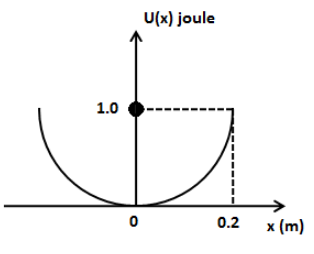
A particle of mass 4 kg moves simple harmonically such that its PE (U) varies with position x, as shown. The period of oscillation is
A. \[\dfrac{{2\pi }}{{25}}\,{\text{s}}\]
B. \[\dfrac{{\pi \sqrt 2 }}{5}\,{\text{s}}\]
C. \[\dfrac{{4\pi }}{5}\,{\text{s}}\]
D. \[\dfrac{{2\pi \sqrt 2 }}{5}\,{\text{s}}\]
Answer
 Verified
600.3k+ views
Hint: Recall the formula for potential energy of the particle performing SHM. Then calculate the value of force constant from the potential energy of the particle. Use the formula for the period of the particle in SHM and substitute the value of mass and force constant.
Formula used:
Potential energy, \[U = \dfrac{1}{2}k{x^2}\]
Here, k is the force constant and x is the position of the particle from the mean position.
Period, \[T = 2\pi \sqrt {\dfrac{m}{k}} \]
Here, m is the mass of the particle.
Complete Step by Step Answer:
We have given that the mass of the particle performing harmonic motion is \[m = 4\,{\text{kg}}\], the potential energy of the particle is \[U = 1.0\,{\text{J}}\] and the position of the particle from the mean position is \[x = 0.2\,{\text{m}}\]. We can express the potential energy of the particle performing harmonic motion as,
\[U = \dfrac{1}{2}k{x^2}\]
Here, k is the force constant and x is the position of the particle from the mean position.
Rearranging the above equation for k, we get,
\[k = \dfrac{{2U}}{{{x^2}}}\]
Substituting \[U = 1.0\,{\text{J}}\] and \[x = 0.2\,{\text{m}}\] in the above equation, we get,
\[k = \dfrac{{2\left( 1 \right)}}{{{{\left( {0.2} \right)}^2}}}\]
\[ \Rightarrow k = 50\,{\text{N/m}}\]
We have the expression for the period of the particle performing harmonic motion,
\[T = 2\pi \sqrt {\dfrac{m}{k}} \]
Here, m is the mass of the particle.
Substituting \[m = 4\,{\text{kg}}\] and \[k = 50\,{\text{N/m}}\] in the above equation, we get,
\[T = 2\pi \sqrt {\dfrac{4}{{50}}} \]
\[ \Rightarrow T = 2\pi \sqrt {\dfrac{2}{{25}}} \]
\[ \therefore T = \dfrac{{2\pi \sqrt 2 }}{5}\,{\text{s}}\]
So, the correct answer is D.
Note:The period of particle in SHM is expressed as, \[T = \dfrac{{2\pi }}{\omega }\]. But since the angular frequency of the particle is \[\omega = \sqrt {\dfrac{k}{m}} \], the period becomes, \[T = 2\pi \sqrt {\dfrac{m}{k}} \]. Note that the mass should be in kilogram and the force constant k should be in N/m. Since both mass and force remain constant, the period remains the same in simple harmonic motion.
Formula used:
Potential energy, \[U = \dfrac{1}{2}k{x^2}\]
Here, k is the force constant and x is the position of the particle from the mean position.
Period, \[T = 2\pi \sqrt {\dfrac{m}{k}} \]
Here, m is the mass of the particle.
Complete Step by Step Answer:
We have given that the mass of the particle performing harmonic motion is \[m = 4\,{\text{kg}}\], the potential energy of the particle is \[U = 1.0\,{\text{J}}\] and the position of the particle from the mean position is \[x = 0.2\,{\text{m}}\]. We can express the potential energy of the particle performing harmonic motion as,
\[U = \dfrac{1}{2}k{x^2}\]
Here, k is the force constant and x is the position of the particle from the mean position.
Rearranging the above equation for k, we get,
\[k = \dfrac{{2U}}{{{x^2}}}\]
Substituting \[U = 1.0\,{\text{J}}\] and \[x = 0.2\,{\text{m}}\] in the above equation, we get,
\[k = \dfrac{{2\left( 1 \right)}}{{{{\left( {0.2} \right)}^2}}}\]
\[ \Rightarrow k = 50\,{\text{N/m}}\]
We have the expression for the period of the particle performing harmonic motion,
\[T = 2\pi \sqrt {\dfrac{m}{k}} \]
Here, m is the mass of the particle.
Substituting \[m = 4\,{\text{kg}}\] and \[k = 50\,{\text{N/m}}\] in the above equation, we get,
\[T = 2\pi \sqrt {\dfrac{4}{{50}}} \]
\[ \Rightarrow T = 2\pi \sqrt {\dfrac{2}{{25}}} \]
\[ \therefore T = \dfrac{{2\pi \sqrt 2 }}{5}\,{\text{s}}\]
So, the correct answer is D.
Note:The period of particle in SHM is expressed as, \[T = \dfrac{{2\pi }}{\omega }\]. But since the angular frequency of the particle is \[\omega = \sqrt {\dfrac{k}{m}} \], the period becomes, \[T = 2\pi \sqrt {\dfrac{m}{k}} \]. Note that the mass should be in kilogram and the force constant k should be in N/m. Since both mass and force remain constant, the period remains the same in simple harmonic motion.
Recently Updated Pages
Master Class 11 English: Engaging Questions & Answers for Success

Master Class 11 Social Science: Engaging Questions & Answers for Success
Master Class 11 Maths: Engaging Questions & Answers for Success
Master Class 11 Biology: Engaging Questions & Answers for Success
Master Class 11 Physics: Engaging Questions & Answers for Success
Master Class 11 Chemistry: Engaging Questions & Answers for Success
Trending doubts
One Metric ton is equal to kg A 10000 B 1000 C 100 class 11 physics CBSE
Difference Between Prokaryotic Cells and Eukaryotic Cells
Find the value of the expression given below sin 30circ class 11 maths CBSE
Difference between physical and chemical change class 11 chemistry CBSE
Two of the body parts which do not appear in MRI are class 11 biology CBSE
Draw a diagram of a plant cell and label at least eight class 11 biology CBSE