




A particle of mass 2m moving with velocity $\upsilon $ strikes a stationary particle of mass 3m and sticks to it. The speed of the system will be
(A) $0.8\upsilon$
(B) $0.2\upsilon$
(C) $0.6\upsilon$
(D) $0.4\upsilon$
Answer
 Verified
614.4k+ views
Hint: To solve this type of problem we can use conservation of momentum which states that the initial momentum of the system must be equal to the final momentum of the system. The value of unknown mass and velocity can be determined by the known value of momentum.
Complete step by step answer:
Let us first write the information given in the question.
${m_1} = 2m,{m_2} = 3m,{u_1} = \upsilon,{u_2} = 0(rest)$
The following is the diagram showing the above situation.
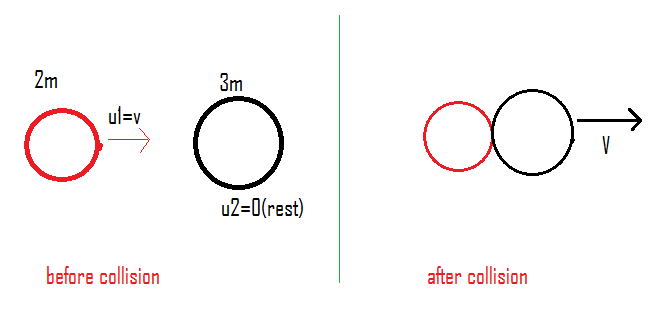
We have to find the speed of the system.
Let the speed of the system after collision is $V$.
Momentum of system before collision:
${m_1}{u_1} + {m_2}{u_2} = 2m\upsilon + 3m \times 0 = 2m\upsilon$……… (1)
Momentum of system after collision:
${m_1}{v_1} + {m_2}{v_2} = 2m \times V + 3m \times V$
Let us further simplify it.
${m_1}{v_1} + {m_2}{v_2} = 5mV$ ………. (2)
Now, let us use the concept of conservation of momentum. Equation (1) and (2) must be equal.
$2m\upsilon = 5mV$
On simplifying we get the following.
$V = \dfrac{2}{5}\upsilon= 0.4\upsilon$
$\therefore $ The speed of the system will be $0.4\upsilon$. Hence option (D) is correct.
Additional information:
- The law of conservation of momentum or the law of conservation of linear momentum states that the momentum of an isolated system remains constant. Momentum is therefore conserved over time.
- The Law of conservation holds no matter how complicated the force is between particles.
- The conservation of momentum applies to all interactions including collisions and separations caused by explosive forces.
Note:
If there are several particles, the momentum exchanged between each pair of particles adds up to zero. So that the total change in momentum is zero. The motion of the object in rest implies that the object has zero momentum. Conservation of momentum used to determine the final value velocity.
Complete step by step answer:
Let us first write the information given in the question.
${m_1} = 2m,{m_2} = 3m,{u_1} = \upsilon,{u_2} = 0(rest)$
The following is the diagram showing the above situation.
We have to find the speed of the system.
Let the speed of the system after collision is $V$.
Momentum of system before collision:
${m_1}{u_1} + {m_2}{u_2} = 2m\upsilon + 3m \times 0 = 2m\upsilon$……… (1)
Momentum of system after collision:
${m_1}{v_1} + {m_2}{v_2} = 2m \times V + 3m \times V$
Let us further simplify it.
${m_1}{v_1} + {m_2}{v_2} = 5mV$ ………. (2)
Now, let us use the concept of conservation of momentum. Equation (1) and (2) must be equal.
$2m\upsilon = 5mV$
On simplifying we get the following.
$V = \dfrac{2}{5}\upsilon= 0.4\upsilon$
$\therefore $ The speed of the system will be $0.4\upsilon$. Hence option (D) is correct.
Additional information:
- The law of conservation of momentum or the law of conservation of linear momentum states that the momentum of an isolated system remains constant. Momentum is therefore conserved over time.
- The Law of conservation holds no matter how complicated the force is between particles.
- The conservation of momentum applies to all interactions including collisions and separations caused by explosive forces.
Note:
If there are several particles, the momentum exchanged between each pair of particles adds up to zero. So that the total change in momentum is zero. The motion of the object in rest implies that the object has zero momentum. Conservation of momentum used to determine the final value velocity.
Recently Updated Pages
Master Class 11 Social Science: Engaging Questions & Answers for Success

Master Class 11 English: Engaging Questions & Answers for Success
Master Class 11 Maths: Engaging Questions & Answers for Success
Master Class 11 Chemistry: Engaging Questions & Answers for Success
Master Class 11 Biology: Engaging Questions & Answers for Success
Master Class 11 Physics: Engaging Questions & Answers for Success
Trending doubts
Differentiate between an exothermic and an endothermic class 11 chemistry CBSE
One Metric ton is equal to kg A 10000 B 1000 C 100 class 11 physics CBSE
Difference Between Prokaryotic Cells and Eukaryotic Cells
There are 720 permutations of the digits 1 2 3 4 5 class 11 maths CBSE
Two of the body parts which do not appear in MRI are class 11 biology CBSE
Which gas is abundant in air class 11 chemistry CBSE