




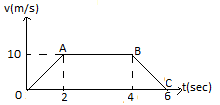
A particle of mass $1kg$ is moved under the action of force and the velocity-time graph of the particle is shown in figure. Work done by the force from $t = 0$ to $t = 6\sec $ is?
Answer
 Verified
608.4k+ views
Hint We know according to the work energy theorem, the work done by resultant forces on a particle is equal to change in its kinetic energy.
i.e. $W = {K_f} - {K_i}$
where
$\Rightarrow$ ${K_f}$ is final kinetic energy
$\Rightarrow$ ${K_i}$ is initial kinetic energy.
We will use the above concept to find the work done under a given velocity-time curve.
Complete Step by step solution
We will find the work done in different portions of the graph.
Firstly, in portion OA:
$\Rightarrow$ ${v_O} = 0$ and ${v_A} = 10m{s^{ - 1}}$ (from graph)
We know, from work energy theorem
$W = {K_f} - {K_i}$
Woke done in moving from O to A,
$\Rightarrow$ $
{W_{OA}} = {K_A} - {K_O} \\
{W_{OA}} = \dfrac{1}{2}mv_A^2 - \dfrac{1}{2}mv_O^2 \\
$
Putting values, we get
$\Rightarrow$ $
{W_{OA}} = \dfrac{1}{2} \times 1 \times {10^2} - 0 \\
{W_{OA}} = 50J......(1) \\
$
Now work done in portion AB:
$\because {v_A} = {v_B} = 10m{s^{ - 1}}$ (from graph)
$\therefore {W_{AB}} = 0......(2)$
Now work done in portion BC:
$\Rightarrow$ ${v_B} = 10m{s^{ - 1}}$ and ${v_C} = 0$ (from graph)
Hence work done in moving from B to C is
$\Rightarrow$ ${W_{BC}} = {K_C} - {K_B}$
${W_{BC}} = \dfrac{1}{2}m{v_c}^2 - \dfrac{1}{2}mv_B^2$
Putting values, we get
$\Rightarrow$ $
{W_{BC}} = 0 - \dfrac{1}{2} \times 1 \times {10^2} \\
{W_{BC}} = - 50J......(3) \\
$
Hence total work under given graph is given by:
$W = {W_{OA}} + {W_{AB}} + {W_{BC}}$
Using equation (1), (2) and (3) we get
$\Rightarrow$ $
W = 50 + 0 - 50 \\
W = 0J \\
$
Hence, the required work done is $0J$.
Note the work energy theorem is valid for all types of forces. It is valid even if the forces are non-conservative in nature but principle of conservation of mechanical energy is not valid for non-conservative forces. It means that in order to change the kinetic energy of the system we have to apply force and it may be of any type.
i.e. $W = {K_f} - {K_i}$
where
$\Rightarrow$ ${K_f}$ is final kinetic energy
$\Rightarrow$ ${K_i}$ is initial kinetic energy.
We will use the above concept to find the work done under a given velocity-time curve.
Complete Step by step solution
We will find the work done in different portions of the graph.
Firstly, in portion OA:
$\Rightarrow$ ${v_O} = 0$ and ${v_A} = 10m{s^{ - 1}}$ (from graph)
We know, from work energy theorem
$W = {K_f} - {K_i}$
Woke done in moving from O to A,
$\Rightarrow$ $
{W_{OA}} = {K_A} - {K_O} \\
{W_{OA}} = \dfrac{1}{2}mv_A^2 - \dfrac{1}{2}mv_O^2 \\
$
Putting values, we get
$\Rightarrow$ $
{W_{OA}} = \dfrac{1}{2} \times 1 \times {10^2} - 0 \\
{W_{OA}} = 50J......(1) \\
$
Now work done in portion AB:
$\because {v_A} = {v_B} = 10m{s^{ - 1}}$ (from graph)
$\therefore {W_{AB}} = 0......(2)$
Now work done in portion BC:
$\Rightarrow$ ${v_B} = 10m{s^{ - 1}}$ and ${v_C} = 0$ (from graph)
Hence work done in moving from B to C is
$\Rightarrow$ ${W_{BC}} = {K_C} - {K_B}$
${W_{BC}} = \dfrac{1}{2}m{v_c}^2 - \dfrac{1}{2}mv_B^2$
Putting values, we get
$\Rightarrow$ $
{W_{BC}} = 0 - \dfrac{1}{2} \times 1 \times {10^2} \\
{W_{BC}} = - 50J......(3) \\
$
Hence total work under given graph is given by:
$W = {W_{OA}} + {W_{AB}} + {W_{BC}}$
Using equation (1), (2) and (3) we get
$\Rightarrow$ $
W = 50 + 0 - 50 \\
W = 0J \\
$
Hence, the required work done is $0J$.
Note the work energy theorem is valid for all types of forces. It is valid even if the forces are non-conservative in nature but principle of conservation of mechanical energy is not valid for non-conservative forces. It means that in order to change the kinetic energy of the system we have to apply force and it may be of any type.
Recently Updated Pages
Master Class 11 English: Engaging Questions & Answers for Success

Master Class 11 Social Science: Engaging Questions & Answers for Success
Master Class 11 Maths: Engaging Questions & Answers for Success
Master Class 11 Biology: Engaging Questions & Answers for Success
Master Class 11 Physics: Engaging Questions & Answers for Success
Master Class 11 Chemistry: Engaging Questions & Answers for Success
Trending doubts
One Metric ton is equal to kg A 10000 B 1000 C 100 class 11 physics CBSE
Difference Between Prokaryotic Cells and Eukaryotic Cells
Find the value of the expression given below sin 30circ class 11 maths CBSE
Difference between physical and chemical change class 11 chemistry CBSE
Two of the body parts which do not appear in MRI are class 11 biology CBSE
Draw a diagram of a plant cell and label at least eight class 11 biology CBSE