




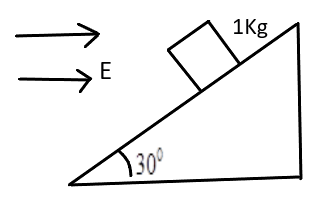
A particle of mass \[1\] Kg carrying \[0.01C\] charge is at rest on an inclined plane of angle \[{30^ \circ }\] with the horizontal when an electric field of $\dfrac{{400}}{{\sqrt 3 }}{\text{N}}{{\text{C}}^{ - 1}}$ is applied parallel to the horizontal as shown. The coefficient of friction is:
A) \[0.5\]
B) $\dfrac{1}{{\sqrt 3 }}$
C) $\dfrac{{\sqrt 3 }}{2}$
D) $\dfrac{{\sqrt 3 }}{7}$
Answer
 Verified
619.5k+ views
Hint: Friction: It is defined as the opposing force acting on a body due to the presence of another body in contact when they are in motion.
Coefficient of friction: It is the relationship between two objects and the normal reaction between the objects that are in contact with each other.
First we will compare the forces on the inclined plane and later we will get the value of friction by substituting the values into the force along the vertical line formula.
Formula used:
Force due to electric field ${\text{ = qEcos}}\theta $
Here, q= charge of the electron, E=magnitude of electric field, θ= angle between the incline plane and horizontal plane
${\text{mg = f sin}}\theta {\text{ + Ncos}}\theta $, mg is the weight of the mass in downward direction
${\text{f = }}\mu {\text{N}}$, here, μ=coefficient of friction, N=normal force acting on the mass, f=frictional force
Complete step-by-step answer:
Given details, $E = \dfrac{{400}}{{\sqrt 3 }}{\text{N}}{{\text{C}}^{ - 1}}$, \[\theta = {30^ \circ }\]
Free body diagram of the mass resting on the inclined plane is shown in the figure,
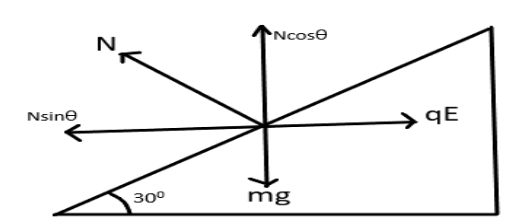
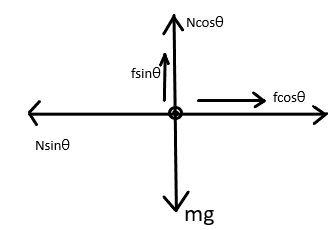
For the body to be at rest on the inclined plane, all the force acting on the body will be balanced with each other.
Comparing the forces on the inclined plane, we get,
${\text{qE cos}}\theta = \dfrac{400}{\sqrt 3} \times \dfrac{\sqrt 3}{2} \times 0.01$ = $2.45{\text{N}}$
${\text{mg sin}}\theta {{ = 1 \times 9}}{\text{.8}}\times \dfrac{1}{2}$$ = 4.9{\text{N}}$
We can say that, ${\text{qE sin}}\theta {\text{ < mg sin}}\theta $
From the above equation we can say that the motion is in the downward direction of the plane and f is up the inclined plane.
Force along the vertical direction gives, ${\text{mg = f sin}}\theta {\text{ + N cos}}\theta $
Substituting the above values in the equations, we get that, $1{\times {9}}{{.8 = f \times sin3}}{{\text{0}}^ \circ } + {\text{N cos3}}{{\text{0}}^ \circ }$
$ \Rightarrow 9.8 = \dfrac{1}{2}{\text{f + }}\dfrac{{\sqrt 3 }}{2}{\text{N}}$
$ \Rightarrow 19.6 = {\text{f + }}\sqrt 3 {\text{N}}$
The balancing force along the x-direction, ${\text{N sin}}\theta {\text{ = f cos}}\theta {\text{ + qE}}$
Substituting the above values in the equations, we get that, $\dfrac{1}{2}{\text{N = }}\dfrac{{\sqrt 3 }}{2}{\text{f + 245}}$
From the above two equations we get that, ${\text{f = }}\dfrac{{\sqrt 3 }}{7}{\text{N}}$
Hence the correct option is D.
Note: Free body diagram: It is the representation of the body on a plan that shows all the force acting on the body.
Electric field: It is defined as the region on which an electric charge has its effect.
Coefficient of friction: It is the relationship between two objects and the normal reaction between the objects that are in contact with each other.
First we will compare the forces on the inclined plane and later we will get the value of friction by substituting the values into the force along the vertical line formula.
Formula used:
Force due to electric field ${\text{ = qEcos}}\theta $
Here, q= charge of the electron, E=magnitude of electric field, θ= angle between the incline plane and horizontal plane
${\text{mg = f sin}}\theta {\text{ + Ncos}}\theta $, mg is the weight of the mass in downward direction
${\text{f = }}\mu {\text{N}}$, here, μ=coefficient of friction, N=normal force acting on the mass, f=frictional force
Complete step-by-step answer:
Given details, $E = \dfrac{{400}}{{\sqrt 3 }}{\text{N}}{{\text{C}}^{ - 1}}$, \[\theta = {30^ \circ }\]
Free body diagram of the mass resting on the inclined plane is shown in the figure,
For the body to be at rest on the inclined plane, all the force acting on the body will be balanced with each other.
Comparing the forces on the inclined plane, we get,
${\text{qE cos}}\theta = \dfrac{400}{\sqrt 3} \times \dfrac{\sqrt 3}{2} \times 0.01$ = $2.45{\text{N}}$
${\text{mg sin}}\theta {{ = 1 \times 9}}{\text{.8}}\times \dfrac{1}{2}$$ = 4.9{\text{N}}$
We can say that, ${\text{qE sin}}\theta {\text{ < mg sin}}\theta $
From the above equation we can say that the motion is in the downward direction of the plane and f is up the inclined plane.
Force along the vertical direction gives, ${\text{mg = f sin}}\theta {\text{ + N cos}}\theta $
Substituting the above values in the equations, we get that, $1{\times {9}}{{.8 = f \times sin3}}{{\text{0}}^ \circ } + {\text{N cos3}}{{\text{0}}^ \circ }$
$ \Rightarrow 9.8 = \dfrac{1}{2}{\text{f + }}\dfrac{{\sqrt 3 }}{2}{\text{N}}$
$ \Rightarrow 19.6 = {\text{f + }}\sqrt 3 {\text{N}}$
The balancing force along the x-direction, ${\text{N sin}}\theta {\text{ = f cos}}\theta {\text{ + qE}}$
Substituting the above values in the equations, we get that, $\dfrac{1}{2}{\text{N = }}\dfrac{{\sqrt 3 }}{2}{\text{f + 245}}$
From the above two equations we get that, ${\text{f = }}\dfrac{{\sqrt 3 }}{7}{\text{N}}$
Hence the correct option is D.
Note: Free body diagram: It is the representation of the body on a plan that shows all the force acting on the body.
Electric field: It is defined as the region on which an electric charge has its effect.
Recently Updated Pages
Basicity of sulphurous acid and sulphuric acid are

Master Class 11 English: Engaging Questions & Answers for Success
Master Class 11 Physics: Engaging Questions & Answers for Success
Master Class 11 Computer Science: Engaging Questions & Answers for Success
Master Class 11 Chemistry: Engaging Questions & Answers for Success
Master Class 11 Social Science: Engaging Questions & Answers for Success
Trending doubts
Difference Between Prokaryotic Cells and Eukaryotic Cells
Two of the body parts which do not appear in MRI are class 11 biology CBSE
One Metric ton is equal to kg A 10000 B 1000 C 100 class 11 physics CBSE
10 examples of friction in our daily life
Draw a diagram of nephron and explain its structur class 11 biology CBSE
What will happen if the mucus is not secreted by the class 11 biology CBSE