




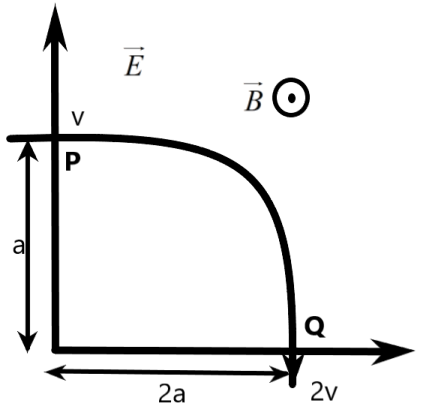
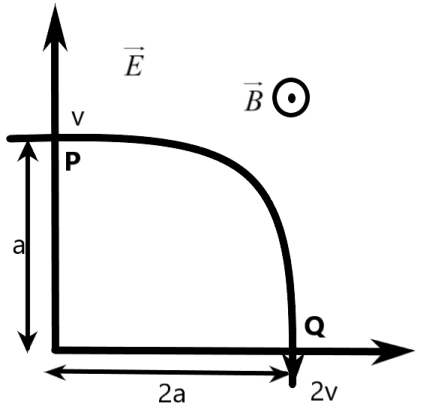
A particle of charge +q and a mass m is moving under the influence of a uniform electric field E\[\widehat{i}\] and a uniform magnetic field B\[\widehat{k}\] follows a trajectory from P to Q as shown below. The velocities at P and Q are V\[\widehat{i}\] and \[-2\widehat{j}\] respectively. Which of the following statement(s) is/are correct?
A) \[E=\dfrac{3m{{v}^{2}}}{4qa}\]
B) Rate of work done by electric fields at P is\[\dfrac{3m{{v}^{2}}}{4a}\].
C) Rate of work done by the electric field at P is zero.
D) Rate of work done by both the fields at Q is zero.
Answer
 Verified
577.2k+ views
Hint: We need to understand the dependence of the uniform magnetic field and the uniform electric field experience by a particle under motion on the trajectory of the particle to get the work done by the two fields that can solve this problem.
Complete Step-by-Step Solution:
We are given that a positively charged particle is moving with a speed along the horizontal direction and vertical direction in a uniform magnetic and electric field. We are asked to find the work done using the information on the trajectory and the velocity along the two directions.
We know that the energy possessed by the particle in motion is due to the kinetic energy provide by the electric field which can be found as the difference between the kinetic energies due to velocities perpendicular to each other as –
\[\begin{align}
& KE=K{{E}_{y}}-K{{E}_{x}} \\
& \Rightarrow KE=\dfrac{1}{2}m{{(-2v)}^{2}}-\dfrac{1}{2}m{{v}^{2}} \\
& \therefore KE=\dfrac{3}{2}m{{v}^{2}} \\
\end{align}\]
The work done by the electric field can be given as –
\[\begin{align}
& \text{From the electrostatic force,} \\
& \text{Electrostatic energy = Electrostatic force }\times \text{ Distance } \\
& \Rightarrow KE=F(2a) \\
& \Rightarrow KE=qE2a \\
& \Rightarrow E=\dfrac{KE}{2aq} \\
& \therefore E=\dfrac{3m{{v}^{2}}}{4aq} \\
\end{align}\]
This is the required solution for the work done by the electric field in total.
At the points P and Q, the fields are perpendicular to the motion of the particle and therefore, there is no work by both the fields at those points.
The correct answers are options A, B and D.
Note:
The work done by the fields are dependent on the displacement of the charge with the field. At point Q, the charge does not have a displacement along the parallel direction of the electric field and therefore, it becomes zero and at P there is no displacement.
Complete Step-by-Step Solution:
We are given that a positively charged particle is moving with a speed along the horizontal direction and vertical direction in a uniform magnetic and electric field. We are asked to find the work done using the information on the trajectory and the velocity along the two directions.
We know that the energy possessed by the particle in motion is due to the kinetic energy provide by the electric field which can be found as the difference between the kinetic energies due to velocities perpendicular to each other as –
\[\begin{align}
& KE=K{{E}_{y}}-K{{E}_{x}} \\
& \Rightarrow KE=\dfrac{1}{2}m{{(-2v)}^{2}}-\dfrac{1}{2}m{{v}^{2}} \\
& \therefore KE=\dfrac{3}{2}m{{v}^{2}} \\
\end{align}\]
The work done by the electric field can be given as –
\[\begin{align}
& \text{From the electrostatic force,} \\
& \text{Electrostatic energy = Electrostatic force }\times \text{ Distance } \\
& \Rightarrow KE=F(2a) \\
& \Rightarrow KE=qE2a \\
& \Rightarrow E=\dfrac{KE}{2aq} \\
& \therefore E=\dfrac{3m{{v}^{2}}}{4aq} \\
\end{align}\]
This is the required solution for the work done by the electric field in total.
At the points P and Q, the fields are perpendicular to the motion of the particle and therefore, there is no work by both the fields at those points.
The correct answers are options A, B and D.
Note:
The work done by the fields are dependent on the displacement of the charge with the field. At point Q, the charge does not have a displacement along the parallel direction of the electric field and therefore, it becomes zero and at P there is no displacement.
Recently Updated Pages
Master Class 12 Social Science: Engaging Questions & Answers for Success

Master Class 12 Physics: Engaging Questions & Answers for Success
Master Class 12 Maths: Engaging Questions & Answers for Success
Master Class 12 Economics: Engaging Questions & Answers for Success
Master Class 12 Chemistry: Engaging Questions & Answers for Success
Master Class 12 Business Studies: Engaging Questions & Answers for Success
Trending doubts
Which are the Top 10 Largest Countries of the World?
Draw a labelled sketch of the human eye class 12 physics CBSE
Explain the structure of megasporangium class 12 biology CBSE
What are the major means of transport Explain each class 12 social science CBSE
How many chromosomes are found in human ovum a 46 b class 12 biology CBSE
The diagram of the section of a maize grain is given class 12 biology CBSE