




A particle moving with uniform acceleration along the x-axis crosses the points $x=2m$ and $x=7m$ with velocities $5ms^{-1}$ and $15ms^{-1}$ respectively. The velocity with which it crosses point $x=3m$ is.
Answer
 Verified
549.6k+ views
Hint: Since the particle is moving along the x axis, we can say that it is following a straight line motion. Since we have to find the velocity at the given point, we can use the other pair of velocity and point to find the acceleration from the formula of motion in a straight line.
Complete step-by-step solution:
Since there is no change in the axis along which the particle moves, clearly we can say that the following is a case, where the particle is moving in a straight line.
Now consider the image as shown below
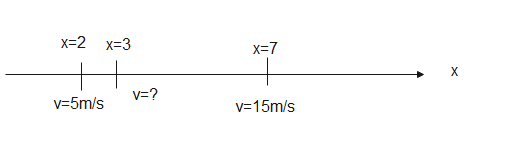
Intuitively from the image, we can say that since the velocity is increasing from$x=2m$ and $x=7m$ , we can safely say that at $x=3$ the velocity is greater than that of $x=2$ but lesser than that of $x=7$. To calculate the exact value, we can use the equation of motion in a straight line.
Then from the motion of the straight line, we have $v^2=u^2+2as$, where $v$ is the final velocity , $u$ is the initial velocity due to $a$ acceleration and covers a distance of $d$.
From $x=2m$ and $x=7m$ with velocities $5ms^{-1}$ and $15ms^{-1}$ respectively, we have
$(15)^{2}-5^{2}=2a(7-2)$
$\implies 2a=\dfrac{225-25}{5}=\dfrac{200}{5}=40$
$\therefore a=20m/s$
Similarly, from $x=2m$ and $x=3m$
$v^2=5^2+2\times 20\times (3-2)$
$\implies v^2=25+40=65$
$\therefore v=\sqrt(65)m/s$
Thus the velocity of the particle when passing via $x=3$ is $\sqrt(65)m/s$
Note: To begin with we can try to represent the given data in the form of a figure, this helps us understand the question better and also helps in drawing a relationship between the given data and the unknown. It is important to identify that the particle is moving in a straight line, and hence we can use the motion of the straight line formula.
Complete step-by-step solution:
Since there is no change in the axis along which the particle moves, clearly we can say that the following is a case, where the particle is moving in a straight line.
Now consider the image as shown below
Intuitively from the image, we can say that since the velocity is increasing from$x=2m$ and $x=7m$ , we can safely say that at $x=3$ the velocity is greater than that of $x=2$ but lesser than that of $x=7$. To calculate the exact value, we can use the equation of motion in a straight line.
Then from the motion of the straight line, we have $v^2=u^2+2as$, where $v$ is the final velocity , $u$ is the initial velocity due to $a$ acceleration and covers a distance of $d$.
From $x=2m$ and $x=7m$ with velocities $5ms^{-1}$ and $15ms^{-1}$ respectively, we have
$(15)^{2}-5^{2}=2a(7-2)$
$\implies 2a=\dfrac{225-25}{5}=\dfrac{200}{5}=40$
$\therefore a=20m/s$
Similarly, from $x=2m$ and $x=3m$
$v^2=5^2+2\times 20\times (3-2)$
$\implies v^2=25+40=65$
$\therefore v=\sqrt(65)m/s$
Thus the velocity of the particle when passing via $x=3$ is $\sqrt(65)m/s$
Note: To begin with we can try to represent the given data in the form of a figure, this helps us understand the question better and also helps in drawing a relationship between the given data and the unknown. It is important to identify that the particle is moving in a straight line, and hence we can use the motion of the straight line formula.
Recently Updated Pages
Master Class 11 English: Engaging Questions & Answers for Success

Master Class 11 Social Science: Engaging Questions & Answers for Success
Master Class 11 Maths: Engaging Questions & Answers for Success
Master Class 11 Biology: Engaging Questions & Answers for Success
Master Class 11 Physics: Engaging Questions & Answers for Success
Master Class 11 Chemistry: Engaging Questions & Answers for Success
Trending doubts
One Metric ton is equal to kg A 10000 B 1000 C 100 class 11 physics CBSE
Difference Between Prokaryotic Cells and Eukaryotic Cells
Find the value of the expression given below sin 30circ class 11 maths CBSE
Difference between physical and chemical change class 11 chemistry CBSE
Two of the body parts which do not appear in MRI are class 11 biology CBSE
Draw a diagram of a plant cell and label at least eight class 11 biology CBSE