




A particle moving along a straight line covers half of the distance with a speed of $3m{{s}^{-1}}$. The other half of the distance is covered in two equal time intervals with speed of $4.5m{{s}^{-1}}$and $7.5m{{s}^{-1}}$. The average speed of the particle (in $m{{s}^{-1}}$) is
$\begin{align}
& A.5.0 \\
& B.5.5 \\
& C.5.8 \\
& D.4.0 \\
& E.4.8 \\
\end{align}$
Answer
 Verified
676.8k+ views
Hint: We can work on the above question by dividing the question in two parts. Because the particle is travelling half the distance with some speed and the other half with other speed in equal time intervals. In the first part we will calculate the average speed that particle travelling in two equal time intervals and in the second part we will calculate the average speed of the entire journey.
Complete step by step answer:
To proceed further let us know some definitions related to our question.
Speed: The distance travelled by particle in unit time is known as speed.
Speed is a scalar quantity i.e. it has only magnitude but no direction and speed is always positive for a moving particle.
Distance: The length of the path travelled by a particle is known as distance.
Distance is a scalar quantity and is always positive for a moving particle.
Average speed: It is the ratio of total distance travelled by the particle to the total time taken to cover that distance.
Now, let us move to our question.
We know that average speed is given by:
$\begin{align}
& {{v}_{AD}}=\dfrac{s}{\left( \dfrac{s}{2{{v}_{AB}}} \right)+\left( \dfrac{s}{2{{v}_{BD}}} \right)} \\
& {{v}_{AD}}=\dfrac{2{{v}_{AB}}{{v}_{BD}}}{{{v}_{AB}}+{{v}_{BD}}} \\
& {{v}_{AD}}=\dfrac{2\times 3\times 6}{3+6} \\
& {{v}_{AD}}=4m{{s}^{-1}} \\
\end{align}$${{v}_{average}}=\dfrac{s}{t}$
Where:
${{v}_{average}}=$average speed
$s=$total distance
$t=$ total time
We are dividing the above problem in two parts, first we calculate the average speed when the particle is moving with different velocity in equal interval of time.
Total Distance is divided in two equal parts. Let the total distance be $s$
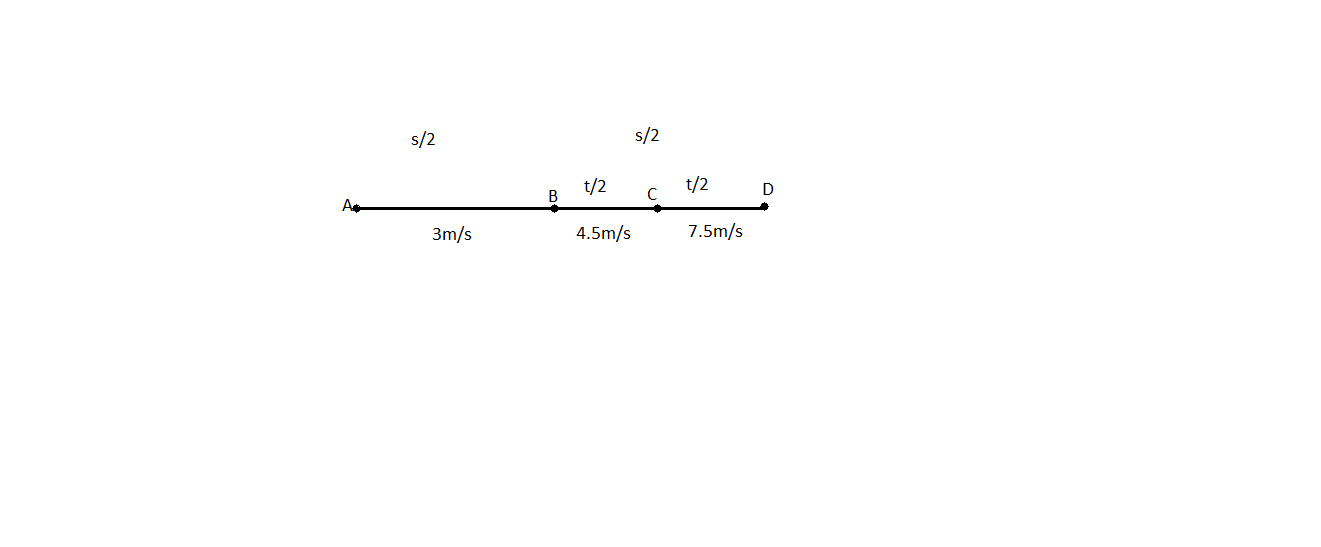
Average speed from B to D, that is particle travelling in equal time interval is given by:
$\begin{align}
& {{v}_{BD}}=\dfrac{{{v}_{1}}\dfrac{t}{2}+{{v}_{2}}\dfrac{t}{2}}{t} \\
& {{v}_{BD}}=\dfrac{{{v}_{1}}+{{v}_{2}}}{2} \\
& {{v}_{BD}}=\dfrac{4.5+7.5}{2} \\
& {{v}_{BD}}=\dfrac{12}{2} \\
& {{v}_{BD}}=6m{{s}^{-1}} \\
\end{align}$
Now calculating average speed of the whole journey:
$\begin{align}
& {{v}_{AD}}=\dfrac{s}{\left( \dfrac{s}{2{{v}_{AB}}} \right)+\left( \dfrac{s}{2{{v}_{BD}}} \right)} \\
& {{v}_{AD}}=\dfrac{2{{v}_{AB}}{{v}_{BD}}}{{{v}_{AB}}+{{v}_{BD}}} \\
& {{v}_{AD}}=\dfrac{2\times 3\times 6}{3+6} \\
& {{v}_{AD}}=4m{{s}^{-1}} \\
\end{align}$
Hence, the average velocity through the entire journey is $4m{{s}^{-1}}$.
Hence, the correct answer is option D.
Note: Students can deal with this type of problem by dividing them into smaller parts. So that it becomes easy to calculate the average speed.
If the particle travels the distance in equal time intervals then the average speed of the particle is simply the average of individual speed.
Complete step by step answer:
To proceed further let us know some definitions related to our question.
Speed: The distance travelled by particle in unit time is known as speed.
Speed is a scalar quantity i.e. it has only magnitude but no direction and speed is always positive for a moving particle.
Distance: The length of the path travelled by a particle is known as distance.
Distance is a scalar quantity and is always positive for a moving particle.
Average speed: It is the ratio of total distance travelled by the particle to the total time taken to cover that distance.
Now, let us move to our question.
We know that average speed is given by:
$\begin{align}
& {{v}_{AD}}=\dfrac{s}{\left( \dfrac{s}{2{{v}_{AB}}} \right)+\left( \dfrac{s}{2{{v}_{BD}}} \right)} \\
& {{v}_{AD}}=\dfrac{2{{v}_{AB}}{{v}_{BD}}}{{{v}_{AB}}+{{v}_{BD}}} \\
& {{v}_{AD}}=\dfrac{2\times 3\times 6}{3+6} \\
& {{v}_{AD}}=4m{{s}^{-1}} \\
\end{align}$${{v}_{average}}=\dfrac{s}{t}$
Where:
${{v}_{average}}=$average speed
$s=$total distance
$t=$ total time
We are dividing the above problem in two parts, first we calculate the average speed when the particle is moving with different velocity in equal interval of time.
Total Distance is divided in two equal parts. Let the total distance be $s$
Average speed from B to D, that is particle travelling in equal time interval is given by:
$\begin{align}
& {{v}_{BD}}=\dfrac{{{v}_{1}}\dfrac{t}{2}+{{v}_{2}}\dfrac{t}{2}}{t} \\
& {{v}_{BD}}=\dfrac{{{v}_{1}}+{{v}_{2}}}{2} \\
& {{v}_{BD}}=\dfrac{4.5+7.5}{2} \\
& {{v}_{BD}}=\dfrac{12}{2} \\
& {{v}_{BD}}=6m{{s}^{-1}} \\
\end{align}$
Now calculating average speed of the whole journey:
$\begin{align}
& {{v}_{AD}}=\dfrac{s}{\left( \dfrac{s}{2{{v}_{AB}}} \right)+\left( \dfrac{s}{2{{v}_{BD}}} \right)} \\
& {{v}_{AD}}=\dfrac{2{{v}_{AB}}{{v}_{BD}}}{{{v}_{AB}}+{{v}_{BD}}} \\
& {{v}_{AD}}=\dfrac{2\times 3\times 6}{3+6} \\
& {{v}_{AD}}=4m{{s}^{-1}} \\
\end{align}$
Hence, the average velocity through the entire journey is $4m{{s}^{-1}}$.
Hence, the correct answer is option D.
Note: Students can deal with this type of problem by dividing them into smaller parts. So that it becomes easy to calculate the average speed.
If the particle travels the distance in equal time intervals then the average speed of the particle is simply the average of individual speed.
Recently Updated Pages
Which will be the least stable resonating structure class 11 chemistry CBSE

How many 5 digit telephone numbers can be construc-class-11-maths-CBSE
How do you find the angle of the resultant vector class 11 physics CBSE
Draw labelled diagram of the following i Gram seed class 11 biology CBSE
1 Quintal is equal to a 110 kg b 10 kg c 100kg d 1000 class 11 physics CBSE
What is the need and importance of classification class 11 biology CBSE
Trending doubts
Find the value of the expression given below sin 30circ class 11 maths CBSE
One Metric ton is equal to kg A 10000 B 1000 C 100 class 11 physics CBSE
10 examples of friction in our daily life
Draw a diagram of a plant cell and label at least eight class 11 biology CBSE
Difference between physical and chemical change class 11 chemistry CBSE
Proton was discovered by A Thomson B Rutherford C Chadwick class 11 chemistry CBSE