




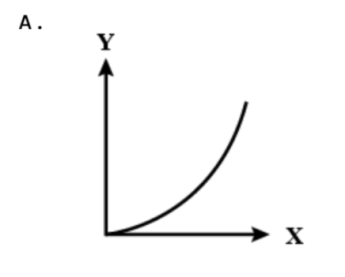
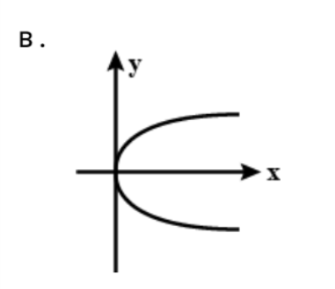
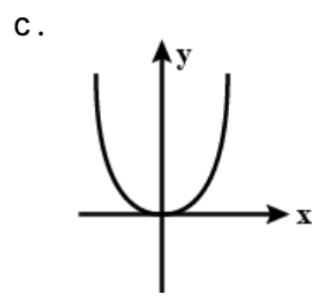
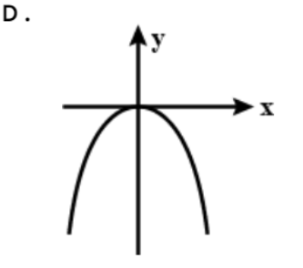
A particle moves in the x-y plane with the velocity $\vec{v}=\hat{a}i+b\hat{x}j$ where a and b are constants. Initially, the particle was at the origin. The trajectory of the particle is.
Answer
 Verified
655.2k+ views
Hint: First take out all the possible things that are given in the question, like the particles are in origin that is x=0, y=0, Then we have to find the equation of the trajectory which will reveal the type of graph then we need the radius of curvature to finalize the graph.
Complete step-by-step answer:
We can write a vector v in the form of,
$\vec{v}=\dfrac{dx}{dt}\hat{i}+\dfrac{dy}{dt}\hat{j}$
We know that the velocity of the particle is,
$\vec{v}=\hat{a}i+b\hat{x}j$,
So on comparing the equations on the upper hand we can say that,
$\dfrac{dx}{dt}=a$, and $\dfrac{dy}{dt}=bx$
We know, $\dfrac{dx}{dt}=a$
$dx=adt$
$\Rightarrow \int{dx=\int{adt}}$ (integrating on both sides)
$\Rightarrow x=at$ ……… Eq.1
We also know that, $\dfrac{dy}{dt}=bx$
$\dfrac{dy}{dt}=bat$ ………(from Eq.1)
$\Rightarrow dy=batdt$
\[\Rightarrow \int{dy=\int{batdt}}\] (integrating on both sides)
Now,
$y=\dfrac{1}{2}ab{{t}^{2}}$ ………Eq.2
On comparing Eq.1 and Eq.2, we get,
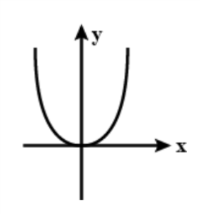
$y=\dfrac{b}{2a}{{x}^{2}}$ , This is the trajectory of the particle.
Answer is option (c)
Additional Information:
A curve is a line smooth in nature that does not take sharp turns to deviate; it deviates gradually resulting in an upward or downward curve.
A trajectory is the path that an object with mass in motion follows through space as a function of time. In classical mechanics, the mass might be a projectile or a satellite.
Origin is the starting point from which a body starts to move. It is generally taken as (0,0).
A graph usually depicts a body’s certain known values at a fixed time, using a graph we can derive the velocity, mass, acceleration, etc at point time. A curve is generally made to predict the pathway of a particle, not generally a particle but rockets, spaceships, planets and many other things also.
Note: Which equation results in what curve is a must know, students often make calculation mistakes, definition of origin. Y is taken as a function of x to get the equation of the curve. Compare the values with vector values properly, only then we can get the answer(dx/dt=a).
Complete step-by-step answer:
We can write a vector v in the form of,
$\vec{v}=\dfrac{dx}{dt}\hat{i}+\dfrac{dy}{dt}\hat{j}$
We know that the velocity of the particle is,
$\vec{v}=\hat{a}i+b\hat{x}j$,
So on comparing the equations on the upper hand we can say that,
$\dfrac{dx}{dt}=a$, and $\dfrac{dy}{dt}=bx$
We know, $\dfrac{dx}{dt}=a$
$dx=adt$
$\Rightarrow \int{dx=\int{adt}}$ (integrating on both sides)
$\Rightarrow x=at$ ……… Eq.1
We also know that, $\dfrac{dy}{dt}=bx$
$\dfrac{dy}{dt}=bat$ ………(from Eq.1)
$\Rightarrow dy=batdt$
\[\Rightarrow \int{dy=\int{batdt}}\] (integrating on both sides)
Now,
$y=\dfrac{1}{2}ab{{t}^{2}}$ ………Eq.2
On comparing Eq.1 and Eq.2, we get,
$y=\dfrac{b}{2a}{{x}^{2}}$ , This is the trajectory of the particle.
Answer is option (c)
Additional Information:
A curve is a line smooth in nature that does not take sharp turns to deviate; it deviates gradually resulting in an upward or downward curve.
A trajectory is the path that an object with mass in motion follows through space as a function of time. In classical mechanics, the mass might be a projectile or a satellite.
Origin is the starting point from which a body starts to move. It is generally taken as (0,0).
A graph usually depicts a body’s certain known values at a fixed time, using a graph we can derive the velocity, mass, acceleration, etc at point time. A curve is generally made to predict the pathway of a particle, not generally a particle but rockets, spaceships, planets and many other things also.
Note: Which equation results in what curve is a must know, students often make calculation mistakes, definition of origin. Y is taken as a function of x to get the equation of the curve. Compare the values with vector values properly, only then we can get the answer(dx/dt=a).
Recently Updated Pages
Master Class 11 Social Science: Engaging Questions & Answers for Success

Master Class 11 English: Engaging Questions & Answers for Success
Master Class 11 Accountancy: Engaging Questions & Answers for Success
Master Class 11 Physics: Engaging Questions & Answers for Success
Master Class 11 Computer Science: Engaging Questions & Answers for Success
Master Class 11 Business Studies: Engaging Questions & Answers for Success
Trending doubts
Find the value of the expression given below sin 30circ class 11 maths CBSE
One Metric ton is equal to kg A 10000 B 1000 C 100 class 11 physics CBSE
Draw a diagram of nephron and explain its structur class 11 biology CBSE
10 examples of friction in our daily life
Proton was discovered by A Thomson B Rutherford C Chadwick class 11 chemistry CBSE
The teeth used for biting and cutting food are called class 11 biology CBSE