




A particle moves in east direction with $15m/\sec $ for $2\sec $ then moves in north direction with $5m/s$ for $8\sec $. Average velocity of the particle is:
(A). $1m/s$
(B). $5m/s$
(C). $7m/s$
(D). $10m/s$
Answer
 Verified
654.9k+ views
- Hint: You can start by describing what a vector quantity is. Then draw a well labelled diagram for the given problem with the resultant displacement vector. Then use the equation $Velocity = \dfrac{{Displacement}}{{Time}}$ to find out the distance traveled in east and north direction. Then use the Pythagoras theorem ( $A{C^2} = A{B^2} + B{C^2}$ ) to find out the net displacement. Then again use the equation $Velocity = \dfrac{{Displacement}}{{Time}}$ to calculate the result.
Complete step-by-step answer:
Before attempting the numerical calculations, let’s first discuss what a vector is?
A vector is a mathematical quantity that has both a magnitude (size) and a direction. To imagine what a vector is like, imagine asking someone for directions in an unknown area and they tell you, “Go $5km$ towards the West”. In this sentence, we see an example of a displacement vector, “ \[5km\] ” is the magnitude of the displacement vector and “towards the North” is the indicator of the direction of the displacement vector.
A vector quantity is different from a scalar quantity in the fact that a scalar quantity has only magnitude, but a vector quantity possesses both direction and magnitude. Unlike scalar quantities, vector quantities cannot undergo any mathematical operation, instead they undergo Dot product and Cross product.
Some examples of vectors are – Displacement, Force, Acceleration, Velocity, Momentum, etc.
The diagram of the movement of the particle is given below
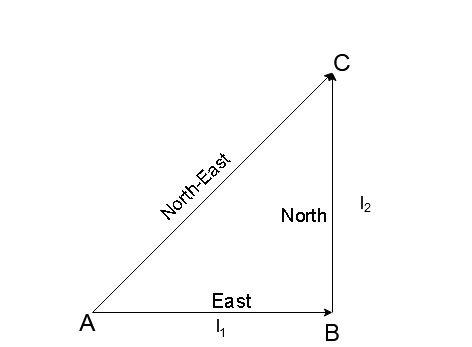
We know that
$Velocity = \dfrac{{Displacement}}{{Time}}$
The length of $AB$ is
$15 = \dfrac{{{l_1}}}{2}$
$ \Rightarrow {l_1} = 30m$
The length of $BC$ is
$5 = \dfrac{{{l_2}}}{8}$
$ \Rightarrow {l_2} = 40m$
By Pythagoras theorem
$A{C^2} = A{B^2} + B{C^2}$
$ \Rightarrow A{C^2} = {(30)^2} + {(40)^2}$
$ \Rightarrow A{C^2} = 900 + 1600$
$ \Rightarrow A{C^2} = 2500$
$ \Rightarrow AC = 50m$
Total time taken by the particle to get to point $C = 2 + 8 = 10\sec $ .
The average velocity of the particle is
$v = \dfrac{{50}}{{10}}$
$ \Rightarrow v = 5m/sec $
The average velocity of the particle is $5m/s$ in the north-east direction.
Hence, option B is the correct option.
Note: In this problem we are basically given three displacement vectors. The first two vectors $AB$ and $BC$ are mentioned in the given problem. The third vector $AC$ is the resultant vector which is used to reach the solution. In the diagram above, we arranged the vectors in a way that makes it easier to understand and solve.
Complete step-by-step answer:
Before attempting the numerical calculations, let’s first discuss what a vector is?
A vector is a mathematical quantity that has both a magnitude (size) and a direction. To imagine what a vector is like, imagine asking someone for directions in an unknown area and they tell you, “Go $5km$ towards the West”. In this sentence, we see an example of a displacement vector, “ \[5km\] ” is the magnitude of the displacement vector and “towards the North” is the indicator of the direction of the displacement vector.
A vector quantity is different from a scalar quantity in the fact that a scalar quantity has only magnitude, but a vector quantity possesses both direction and magnitude. Unlike scalar quantities, vector quantities cannot undergo any mathematical operation, instead they undergo Dot product and Cross product.
Some examples of vectors are – Displacement, Force, Acceleration, Velocity, Momentum, etc.
The diagram of the movement of the particle is given below
We know that
$Velocity = \dfrac{{Displacement}}{{Time}}$
The length of $AB$ is
$15 = \dfrac{{{l_1}}}{2}$
$ \Rightarrow {l_1} = 30m$
The length of $BC$ is
$5 = \dfrac{{{l_2}}}{8}$
$ \Rightarrow {l_2} = 40m$
By Pythagoras theorem
$A{C^2} = A{B^2} + B{C^2}$
$ \Rightarrow A{C^2} = {(30)^2} + {(40)^2}$
$ \Rightarrow A{C^2} = 900 + 1600$
$ \Rightarrow A{C^2} = 2500$
$ \Rightarrow AC = 50m$
Total time taken by the particle to get to point $C = 2 + 8 = 10\sec $ .
The average velocity of the particle is
$v = \dfrac{{50}}{{10}}$
$ \Rightarrow v = 5m/sec $
The average velocity of the particle is $5m/s$ in the north-east direction.
Hence, option B is the correct option.
Note: In this problem we are basically given three displacement vectors. The first two vectors $AB$ and $BC$ are mentioned in the given problem. The third vector $AC$ is the resultant vector which is used to reach the solution. In the diagram above, we arranged the vectors in a way that makes it easier to understand and solve.
Recently Updated Pages
Which will be the least stable resonating structure class 11 chemistry CBSE

Explain the structure of megasporangium class 12 biology CBSE
Differentiate between voluntary action and reflex class 10 biology CBSE
How many 5 digit telephone numbers can be construc-class-11-maths-CBSE
How do you find the angle of the resultant vector class 11 physics CBSE
Why is chloroform kept in dark coloured bottles class 12 chemistry CBSE
Trending doubts
The common name of Rheo leaf is A Oyster plant B Boat class 9 biology CBSE
Difference Between Plant Cell and Animal Cell
Fill the blanks with the suitable prepositions 1 The class 9 english CBSE
What is the full form of pH?
Any five important events between the years 1930 to class 9 social science CBSE
On an outline map of India show its neighbouring c class 9 social science CBSE