




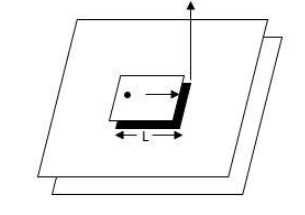
A particle moves from one end of the strip to the other end in time \[t\] with uniform velocity. The particle then files off vertically making the strip move on the smooth horizontal table. Further distance travelled by the strip in time \[T\] is equal to the length of the strip \[L\]. Then
A. \[T > t\]
B. \[T = t\]
C. \[T < t\]
D. data is insufficient.
Answer
 Verified
585.6k+ views
Hint: A relative velocity is the velocity of an object or observed in the rest frame of another object. It is basically between two objects, one is an object and the second one is the frame of an object.
Complete step by step answer:
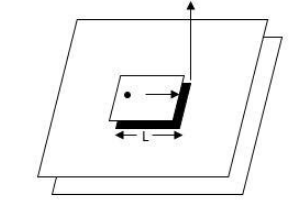
In the given question. The particle and the strip have to move in the opposite direction.
Let their relative velocity is given by ${V_r}.$
So, ${V_r} = \dfrac{L}{t}$
Where, $L \to $ length of the strip
$t \to $time (with uniform velocity).
So, the strip continues to move in its previous speed that is less than the relative velocity. And it will also cover the same distance rather slowly. Therefore, travelled trip time is greater than the time (with uniform velocity).
$\therefore T > t$
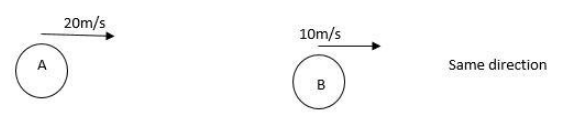
Note:Relative velocity is calculated by additional or subtraction method.

Relative velocity$ = {V_A} - {V_B}$
$ = 10 - ( - 20)$
$ = 10 + 20 = 30m/s.$
Formulae:
(1) Velocity of object (A) relative to the object (B)$ \to {V_{ab}} = {V_a} - {V_b}$
(2) Velocity of object B relative to, object ${V_{ba}} = {V_b} - {V_a}$
Complete step by step answer:
In the given question. The particle and the strip have to move in the opposite direction.
Let their relative velocity is given by ${V_r}.$
So, ${V_r} = \dfrac{L}{t}$
Where, $L \to $ length of the strip
$t \to $time (with uniform velocity).
So, the strip continues to move in its previous speed that is less than the relative velocity. And it will also cover the same distance rather slowly. Therefore, travelled trip time is greater than the time (with uniform velocity).
$\therefore T > t$
Note:Relative velocity is calculated by additional or subtraction method.
Relative velocity$ = {V_A} - {V_B}$
$ = 10 - ( - 20)$
$ = 10 + 20 = 30m/s.$
Formulae:
(1) Velocity of object (A) relative to the object (B)$ \to {V_{ab}} = {V_a} - {V_b}$
(2) Velocity of object B relative to, object ${V_{ba}} = {V_b} - {V_a}$
Recently Updated Pages
Master Class 11 English: Engaging Questions & Answers for Success

Master Class 11 Maths: Engaging Questions & Answers for Success
Master Class 11 Biology: Engaging Questions & Answers for Success
Master Class 11 Physics: Engaging Questions & Answers for Success
Master Class 11 Accountancy: Engaging Questions & Answers for Success
Class 11 Question and Answer - Your Ultimate Solutions Guide
Trending doubts
One Metric ton is equal to kg A 10000 B 1000 C 100 class 11 physics CBSE
Discuss the various forms of bacteria class 11 biology CBSE
Draw a diagram of a plant cell and label at least eight class 11 biology CBSE
State the laws of reflection of light
Explain zero factorial class 11 maths CBSE
10 examples of friction in our daily life