




A particle is placed at rest inside a hollow hemisphere of radius $R$. The coefficient of friction between the particle and the hemisphere is $\mu = \dfrac{1}{{\sqrt 3 }}$ . the maximum height up to which the particle can remain stationary is
\[(A)\dfrac{R}{2}\]
\[(B)\left( {1 - \dfrac{{\sqrt 3 }}{2}} \right)R\]
\[(C)\dfrac{{\sqrt 3 }}{2}R\]
\[(D)\dfrac{{3R}}{8}\]
Answer
 Verified
579.3k+ views
Hint: The free-body diagram has to be drawn to show the applied forces on the given particle. The forces have to be divided into components as per requirements. The amount of the limiting friction will be the frictional coefficient times radius of the sphere. After equating the forces that are equally applied on the particle the value of the tangent of the angle (in which the forces are divided into components) can be found. From this value, the maximum height up to which the particle can remain stationary can be calculated.
Formula used:
The limiting friction $F = \mu N$ , $\mu $ is the coefficient of friction between the particle and the hemisphere.
$N$ is the normal reaction force of the sphere on the particle.
$N = mg\cos \theta $ , $mg\cos \theta $ is the horizontal component of the weight of the particle $mg$ .
The height \[h = R - R\cos \theta \] , \[R\] is the radius of the sphere.
Complete step by step solution:
Let the particle of mass \[m\] stay at rest on the point \[B\] w.r…t the point\[A\] .
The point \[B\] is at height \[h\] .
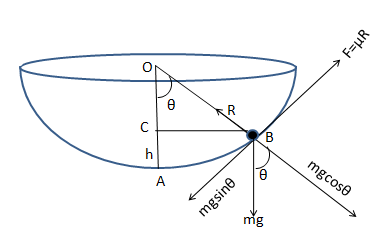
The horizontal component of the weight of the particle along the radius is $mg\cos \theta $. Hence the normal reaction force of the sphere on the particle $N = mg\cos \theta $.
The vertical component of the weight $mg\sin \theta $ tries to move the particle.
The limiting friction $F = \mu N$ , $\mu $ is the coefficient of friction between the particle and the hemisphere.
The condition for staying at the rest is that these two forces have to eliminate each other.
i.e. $mg\sin \theta = \mu mg\cos \theta $
$ \Rightarrow \tan \theta = \mu $
Given that, $\mu = \dfrac{1}{{\sqrt 3 }}$
$\therefore \tan \theta = \mu $
$ \Rightarrow \tan \theta = \dfrac{1}{{\sqrt 3 }}$
$ \Rightarrow \theta = {30^ \circ }$
Now, from the diagram $\Delta OBC \Rightarrow OC = OB\cos 30^\circ $
$ \Rightarrow OC = R\dfrac{{\sqrt 3 }}{2}$ [since, the radius of the sphere $OB = R$ ]
Now, The height $h = AC = AO - OC$
$ \Rightarrow h = R - \dfrac{{\sqrt 3 R}}{2}$ [ also, we can write $h = R - R\cos \theta $ ]
\[ \Rightarrow h = R\left( {1 - \dfrac{{\sqrt 3 }}{2}} \right)\]
Hence, the maximum height up to which the particle can remain stationary is \[ \Rightarrow h = R\left( {1 - \dfrac{{\sqrt 3 }}{2}} \right)\]
Note:Here we can know about a term called ‘limiting friction’. When the amount of the applied force along the horizontal axis, the value of static friction ( the friction that tries to stop a particle from a movement) also increases slowly and reaches a maximum value. That means, there is also a limit in the increase of the friction by itself. The applied force when greater than the limit, the particle can not remain at rest. This maximum value of the static friction is known as the limiting friction or limiting value of static friction. After that, with the increase of the applied force, the value of the friction can not increase.
Formula used:
The limiting friction $F = \mu N$ , $\mu $ is the coefficient of friction between the particle and the hemisphere.
$N$ is the normal reaction force of the sphere on the particle.
$N = mg\cos \theta $ , $mg\cos \theta $ is the horizontal component of the weight of the particle $mg$ .
The height \[h = R - R\cos \theta \] , \[R\] is the radius of the sphere.
Complete step by step solution:
Let the particle of mass \[m\] stay at rest on the point \[B\] w.r…t the point\[A\] .
The point \[B\] is at height \[h\] .
The horizontal component of the weight of the particle along the radius is $mg\cos \theta $. Hence the normal reaction force of the sphere on the particle $N = mg\cos \theta $.
The vertical component of the weight $mg\sin \theta $ tries to move the particle.
The limiting friction $F = \mu N$ , $\mu $ is the coefficient of friction between the particle and the hemisphere.
The condition for staying at the rest is that these two forces have to eliminate each other.
i.e. $mg\sin \theta = \mu mg\cos \theta $
$ \Rightarrow \tan \theta = \mu $
Given that, $\mu = \dfrac{1}{{\sqrt 3 }}$
$\therefore \tan \theta = \mu $
$ \Rightarrow \tan \theta = \dfrac{1}{{\sqrt 3 }}$
$ \Rightarrow \theta = {30^ \circ }$
Now, from the diagram $\Delta OBC \Rightarrow OC = OB\cos 30^\circ $
$ \Rightarrow OC = R\dfrac{{\sqrt 3 }}{2}$ [since, the radius of the sphere $OB = R$ ]
Now, The height $h = AC = AO - OC$
$ \Rightarrow h = R - \dfrac{{\sqrt 3 R}}{2}$ [ also, we can write $h = R - R\cos \theta $ ]
\[ \Rightarrow h = R\left( {1 - \dfrac{{\sqrt 3 }}{2}} \right)\]
Hence, the maximum height up to which the particle can remain stationary is \[ \Rightarrow h = R\left( {1 - \dfrac{{\sqrt 3 }}{2}} \right)\]
Note:Here we can know about a term called ‘limiting friction’. When the amount of the applied force along the horizontal axis, the value of static friction ( the friction that tries to stop a particle from a movement) also increases slowly and reaches a maximum value. That means, there is also a limit in the increase of the friction by itself. The applied force when greater than the limit, the particle can not remain at rest. This maximum value of the static friction is known as the limiting friction or limiting value of static friction. After that, with the increase of the applied force, the value of the friction can not increase.
Recently Updated Pages
Which will be the least stable resonating structure class 11 chemistry CBSE

How many 5 digit telephone numbers can be construc-class-11-maths-CBSE
How do you find the angle of the resultant vector class 11 physics CBSE
Draw labelled diagram of the following i Gram seed class 11 biology CBSE
1 Quintal is equal to a 110 kg b 10 kg c 100kg d 1000 class 11 physics CBSE
What is the need and importance of classification class 11 biology CBSE
Trending doubts
Find the value of the expression given below sin 30circ class 11 maths CBSE
One Metric ton is equal to kg A 10000 B 1000 C 100 class 11 physics CBSE
10 examples of friction in our daily life
Draw a diagram of a plant cell and label at least eight class 11 biology CBSE
Difference between physical and chemical change class 11 chemistry CBSE
Proton was discovered by A Thomson B Rutherford C Chadwick class 11 chemistry CBSE