




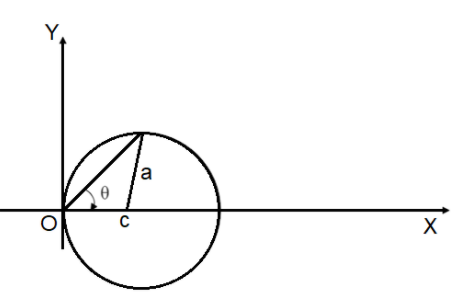
A particle is moving in a circular path of radius $a$ , with constant velocity $v$ as shown in figure. The centre of circle is marked by ‘C’ the angular momentum from the origin O can be written as:
(A) $va\left( {1 + \cos 2\theta } \right)$
(B) $va\left( {1 + \cos \theta } \right)$
(C) $va\cos 2\theta $
(D) $va$
Answer
 Verified
595.5k+ views
Hint: A body experiencing circular motion would experience angular velocity $\omega $ but when linear velocity is considered in non-linear circumstances the perpendicular component of the linear velocity is taken. The non-perpendicular component of the velocity vector has no effect on the angular momentum of a body.
Formula used: We will be using the formula $L = m{v_ \bot }r$ where $L$ is the angular momentum of the body in circular motion, ${v_ \bot }$ is the perpendicular component of velocity vector, $r$ is the radius of the circular path in which the body was moving.
Complete step by Step answer:
We know that when a body is in circular motion it experiences angular velocity, which is given by $\omega $ and is related to linear velocity as ${v_ \bot } = \omega r$ . The linear velocity $v$ of the body is experienced due to centripetal force on the body and moves outward from the body, tangential to its circular path of motion.
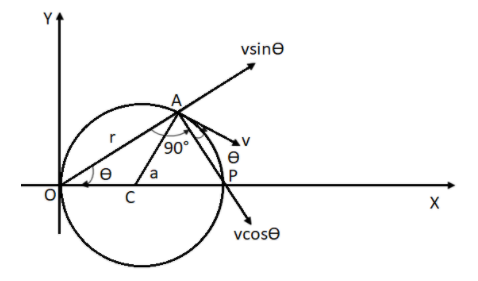
Let us make a construction and extend the line AP to touch the circle on its circumference, such that OP is the diameter. Now we know that by the property of a circle the angle subtended by the diameter on the circumference of the circle is a right angle, $\angle OAP = 90^\circ $ .
Also, by the property of the isosceles triangle the angles adjacent to the equal sides are equal thus, $\angle AOC = \angle CAO = \theta $. So, $\angle CAP$ will be $\left( {90^\circ - \theta } \right)$ . We know that the velocity vector caused by centripetal force will be perpendicular to the radius of the circle. Thus, the angle subtended by the line AC and velocity vector is $90^\circ $ . Thus, making the angle formed by velocity vector and the line AP,
$\angle A - \angle CAP = 90^\circ - \left( {90^\circ - \theta } \right) = \theta $ .
Now the velocity vector can be taken into 2 components: the vertical component along AP, $v\cos \theta $ and the horizontal component, $v\sin \theta $ . We know that the horizontal component of the velocity vector has no effect on angular momentum of the body.
Now in $\Delta OAP$ , $\cos \theta = \dfrac{{OA}}{{OP}}$ . OP is the diameter hence, $OP = 2a$ and let $OA = r$ .
$\cos \theta = \dfrac{r}{{2a}}$
$ \Rightarrow r = 2a\cos \theta $
Now to find the angular momentum along the origin O,
$L = m{v_ \bot }r$
$ \Rightarrow L = m \times v\cos \theta \times 2a\cos \theta $
[Since $v\sin \theta $ has no effect on the angular momentum along origin.]
$L = mva\left( {2{{\cos }^2}\theta } \right)$
According to the trigonometric formula, $2{\cos ^2}\theta = \left( {1 + \cos 2\theta } \right)$
$L = mva\left( {1 + \cos 2\theta } \right)$
Let us consider that the particle in motion has unit mass. Thus, the angular momentum of the particle along origin will be, $L = va\left( {1 + \cos 2\theta } \right)$ [option A]
Note: Centripetal force is the force that makes the body follow a curved path. The direction is always perpendicular to the direction of motion. This is why the horizontal component of velocity $v\sin \theta $ is neglected.
Formula used: We will be using the formula $L = m{v_ \bot }r$ where $L$ is the angular momentum of the body in circular motion, ${v_ \bot }$ is the perpendicular component of velocity vector, $r$ is the radius of the circular path in which the body was moving.
Complete step by Step answer:
We know that when a body is in circular motion it experiences angular velocity, which is given by $\omega $ and is related to linear velocity as ${v_ \bot } = \omega r$ . The linear velocity $v$ of the body is experienced due to centripetal force on the body and moves outward from the body, tangential to its circular path of motion.
Let us make a construction and extend the line AP to touch the circle on its circumference, such that OP is the diameter. Now we know that by the property of a circle the angle subtended by the diameter on the circumference of the circle is a right angle, $\angle OAP = 90^\circ $ .
Also, by the property of the isosceles triangle the angles adjacent to the equal sides are equal thus, $\angle AOC = \angle CAO = \theta $. So, $\angle CAP$ will be $\left( {90^\circ - \theta } \right)$ . We know that the velocity vector caused by centripetal force will be perpendicular to the radius of the circle. Thus, the angle subtended by the line AC and velocity vector is $90^\circ $ . Thus, making the angle formed by velocity vector and the line AP,
$\angle A - \angle CAP = 90^\circ - \left( {90^\circ - \theta } \right) = \theta $ .
Now the velocity vector can be taken into 2 components: the vertical component along AP, $v\cos \theta $ and the horizontal component, $v\sin \theta $ . We know that the horizontal component of the velocity vector has no effect on angular momentum of the body.
Now in $\Delta OAP$ , $\cos \theta = \dfrac{{OA}}{{OP}}$ . OP is the diameter hence, $OP = 2a$ and let $OA = r$ .
$\cos \theta = \dfrac{r}{{2a}}$
$ \Rightarrow r = 2a\cos \theta $
Now to find the angular momentum along the origin O,
$L = m{v_ \bot }r$
$ \Rightarrow L = m \times v\cos \theta \times 2a\cos \theta $
[Since $v\sin \theta $ has no effect on the angular momentum along origin.]
$L = mva\left( {2{{\cos }^2}\theta } \right)$
According to the trigonometric formula, $2{\cos ^2}\theta = \left( {1 + \cos 2\theta } \right)$
$L = mva\left( {1 + \cos 2\theta } \right)$
Let us consider that the particle in motion has unit mass. Thus, the angular momentum of the particle along origin will be, $L = va\left( {1 + \cos 2\theta } \right)$ [option A]
Note: Centripetal force is the force that makes the body follow a curved path. The direction is always perpendicular to the direction of motion. This is why the horizontal component of velocity $v\sin \theta $ is neglected.
Recently Updated Pages
Master Class 11 English: Engaging Questions & Answers for Success

Master Class 11 Social Science: Engaging Questions & Answers for Success
Master Class 11 Maths: Engaging Questions & Answers for Success
Master Class 11 Biology: Engaging Questions & Answers for Success
Master Class 11 Physics: Engaging Questions & Answers for Success
Master Class 11 Chemistry: Engaging Questions & Answers for Success
Trending doubts
One Metric ton is equal to kg A 10000 B 1000 C 100 class 11 physics CBSE
Difference Between Prokaryotic Cells and Eukaryotic Cells
Find the value of the expression given below sin 30circ class 11 maths CBSE
Difference between physical and chemical change class 11 chemistry CBSE
Two of the body parts which do not appear in MRI are class 11 biology CBSE
Draw a diagram of a plant cell and label at least eight class 11 biology CBSE