



A particle is free to move along the x-axis has potential energy given by $U(x)=k[1-exp^{-x^{2}}]$ for $-\infty \leq x\leq +\infty$ where $k$ is a positive constant of appropriate dimensions. Then :
A. at points away from the origin, the particle is in unstable equilibrium
B. For any finite non-zero value of $x$ there is a force directed away from the origin
C. if its total mechanical energy is $\dfrac{k}{2}$ it has its minimum kinetic energy at the origin
D. for small displacements from $x=0$ the motion is simple harmonic
Answer
 Verified
516.3k+ views
Hint: We know that potential energy is the energy posed by the position of the object with respect to the origin. is the Since the given potential energy is in terms of exponents, let us first try to understand the nature of motion of the particle, using a graph which will be discussed below.
Complete step-by-step solution:
Let us consider the given equation $U(x)=k[1-exp^{-x^{2}}]$ for $-\infty \leq x\leq +\infty$ where $k$ is a positive constant .
Now look at
$U(0)=k[1-exp^{-0^{2}}]$
$\implies U(0)=0$
To under the equation better, let us draw a graph as shown below
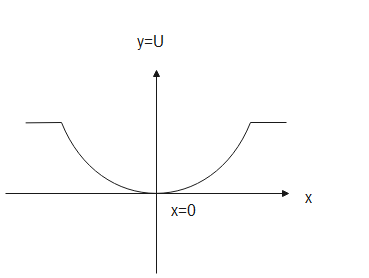
Clearly, from the diagram the particle is stable, for any small displacement the particle will return to its mean position, which is the origin where potential energy is minimum.
Hence clearly A and B is not the answer.
Now look at the force which acts in the particle it is given as
$F=\dfrac{-\delta U}{\delta x}$
$\implies F=\dfrac{-\delta k[1-exp^{-x^{2}}]}{\delta x}$
$\implies F= k[-exp^{-x^{2}}]\times -2x$
$\implies F=2xk[exp^{-x^{2}}]$
From the above we can say that
$\therefore F\propto x$
Since in SHM also, we have $F\propto x$, we can say that the particle undergoes SHM for displacement in the regions near $x=0$
Thus the correct answer is option D. for small displacements from $x=0$ the motion is simple harmonic.
Note: We know that SHM or simple harmonic motion is the to and from oscillatory motion of a particle along its mean position, which is $x=0$ or the origin here. Also note that the total energy of the particle is the sum of its kinetic and potential energy, thus if potential energy is $0$ at $x=0$, then from C, we can say that $K.E(0)=\dfrac{K}{2}$, however, that is not the minimum kinetic energy possible.
Complete step-by-step solution:
Let us consider the given equation $U(x)=k[1-exp^{-x^{2}}]$ for $-\infty \leq x\leq +\infty$ where $k$ is a positive constant .
Now look at
$U(0)=k[1-exp^{-0^{2}}]$
$\implies U(0)=0$
To under the equation better, let us draw a graph as shown below
Clearly, from the diagram the particle is stable, for any small displacement the particle will return to its mean position, which is the origin where potential energy is minimum.
Hence clearly A and B is not the answer.
Now look at the force which acts in the particle it is given as
$F=\dfrac{-\delta U}{\delta x}$
$\implies F=\dfrac{-\delta k[1-exp^{-x^{2}}]}{\delta x}$
$\implies F= k[-exp^{-x^{2}}]\times -2x$
$\implies F=2xk[exp^{-x^{2}}]$
From the above we can say that
$\therefore F\propto x$
Since in SHM also, we have $F\propto x$, we can say that the particle undergoes SHM for displacement in the regions near $x=0$
Thus the correct answer is option D. for small displacements from $x=0$ the motion is simple harmonic.
Note: We know that SHM or simple harmonic motion is the to and from oscillatory motion of a particle along its mean position, which is $x=0$ or the origin here. Also note that the total energy of the particle is the sum of its kinetic and potential energy, thus if potential energy is $0$ at $x=0$, then from C, we can say that $K.E(0)=\dfrac{K}{2}$, however, that is not the minimum kinetic energy possible.
Recently Updated Pages
Master Class 11 Computer Science: Engaging Questions & Answers for Success

Master Class 11 Business Studies: Engaging Questions & Answers for Success
Master Class 11 Economics: Engaging Questions & Answers for Success
Master Class 11 English: Engaging Questions & Answers for Success
Master Class 11 Maths: Engaging Questions & Answers for Success
Master Class 11 Biology: Engaging Questions & Answers for Success
Trending doubts
One Metric ton is equal to kg A 10000 B 1000 C 100 class 11 physics CBSE
There are 720 permutations of the digits 1 2 3 4 5 class 11 maths CBSE
Discuss the various forms of bacteria class 11 biology CBSE
Draw a diagram of a plant cell and label at least eight class 11 biology CBSE
State the laws of reflection of light
Explain zero factorial class 11 maths CBSE