




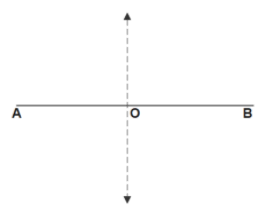
A particle executes simple harmonic motion of period T and amplitude l along a rod AB of length 2l. The rod AB itself executes simple harmonic motion of the same period and amplitude in a direction perpendicular to its length. Initially, both the particle and the rod are in their mean positions. The path traced out by the particle will be:
A. a circle of radius 1
B. a straight line inclined at $\dfrac{\pi }{4}$ to the rod
C. an ellipse
D. a figure of eight
Answer
 Verified
596.1k+ views
Hint: To find the path traced by the particle we need to establish a relationship between the SHM equation of the rod and the particle. We need to first find the wave equation for the particle and for the rod individually, from the data given in the equation regarding the amplitude and time period of the wave. Comparing these equations, one can obtain the required equation of the path traced by the particle.
Formula used:
$x = A\sin \left( {\omega t + \theta } \right)$
Complete answer:
The wave equation for any particle executing SHM is given by
$x = A\sin \left( {\omega t + \theta } \right)$
Where,
x is the displacement of the particle from the mean position;
A is the amplitude of the wave;
ω is the angular frequency;
t is the time; and
θ is the phase angle.
From the data given in the question the particle is oscillating with an amplitude of ‘$l$’, along the rod and it is at the mean position, at t=0. The wave equation of this particle will be given by
$x = l\sin \left( {\omega t} \right)$
Here, we’re assuming that $T = \dfrac{{2\pi }}{\omega }$, where T is the time period.
It is also given that the rod also executes SHM with the same amplitude ‘$l$’ and time period, i.e. same angular frequency. But the rod will be oscillating in the y-axis, say with initial phase angle θ. The wave equation of rod will be given by
$y = l\cos \left( {\omega t + \theta } \right)$
It is mentioned that the rod is at the mean position, initially i.e. at t = 0. Thus,
$\eqalign{
& y = l\cos \left( {\omega t + \theta } \right) \cr
& \Rightarrow 0 = l\cos \left( {\omega (0) + \theta } \right) \cr
& \Rightarrow \cos \theta = 0 \cr
& \Rightarrow \theta = \dfrac{\pi }{2} \cr} $
The equation of rod can be written as
$\eqalign{
& y = l\cos \left( {\omega t + \theta } \right) \cr
& \Rightarrow y = l\cos \left( {\omega t + \dfrac{\pi }{2}} \right) \cr
& \Rightarrow y = - l\sin \left( {\omega t} \right) \cr} $
Comparing the wave equations of particle and the rod, we get
$\eqalign{
& y = - l\sin \left( {\omega t} \right) \cr
& \Rightarrow y = - x \cr} $
This equation is similar to that of a straight line, $y = mx + c$. But the y-intercept, ‘c’ is zero indicating that the particle passes through the origin and is inclined at an angle $\dfrac{\pi }{4}$, to the rod in the second quadrant.
Hence, the correct option is B.
Note:
Here, the particle is making an angle of $\dfrac{\pi }{4}$ with the rod, but not with respect to the x-axis. Thus, we neglect the part that the line is in the second quadrant. The particle and the rod are said to be in the mean position, initially. This indicates that their displacement is equal to zero at time t = 0.
Formula used:
$x = A\sin \left( {\omega t + \theta } \right)$
Complete answer:
The wave equation for any particle executing SHM is given by
$x = A\sin \left( {\omega t + \theta } \right)$
Where,
x is the displacement of the particle from the mean position;
A is the amplitude of the wave;
ω is the angular frequency;
t is the time; and
θ is the phase angle.
From the data given in the question the particle is oscillating with an amplitude of ‘$l$’, along the rod and it is at the mean position, at t=0. The wave equation of this particle will be given by
$x = l\sin \left( {\omega t} \right)$
Here, we’re assuming that $T = \dfrac{{2\pi }}{\omega }$, where T is the time period.
It is also given that the rod also executes SHM with the same amplitude ‘$l$’ and time period, i.e. same angular frequency. But the rod will be oscillating in the y-axis, say with initial phase angle θ. The wave equation of rod will be given by
$y = l\cos \left( {\omega t + \theta } \right)$
It is mentioned that the rod is at the mean position, initially i.e. at t = 0. Thus,
$\eqalign{
& y = l\cos \left( {\omega t + \theta } \right) \cr
& \Rightarrow 0 = l\cos \left( {\omega (0) + \theta } \right) \cr
& \Rightarrow \cos \theta = 0 \cr
& \Rightarrow \theta = \dfrac{\pi }{2} \cr} $
The equation of rod can be written as
$\eqalign{
& y = l\cos \left( {\omega t + \theta } \right) \cr
& \Rightarrow y = l\cos \left( {\omega t + \dfrac{\pi }{2}} \right) \cr
& \Rightarrow y = - l\sin \left( {\omega t} \right) \cr} $
Comparing the wave equations of particle and the rod, we get
$\eqalign{
& y = - l\sin \left( {\omega t} \right) \cr
& \Rightarrow y = - x \cr} $
This equation is similar to that of a straight line, $y = mx + c$. But the y-intercept, ‘c’ is zero indicating that the particle passes through the origin and is inclined at an angle $\dfrac{\pi }{4}$, to the rod in the second quadrant.
Hence, the correct option is B.
Note:
Here, the particle is making an angle of $\dfrac{\pi }{4}$ with the rod, but not with respect to the x-axis. Thus, we neglect the part that the line is in the second quadrant. The particle and the rod are said to be in the mean position, initially. This indicates that their displacement is equal to zero at time t = 0.
Recently Updated Pages
Master Class 12 Social Science: Engaging Questions & Answers for Success

Master Class 12 Physics: Engaging Questions & Answers for Success
Master Class 12 Maths: Engaging Questions & Answers for Success
Master Class 12 Economics: Engaging Questions & Answers for Success
Master Class 12 Chemistry: Engaging Questions & Answers for Success
Master Class 12 Business Studies: Engaging Questions & Answers for Success
Trending doubts
Which are the Top 10 Largest Countries of the World?
Draw a labelled sketch of the human eye class 12 physics CBSE
Explain the structure of megasporangium class 12 biology CBSE
What are the major means of transport Explain each class 12 social science CBSE
How many chromosomes are found in human ovum a 46 b class 12 biology CBSE
The diagram of the section of a maize grain is given class 12 biology CBSE