




A particle describes a horizontal circle of radius $'r'$ on a smooth surface of an inverted cone. The height of the plane of the circle above the vertex is $'h'$ . Then the speed of the particle will be.
Answer
 Verified
544.5k+ views
Hint: When a particle moves in a circular path it feels forces like centrifugal force and force due to its weight.
Centrifugal force: It is an inertial force that appears to act on all objects when viewed in a rotating frame of reference. It is gives by $\dfrac{m{{v}^{2}}}{r}$
Complete step by step solution
Let us consider a particle moving in a circular path and it is mounted on a smooth surface of an Inverted cone. The height of the plane of the circle from the vertex is $'h'$ .
The particle experiences centrifugal force and force due to its weight.
Centrifugal force is$=\dfrac{m{{v}^{2}}}{r}$
Force due to its weight$=mg$
When particle reaches at the surface of the cone we draw a normal $'N'$ and its component is $N\text{ cos}\theta ,N\sin \theta $
Now, we have two vertical components and two transverse components.
From geometry of figure:
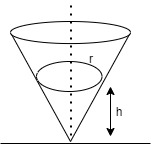
$N\text{ cos}\theta =\dfrac{m{{v}^{2}}}{r}$ ……. (1)
And
$N\sin \theta =mg$ …… (2)
Now,
Divide (1) by (2)
$\dfrac{N\text{ cos}\theta }{N\text{ sin}\theta }=\dfrac{m{{v}^{2}}}{r}/mg=\dfrac{\text{cos}\theta }{\sin \theta }=\dfrac{{{v}^{2}}}{rg}$
$\cot \theta =\dfrac{{{v}^{2}}}{rg}$
In our case,$\cot \theta =\dfrac{h}{r}$
This equation becomes
$\begin{align}
& \dfrac{h}{r}=\dfrac{{{v}^{2}}}{rg}={{v}^{2}}=hg \\
& \text{ }v=\sqrt{hg} \\
& \text{This is speed of the particle}\text{.} \\
\end{align}$
Note: From this discussion, we can find the time revolution of particles by using the value of ‘speed’.
$T=\dfrac{2\pi r}{v}$
Concept of forces should be clear. Knowledge of how they are acting on particles should be clear. Knowledge of trigonometric concepts is needed in such questions.
Centrifugal force: It is an inertial force that appears to act on all objects when viewed in a rotating frame of reference. It is gives by $\dfrac{m{{v}^{2}}}{r}$
Complete step by step solution
Let us consider a particle moving in a circular path and it is mounted on a smooth surface of an Inverted cone. The height of the plane of the circle from the vertex is $'h'$ .
The particle experiences centrifugal force and force due to its weight.
Centrifugal force is$=\dfrac{m{{v}^{2}}}{r}$
Force due to its weight$=mg$
When particle reaches at the surface of the cone we draw a normal $'N'$ and its component is $N\text{ cos}\theta ,N\sin \theta $
Now, we have two vertical components and two transverse components.
From geometry of figure:
$N\text{ cos}\theta =\dfrac{m{{v}^{2}}}{r}$ ……. (1)
And
$N\sin \theta =mg$ …… (2)
Now,
Divide (1) by (2)
$\dfrac{N\text{ cos}\theta }{N\text{ sin}\theta }=\dfrac{m{{v}^{2}}}{r}/mg=\dfrac{\text{cos}\theta }{\sin \theta }=\dfrac{{{v}^{2}}}{rg}$
$\cot \theta =\dfrac{{{v}^{2}}}{rg}$
In our case,$\cot \theta =\dfrac{h}{r}$
This equation becomes
$\begin{align}
& \dfrac{h}{r}=\dfrac{{{v}^{2}}}{rg}={{v}^{2}}=hg \\
& \text{ }v=\sqrt{hg} \\
& \text{This is speed of the particle}\text{.} \\
\end{align}$
Note: From this discussion, we can find the time revolution of particles by using the value of ‘speed’.
$T=\dfrac{2\pi r}{v}$
Concept of forces should be clear. Knowledge of how they are acting on particles should be clear. Knowledge of trigonometric concepts is needed in such questions.
Recently Updated Pages
Master Class 11 Computer Science: Engaging Questions & Answers for Success

Master Class 11 Business Studies: Engaging Questions & Answers for Success
Master Class 11 Economics: Engaging Questions & Answers for Success
Master Class 11 English: Engaging Questions & Answers for Success
Master Class 11 Maths: Engaging Questions & Answers for Success
Master Class 11 Biology: Engaging Questions & Answers for Success
Trending doubts
One Metric ton is equal to kg A 10000 B 1000 C 100 class 11 physics CBSE
There are 720 permutations of the digits 1 2 3 4 5 class 11 maths CBSE
Discuss the various forms of bacteria class 11 biology CBSE
Draw a diagram of a plant cell and label at least eight class 11 biology CBSE
State the laws of reflection of light
Explain zero factorial class 11 maths CBSE