




A park has a radius of 10m. If a vehicle goes round it at average speed of 18 km/hr, what should be the proper angle of banking $\left[ {g = 10m{s^{ - 2}}} \right]$
A. ${\tan ^{ - 1}}\left( {\dfrac{1}{4}} \right)$
B. ${\tan ^{ - 1}}\left( {\dfrac{3}{2}} \right)$
C. ${\tan ^{ - 1}}\left( {\dfrac{1}{2}} \right)$
D. ${\tan ^{ - 1}}\left( {\dfrac{2}{3}} \right)$
Answer
 Verified
601.5k+ views
Hint: To solve the question, it is necessary to understand the definition of banking. Banking of roads is the phenomenon in which the edges are raised for curved roads above the inner edge to provide the necessary centripetal force to the vehicles so that they take a safe turn.
Complete step by step answer:
We have seen the definition of the term banking of roads. But we need to understand the necessity of banking the roads.
When the vehicle is moving on a flat curved road, there is a centripetal force acting on the vehicle when it is moving in the circular path. But still, the car moves in the circular path without deviating. However, if the velocity crosses beyond a limit, the centripetal force overpowers and the car deviates from the circular path and moves towards the center.
The best way to avoid this incident is by decreasing the vehicle speed around the corner.
However, it is not always practical to decrease the speed around the corners in cases like highways where the cars will be at a very high speed. Hence, it is advisable to increase the speed limit without altering the curvature of the road.
This can be done by the process of banking wherein the outer edge is raised above the inner edge by an angle called the angle of banking.
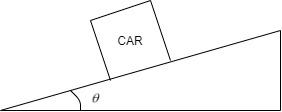
Here, $\theta $ is called the angle of banking, through which the outer edge of the road is raised.
The minimum velocity required to be maintained without the banking is –
$v^2 = rg$
where r = radius of curvature, g = acceleration due to gravity.
Now, if the banking is provided, we get
$v^2 = rg\tan \theta $
where $\theta $ is called the angle of banking.
Given, velocity, $v = 18kmph = 18 \times \dfrac{5}{{18}} = 5m{s^{ - 1}}$
Radius of the turn, $r = 10m$
Acceleration due to gravity, $g = 10m{s^{ - 2}}$
Substituting the values, we get
$\Rightarrow v^2 = rg\tan \theta $
$\Rightarrow {5^2} = 10 \times 10 \times \tan \theta $
$\Rightarrow \tan \theta = \dfrac{{25}}{{100}} = \dfrac{1}{4} $
$\therefore \theta = {\tan ^{ - 1}}\left( {\dfrac{1}{4}} \right) $
Therefore, the correct option is Option A.
Note:
Now, let us see the case if there was no banking in the road. Then, the minimum velocity to be maintained will be equal to :
$v^2 = rg = 10 \times 10 = 100 $
$\Rightarrow v = 10m{s^{ - 1}} = \dfrac{{18}}{5} \times 10 = 18 \times 2 = 36kmph $
Here, we can see that without the banking, the vehicle would have to maintain a higher speed of limit to avoid the overturning.
Complete step by step answer:
We have seen the definition of the term banking of roads. But we need to understand the necessity of banking the roads.
When the vehicle is moving on a flat curved road, there is a centripetal force acting on the vehicle when it is moving in the circular path. But still, the car moves in the circular path without deviating. However, if the velocity crosses beyond a limit, the centripetal force overpowers and the car deviates from the circular path and moves towards the center.
The best way to avoid this incident is by decreasing the vehicle speed around the corner.
However, it is not always practical to decrease the speed around the corners in cases like highways where the cars will be at a very high speed. Hence, it is advisable to increase the speed limit without altering the curvature of the road.
This can be done by the process of banking wherein the outer edge is raised above the inner edge by an angle called the angle of banking.
Here, $\theta $ is called the angle of banking, through which the outer edge of the road is raised.
The minimum velocity required to be maintained without the banking is –
$v^2 = rg$
where r = radius of curvature, g = acceleration due to gravity.
Now, if the banking is provided, we get
$v^2 = rg\tan \theta $
where $\theta $ is called the angle of banking.
Given, velocity, $v = 18kmph = 18 \times \dfrac{5}{{18}} = 5m{s^{ - 1}}$
Radius of the turn, $r = 10m$
Acceleration due to gravity, $g = 10m{s^{ - 2}}$
Substituting the values, we get
$\Rightarrow v^2 = rg\tan \theta $
$\Rightarrow {5^2} = 10 \times 10 \times \tan \theta $
$\Rightarrow \tan \theta = \dfrac{{25}}{{100}} = \dfrac{1}{4} $
$\therefore \theta = {\tan ^{ - 1}}\left( {\dfrac{1}{4}} \right) $
Therefore, the correct option is Option A.
Note:
Now, let us see the case if there was no banking in the road. Then, the minimum velocity to be maintained will be equal to :
$v^2 = rg = 10 \times 10 = 100 $
$\Rightarrow v = 10m{s^{ - 1}} = \dfrac{{18}}{5} \times 10 = 18 \times 2 = 36kmph $
Here, we can see that without the banking, the vehicle would have to maintain a higher speed of limit to avoid the overturning.
Recently Updated Pages
Three beakers labelled as A B and C each containing 25 mL of water were taken A small amount of NaOH anhydrous CuSO4 and NaCl were added to the beakers A B and C respectively It was observed that there was an increase in the temperature of the solutions contained in beakers A and B whereas in case of beaker C the temperature of the solution falls Which one of the following statements isarecorrect i In beakers A and B exothermic process has occurred ii In beakers A and B endothermic process has occurred iii In beaker C exothermic process has occurred iv In beaker C endothermic process has occurred

Master Class 11 Social Science: Engaging Questions & Answers for Success
Master Class 11 Physics: Engaging Questions & Answers for Success
Master Class 11 Maths: Engaging Questions & Answers for Success
Master Class 11 Economics: Engaging Questions & Answers for Success
Master Class 11 Computer Science: Engaging Questions & Answers for Success
Three beakers labelled as A B and C each containing 25 mL of water were taken A small amount of NaOH anhydrous CuSO4 and NaCl were added to the beakers A B and C respectively It was observed that there was an increase in the temperature of the solutions contained in beakers A and B whereas in case of beaker C the temperature of the solution falls Which one of the following statements isarecorrect i In beakers A and B exothermic process has occurred ii In beakers A and B endothermic process has occurred iii In beaker C exothermic process has occurred iv In beaker C endothermic process has occurred
Master Class 11 Social Science: Engaging Questions & Answers for Success
Master Class 11 Physics: Engaging Questions & Answers for Success
Trending doubts
One Metric ton is equal to kg A 10000 B 1000 C 100 class 11 physics CBSE
There are 720 permutations of the digits 1 2 3 4 5 class 11 maths CBSE
State and prove Bernoullis theorem class 11 physics CBSE
Draw a diagram of a plant cell and label at least eight class 11 biology CBSE
Difference Between Prokaryotic Cells and Eukaryotic Cells
1 Quintal is equal to a 110 kg b 10 kg c 100kg d 1000 class 11 physics CBSE