




A parabola is drawn such that each vertex of a given triangle is the pole of the opposite side; show that the focus of the parabola lies on the nine point circle of the triangle and that the orthocentre of the triangle formed by joining the middle points of the sides line on the directrix.
Answer
 Verified
665.4k+ views
Hint: The circle circumscribing the triangle is joined by the middle point of the sides forming a $9$ point circle of triangle. Use the mid-point theorem and form the equation of line. By simplifying you will get an equation similar to $y=mx+c$.
Complete step-by-step solution -
The circle circumscribing the triangle is formed by joining the middle points of the sides of six of the given triangle and this will form a $9$ point circle of the triangle.
The circle circumscribing the triangle is formed by $3$ tangent on the parabola, which always passes through the focus of parabola.
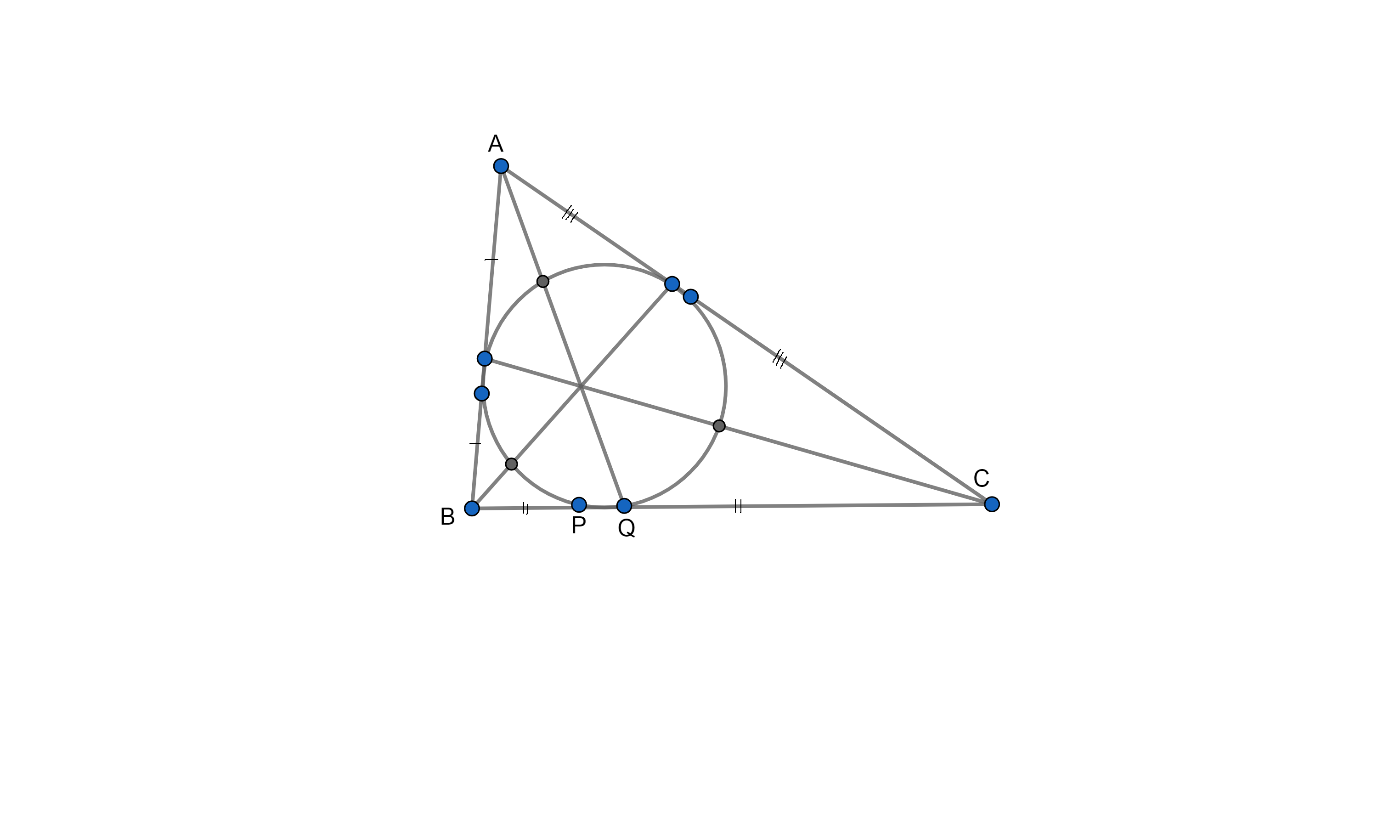
In geometry, the $9$point circle is a circle that can be constructed for any given triangle.
The $9$ points are
(i) Midpoint of each side of the triangle
(ii) The foot of each attitude
(iii) The mid point of the line segment from each vertex of the triangle to the orthocentre.
Now in this question we have to prove that the lines joining the midpoints of the given triangle are tangents on the parabola.
We know the equation of parabola $\Rightarrow {{y}^{2}}=4ax.................\left( 1 \right)$
The given triangle is $ABC$. Let $PQ$ be the chord of contact of $A$ w.r.t to equation $\left( 1 \right)$
Let $BC$ be the polar of $A$ w.r.t equation $\left( 1 \right)$
$\therefore BC$ and $PQ$ must lie on the same line.
i.e. the line joining the mid points of $AP$ and $AQ$ also passes through the mid point of $AB$ and $AC$
Let us consider the coordinates of $P$ and $Q$ as $\left( a{{t}_{1}}^{2},2a{{t}_{1}} \right)$ and $\left( a{{t}_{2}}^{2},2a{{t}_{2}} \right)$ respectively, so that the coordinates of the point of intersection of the tangents $P$ and $Q$are $\left[ a{{t}_{1}}{{t}_{2}},a\left( {{t}_{1}}+{{t}_{2}} \right) \right]$
$\therefore $ Mid point of \[AP\Rightarrow \text{where }A\left( \underset{{{x}_{1}}}{\mathop{a{{t}_{1}}^{2}}}\,,\underset{{{y}_{1}}}{\mathop{2a{{t}_{1}}}}\, \right)\]
\[P\left( \underset{{{x}_{2}}}{\mathop{a{{t}_{1}}{{t}_{2}}}}\,,\underset{{{y}_{2}}}{\mathop{a\left( {{t}_{1}}+{{t}_{2}} \right)}}\, \right)\]
Formula of mid point theorem $\left( \dfrac{{{x}_{1}}+{{x}_{2}}}{2},\dfrac{{{y}_{1}}+{{y}_{2}}}{2} \right)$
$\therefore $ Midpoint of $AP\Rightarrow \left[ \dfrac{a{{t}_{1}}^{2}+a{{t}_{1}}{{t}_{2}}}{2},\dfrac{2a{{t}_{1}}+a\left( {{t}_{1}}+{{t}_{2}} \right)}{2} \right]$
Simplifying the above coordinate $=\left\{ \dfrac{a{{t}_{1}}\left( {{t}_{1}}+{{t}_{2}} \right)}{2},\dfrac{a\left( 3{{t}_{1}}+{{t}_{2}} \right)}{2} \right\}$
Similarly the coordinates of midpoint of $AQ$
$A\left( \underset{{{x}_{1}}}{\mathop{a{{t}_{2}}^{2}}}\,,\underset{{{y}_{1}}}{\mathop{2a{{t}_{2}}}}\, \right)\text{ and Q}\left( \underset{{{x}_{2}}}{\mathop{a{{t}_{1}}{{t}_{2}}}}\,,\underset{{{y}_{2}}}{\mathop{2\left( {{t}_{1}}{{t}_{2}} \right)}}\, \right)$
Midpoint of $AQ=\left\{ \dfrac{a{{t}_{2}}\left( {{t}_{1}}+{{t}_{2}} \right)}{2},\dfrac{a\left( {{t}_{1}}+3{{t}_{2}} \right)}{2} \right\}$
$\begin{align}
& \left( {{x}_{1}}{{y}_{1}} \right)=\left[ \dfrac{a{{t}_{1}}\left( {{t}_{1}}+{{t}_{2}} \right)}{2},\dfrac{a\left( 3{{t}_{1}}+{{t}_{2}} \right)}{2} \right]..................\left( 2 \right) \\
& \left( {{x}_{2}}{{y}_{2}} \right)=\left[ \dfrac{a{{t}_{2}}\left( {{t}_{1}}+{{t}_{2}} \right)}{2},\dfrac{a\left( {{t}_{1}}+3{{t}_{2}} \right)}{2} \right]...................\left( 3 \right) \\
\end{align}$
Now by using equation of line formula $\dfrac{y-{{y}_{1}}}{x-{{x}_{1}}}=\dfrac{{{y}_{1}}-{{y}_{2}}}{{{x}_{1}}-{{x}_{2}}}$
$\Rightarrow y-{{y}_{1}}=\left( \dfrac{{{y}_{1}}-{{y}_{2}}}{{{x}_{1}}-{{x}_{2}}} \right)\left( x-{{x}_{1}} \right)................\left( 4 \right)$
Now substituting the values of $\left( 2 \right)\text{ and }\left( 3 \right)\text{ in }\left( 4 \right)$
$y-\left[ \dfrac{a\left( 3{{t}_{1}}+{{t}_{2}} \right)}{2} \right]=\left( \dfrac{\dfrac{a\left( 3{{t}_{1}}+{{t}_{2}} \right)}{2}-\dfrac{a\left( {{t}_{1}}+3{{t}_{2}} \right)}{2}}{\dfrac{a{{t}_{1}}\left( {{t}_{1}}+{{t}_{2}} \right)}{2}-\dfrac{a{{t}_{2}}\left( {{t}_{1}}+{{t}_{2}} \right)}{2}} \right)\left[ x-\dfrac{a{{t}_{1}}\left( {{t}_{1}}+{{t}_{2}} \right)}{2} \right]$
Simplifying and cancelling out like terms:
$y-\dfrac{a\left( 3{{t}_{1}}+{{t}_{2}} \right)}{2}=\left( \dfrac{3a{{t}_{1}}+a{{t}_{2}}-a{{t}_{1}}-3a{{t}_{2}}}{a{{t}_{1}}^{2}+a{{t}_{1}}{{t}_{2}}-a{{t}_{1}}{{t}_{2}}-a{{t}_{2}}^{2}} \right)\left\{ x-\dfrac{a{{t}_{1}}\left( {{t}_{1}}+{{t}_{2}} \right)}{2} \right\}$
$y-\dfrac{a\left( 3{{t}_{1}}+{{t}_{2}} \right)}{2}=\left( \dfrac{2a{{t}_{1}}-2a{{t}_{2}}}{a{{t}_{1}}^{2}-a{{t}_{2}}^{2}} \right)\left\{ x-\dfrac{a{{t}_{1}}\left( {{t}_{1}}+{{t}_{2}} \right)}{2} \right\}$(cancel out like terms)
\[\begin{align}
& \Rightarrow y-\dfrac{a\left( 3{{t}_{1}}+{{t}_{2}} \right)}{2}=\left( \dfrac{1}{{{t}_{1}}+{{t}_{2}}} \right)\left\{ x-\dfrac{a{{t}_{1}}\left( {{t}_{1}}+{{t}_{2}} \right)}{2} \right\} \\
& \left[ \because {{a}^{2}}-{{b}^{2}}=\left( a+b \right)\left( a-b \right) \right] \\
& y=\dfrac{a\left( 3{{t}_{1}}+{{t}_{2}} \right)}{2}+\dfrac{x}{{{t}_{1}}+{{t}_{2}}}-\dfrac{a{{t}_{1}}}{2} \\
& y=\dfrac{3a{{t}_{1}}-a{{t}_{1}}}{2}+\dfrac{a{{t}_{2}}}{2}+\dfrac{x}{{{t}_{1}}+{{t}_{2}}}\Rightarrow y=a{{t}_{1}}+\dfrac{a{{t}_{2}}}{2}+\dfrac{x}{{{t}_{1}}+{{t}_{2}}} \\
& y=\dfrac{a\left( 2{{t}_{1}}+{{t}_{2}} \right)}{2}+\dfrac{x}{{{t}_{1}}+{{t}_{2}}} \\
\end{align}\]
Now this equation is of the form $\Rightarrow y=mx+c$
And this tangent is on the parabola.
Note: (i) The ortho-centre of the triangle formed by the tangents is on directrix and we have proved that the lines joining the midpoints of the side of the triangle are tangents on parabola.
Hence the ortho-centre of the triangle formed by joining the midpoint of the sides of the triangle lies on directrix of the parabola.
(ii) How to find the coordinates of points of intersection of tangents
$A\left( a{{t}_{1}}^{2},2a{{t}_{1}} \right),B\left( a{{t}_{2}}^{2},2a{{t}_{2}} \right)$
Equation of parabola$\Rightarrow {{y}^{2}}=4ax$
The equation of tangent at ${{t}_{1}}\Rightarrow y{{t}_{1}}=x+a{{t}_{1}}^{2}.................\left( 1 \right)$
Equation of tangent at ${{t}_{2}}\Rightarrow y{{t}_{2}}=x+a{{t}_{2}}^{2}.................\left( 2 \right)$
$\begin{align}
& \left( 1 \right)-\left( 2 \right)\Rightarrow y\left( {{t}_{1}}-{{t}_{2}} \right)=a\left( {{t}_{1}}^{2}-{{t}_{2}}^{2} \right) \\
& \Rightarrow y\left( {{t}_{1}}-{{t}_{2}} \right)=a\left( {{t}_{1}}-{{t}_{2}} \right)\left( {{t}_{1}}+{{t}_{2}} \right) \\
& \therefore y=a\left( {{t}_{1}}+{{t}_{2}} \right) \\
\end{align}$
From equation $\left( 1 \right)\Rightarrow y{{t}_{1}}=x+a{{t}_{1}}^{2}\Rightarrow a\left( {{t}_{1}}+{{t}_{2}} \right)=x+a{{t}_{1}}^{2}$
$a{{t}_{1}}^{2}+a{{t}_{1}}{{t}_{2}}=x+a{{t}_{1}}^{2}\Rightarrow x=a{{t}_{1}}{{t}_{2}}$
$\therefore $ Point of intersection $=\left( x,y \right)=\left( a{{t}_{1}}{{t}_{2}},a\left( {{t}_{1}}+{{t}_{2}} \right) \right)$
Complete step-by-step solution -
The circle circumscribing the triangle is formed by joining the middle points of the sides of six of the given triangle and this will form a $9$ point circle of the triangle.
The circle circumscribing the triangle is formed by $3$ tangent on the parabola, which always passes through the focus of parabola.
In geometry, the $9$point circle is a circle that can be constructed for any given triangle.
The $9$ points are
(i) Midpoint of each side of the triangle
(ii) The foot of each attitude
(iii) The mid point of the line segment from each vertex of the triangle to the orthocentre.
Now in this question we have to prove that the lines joining the midpoints of the given triangle are tangents on the parabola.
We know the equation of parabola $\Rightarrow {{y}^{2}}=4ax.................\left( 1 \right)$
The given triangle is $ABC$. Let $PQ$ be the chord of contact of $A$ w.r.t to equation $\left( 1 \right)$
Let $BC$ be the polar of $A$ w.r.t equation $\left( 1 \right)$
$\therefore BC$ and $PQ$ must lie on the same line.
i.e. the line joining the mid points of $AP$ and $AQ$ also passes through the mid point of $AB$ and $AC$
Let us consider the coordinates of $P$ and $Q$ as $\left( a{{t}_{1}}^{2},2a{{t}_{1}} \right)$ and $\left( a{{t}_{2}}^{2},2a{{t}_{2}} \right)$ respectively, so that the coordinates of the point of intersection of the tangents $P$ and $Q$are $\left[ a{{t}_{1}}{{t}_{2}},a\left( {{t}_{1}}+{{t}_{2}} \right) \right]$
$\therefore $ Mid point of \[AP\Rightarrow \text{where }A\left( \underset{{{x}_{1}}}{\mathop{a{{t}_{1}}^{2}}}\,,\underset{{{y}_{1}}}{\mathop{2a{{t}_{1}}}}\, \right)\]
\[P\left( \underset{{{x}_{2}}}{\mathop{a{{t}_{1}}{{t}_{2}}}}\,,\underset{{{y}_{2}}}{\mathop{a\left( {{t}_{1}}+{{t}_{2}} \right)}}\, \right)\]
Formula of mid point theorem $\left( \dfrac{{{x}_{1}}+{{x}_{2}}}{2},\dfrac{{{y}_{1}}+{{y}_{2}}}{2} \right)$
$\therefore $ Midpoint of $AP\Rightarrow \left[ \dfrac{a{{t}_{1}}^{2}+a{{t}_{1}}{{t}_{2}}}{2},\dfrac{2a{{t}_{1}}+a\left( {{t}_{1}}+{{t}_{2}} \right)}{2} \right]$
Simplifying the above coordinate $=\left\{ \dfrac{a{{t}_{1}}\left( {{t}_{1}}+{{t}_{2}} \right)}{2},\dfrac{a\left( 3{{t}_{1}}+{{t}_{2}} \right)}{2} \right\}$
Similarly the coordinates of midpoint of $AQ$
$A\left( \underset{{{x}_{1}}}{\mathop{a{{t}_{2}}^{2}}}\,,\underset{{{y}_{1}}}{\mathop{2a{{t}_{2}}}}\, \right)\text{ and Q}\left( \underset{{{x}_{2}}}{\mathop{a{{t}_{1}}{{t}_{2}}}}\,,\underset{{{y}_{2}}}{\mathop{2\left( {{t}_{1}}{{t}_{2}} \right)}}\, \right)$
Midpoint of $AQ=\left\{ \dfrac{a{{t}_{2}}\left( {{t}_{1}}+{{t}_{2}} \right)}{2},\dfrac{a\left( {{t}_{1}}+3{{t}_{2}} \right)}{2} \right\}$
$\begin{align}
& \left( {{x}_{1}}{{y}_{1}} \right)=\left[ \dfrac{a{{t}_{1}}\left( {{t}_{1}}+{{t}_{2}} \right)}{2},\dfrac{a\left( 3{{t}_{1}}+{{t}_{2}} \right)}{2} \right]..................\left( 2 \right) \\
& \left( {{x}_{2}}{{y}_{2}} \right)=\left[ \dfrac{a{{t}_{2}}\left( {{t}_{1}}+{{t}_{2}} \right)}{2},\dfrac{a\left( {{t}_{1}}+3{{t}_{2}} \right)}{2} \right]...................\left( 3 \right) \\
\end{align}$
Now by using equation of line formula $\dfrac{y-{{y}_{1}}}{x-{{x}_{1}}}=\dfrac{{{y}_{1}}-{{y}_{2}}}{{{x}_{1}}-{{x}_{2}}}$
$\Rightarrow y-{{y}_{1}}=\left( \dfrac{{{y}_{1}}-{{y}_{2}}}{{{x}_{1}}-{{x}_{2}}} \right)\left( x-{{x}_{1}} \right)................\left( 4 \right)$
Now substituting the values of $\left( 2 \right)\text{ and }\left( 3 \right)\text{ in }\left( 4 \right)$
$y-\left[ \dfrac{a\left( 3{{t}_{1}}+{{t}_{2}} \right)}{2} \right]=\left( \dfrac{\dfrac{a\left( 3{{t}_{1}}+{{t}_{2}} \right)}{2}-\dfrac{a\left( {{t}_{1}}+3{{t}_{2}} \right)}{2}}{\dfrac{a{{t}_{1}}\left( {{t}_{1}}+{{t}_{2}} \right)}{2}-\dfrac{a{{t}_{2}}\left( {{t}_{1}}+{{t}_{2}} \right)}{2}} \right)\left[ x-\dfrac{a{{t}_{1}}\left( {{t}_{1}}+{{t}_{2}} \right)}{2} \right]$
Simplifying and cancelling out like terms:
$y-\dfrac{a\left( 3{{t}_{1}}+{{t}_{2}} \right)}{2}=\left( \dfrac{3a{{t}_{1}}+a{{t}_{2}}-a{{t}_{1}}-3a{{t}_{2}}}{a{{t}_{1}}^{2}+a{{t}_{1}}{{t}_{2}}-a{{t}_{1}}{{t}_{2}}-a{{t}_{2}}^{2}} \right)\left\{ x-\dfrac{a{{t}_{1}}\left( {{t}_{1}}+{{t}_{2}} \right)}{2} \right\}$
$y-\dfrac{a\left( 3{{t}_{1}}+{{t}_{2}} \right)}{2}=\left( \dfrac{2a{{t}_{1}}-2a{{t}_{2}}}{a{{t}_{1}}^{2}-a{{t}_{2}}^{2}} \right)\left\{ x-\dfrac{a{{t}_{1}}\left( {{t}_{1}}+{{t}_{2}} \right)}{2} \right\}$(cancel out like terms)
\[\begin{align}
& \Rightarrow y-\dfrac{a\left( 3{{t}_{1}}+{{t}_{2}} \right)}{2}=\left( \dfrac{1}{{{t}_{1}}+{{t}_{2}}} \right)\left\{ x-\dfrac{a{{t}_{1}}\left( {{t}_{1}}+{{t}_{2}} \right)}{2} \right\} \\
& \left[ \because {{a}^{2}}-{{b}^{2}}=\left( a+b \right)\left( a-b \right) \right] \\
& y=\dfrac{a\left( 3{{t}_{1}}+{{t}_{2}} \right)}{2}+\dfrac{x}{{{t}_{1}}+{{t}_{2}}}-\dfrac{a{{t}_{1}}}{2} \\
& y=\dfrac{3a{{t}_{1}}-a{{t}_{1}}}{2}+\dfrac{a{{t}_{2}}}{2}+\dfrac{x}{{{t}_{1}}+{{t}_{2}}}\Rightarrow y=a{{t}_{1}}+\dfrac{a{{t}_{2}}}{2}+\dfrac{x}{{{t}_{1}}+{{t}_{2}}} \\
& y=\dfrac{a\left( 2{{t}_{1}}+{{t}_{2}} \right)}{2}+\dfrac{x}{{{t}_{1}}+{{t}_{2}}} \\
\end{align}\]
Now this equation is of the form $\Rightarrow y=mx+c$
And this tangent is on the parabola.
Note: (i) The ortho-centre of the triangle formed by the tangents is on directrix and we have proved that the lines joining the midpoints of the side of the triangle are tangents on parabola.
Hence the ortho-centre of the triangle formed by joining the midpoint of the sides of the triangle lies on directrix of the parabola.
(ii) How to find the coordinates of points of intersection of tangents
$A\left( a{{t}_{1}}^{2},2a{{t}_{1}} \right),B\left( a{{t}_{2}}^{2},2a{{t}_{2}} \right)$
Equation of parabola$\Rightarrow {{y}^{2}}=4ax$
The equation of tangent at ${{t}_{1}}\Rightarrow y{{t}_{1}}=x+a{{t}_{1}}^{2}.................\left( 1 \right)$
Equation of tangent at ${{t}_{2}}\Rightarrow y{{t}_{2}}=x+a{{t}_{2}}^{2}.................\left( 2 \right)$
$\begin{align}
& \left( 1 \right)-\left( 2 \right)\Rightarrow y\left( {{t}_{1}}-{{t}_{2}} \right)=a\left( {{t}_{1}}^{2}-{{t}_{2}}^{2} \right) \\
& \Rightarrow y\left( {{t}_{1}}-{{t}_{2}} \right)=a\left( {{t}_{1}}-{{t}_{2}} \right)\left( {{t}_{1}}+{{t}_{2}} \right) \\
& \therefore y=a\left( {{t}_{1}}+{{t}_{2}} \right) \\
\end{align}$
From equation $\left( 1 \right)\Rightarrow y{{t}_{1}}=x+a{{t}_{1}}^{2}\Rightarrow a\left( {{t}_{1}}+{{t}_{2}} \right)=x+a{{t}_{1}}^{2}$
$a{{t}_{1}}^{2}+a{{t}_{1}}{{t}_{2}}=x+a{{t}_{1}}^{2}\Rightarrow x=a{{t}_{1}}{{t}_{2}}$
$\therefore $ Point of intersection $=\left( x,y \right)=\left( a{{t}_{1}}{{t}_{2}},a\left( {{t}_{1}}+{{t}_{2}} \right) \right)$
Recently Updated Pages
If x a + bt + ct2 where x is in meters and t is in class 11 physics CBSE

A car covers the first half distance between two places class 11 physics CBSE
The resultant of two vectors overrightarrow P and overrightarrow class 11 physics CBSE
Find the value of cos 135 class 11 maths CBSE
A mass M is held in place by an applied force F and class 11 physics CBSE
A solution of glucose in water is labelled as 10 dfracwv class 11 chemistry CBSE
Trending doubts
One Metric ton is equal to kg A 10000 B 1000 C 100 class 11 physics CBSE
Find the value of the expression given below sin 30circ class 11 maths CBSE
Draw a diagram of nephron and explain its structur class 11 biology CBSE
10 examples of friction in our daily life
Proton was discovered by A Thomson B Rutherford C Chadwick class 11 chemistry CBSE
Bond order ofO2 O2+ O2 and O22 is in order A O2 langle class 11 chemistry CBSE