




A normal to the hyperbola, \[4{{x}^{2}}-9{{y}^{2}}=36\] meets the coordinate axes x and y at A and B, respectively. If the parallelogram OABP (O being the Origin) is formed, then the locus of P is
(a) \[4{{x}^{2}}-9{{y}^{2}}=121\]
(b) \[4{{x}^{2}}+9{{y}^{2}}=121\]
(c) \[9{{x}^{2}}-4{{y}^{2}}=169\]
(d) \[9{{x}^{2}}+4{{y}^{2}}=169\]
Answer
 Verified
585.6k+ views
Hint: Let us first draw the figure according to the information, using the equation of hyperbola,\[\dfrac{{{x}^{2}}}{{{a}^{2}}}-\dfrac{{{y}^{2}}}{{{b}^{2}}}=1\]. We will find the vertices of hyperbola. Now using the equation of normal on hyperbola is\[\dfrac{ax}{\sec \theta }+\dfrac{by}{\tan \theta }={{a}^{2}}+{{b}^{2}}\].
Complete step-by-step solution:
Find the midpoint of both the diagonal of parallelogram OABP, and using Pythagorean identities,\[1+{{\tan }^{2}}\theta ={{\sec }^{2}}\theta \]. Find the locus of point P.
Let us draw the hyperbola and the normal to the hyperbola such that the normal meets the coordinates axes x and y at A and B respectively.
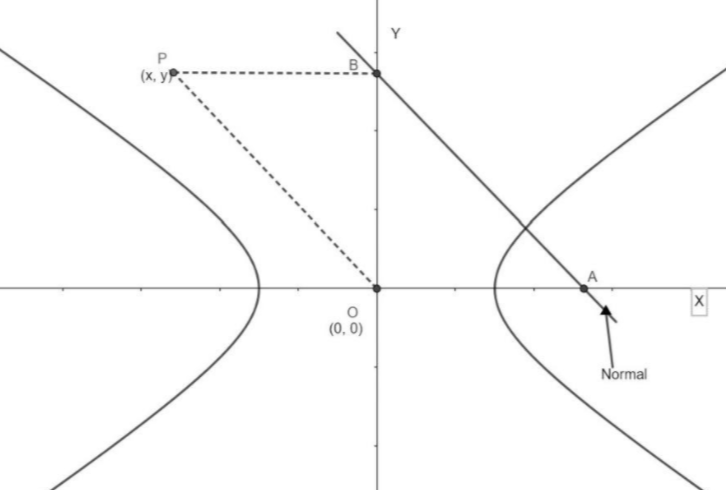
Here from the diagram, we can see that from the hyperbola,
\[4{{x}^{2}}-9{{y}^{2}}=36\] has a normal which intersects x and y axes at a point A and B respectively.
Let us divide the equation by 36 throughout the equation, we get,
\[\begin{align}
& \dfrac{4{{x}^{2}}-9{{y}^{2}}}{36}=\dfrac{36}{36} \\
&\Rightarrow \dfrac{4{{x}^{2}}}{36}-\dfrac{9{{y}^{2}}}{36}=1 \\
&\Rightarrow \dfrac{{{x}^{2}}}{9}-\dfrac{{{y}^{2}}}{4}=1 \\
&\Rightarrow \dfrac{{{x}^{2}}}{{{(3)}^{2}}}-\dfrac{{{y}^{2}}}{{{(2)}^{2}}}=1 \\
\end{align}\]
Let us compare the above equation with \[\dfrac{{{x}^{2}}}{{{a}^{2}}}-\dfrac{{{y}^{2}}}{{{b}^{2}}}=1\]
Which gives us the vertices $(a, 0)$ and $(-a, 0)$
We get,\[{{a}^{2}}={{(3)}^{2}}=9,{{b}^{2}}={{(2)}^{2}}=4\], the vertices (3, 0) and (-3, 0).
We know,
The equation of the normal at the point P \[(a\sec \theta ,b\tan \theta )\] on the hyperbola \[\dfrac{{{x}^{2}}}{{{a}^{2}}}-\dfrac{{{y}^{2}}}{{{b}^{2}}}=1\] is
\[\dfrac{ax}{\sec \theta }+\dfrac{by}{\tan \theta }={{a}^{2}}+{{b}^{2}}\]
Substitute the values of a=3 and b=2 in the above expression.
\[\begin{align}
& \dfrac{3x}{\sec \theta }+\dfrac{2y}{\tan \theta }={{(3)}^{2}}+{{(2)}^{2}} \\
& =9+4 \\
& =13 \\
& \dfrac{3x}{\sec \theta }+\dfrac{2y}{\tan \theta }=13 \\
\end{align}\]
Change the above expression in the form \[\dfrac{x}{a}+\dfrac{y}{b}=1\]
From which we can get the coordinates of point A and B that is (a, 0) and (0, b) respectively.
$ \dfrac{x}{\dfrac{13\sec \theta }{3}}+\dfrac{y}{\dfrac{13\tan \theta }{2}}=1 $
$ A\left( \dfrac{13\sec \theta }{3},0 \right)$ & \[B\left( 0,\dfrac{13\tan \theta }{2} \right)\]
We also know, O is the origin that is (0, 0) and let us consider the locus\[P({{x}_{1}},{{y}_{1}})\].
Let us consider there are diagonals OB and AP of parallelogram OABP. These diagonals bisects each other, hence their midpoints of diagonals are the same.
Therefore, midpoint of OB=midpoint of AP
For midpoint of OB, we have O (0, 0) = \[({{x}_{1}},{{y}_{1}})\]and \[B\left( 0,\dfrac{13\tan \theta }{2} \right)\]= \[({{x}_{2}},{{y}_{2}})\]
Midpoint of OB \[\begin{align}
& =\left( \dfrac{{{x}_{1}}+{{x}_{2}}}{2},\dfrac{{{y}_{1}}+{{y}_{2}}}{2} \right) \\
& =\left( \dfrac{0+0}{2},\dfrac{0+\dfrac{13\tan \theta }{2}}{2} \right) \\
& =\left( 0,\dfrac{13\tan \theta }{4} \right) \\
\end{align}\]
Similarly, midpoint of AP \[\begin{align}
& =\left( \dfrac{\dfrac{13\sec \theta }{3}+{{x}_{1}}}{2},\dfrac{0+{{y}_{1}}}{2} \right) \\
& =\left( \dfrac{13\sec \theta +3{{x}_{1}}}{6},\dfrac{{{y}_{1}}}{2} \right) \\
\end{align}\]
Now, midpoint of OB=midpoint of AP
\[\left( 0,\dfrac{13\tan \theta }{4} \right)\] = \[\left( \dfrac{13\sec \theta +3{{x}_{1}}}{6},\dfrac{{{y}_{1}}}{2} \right)\]
Here we have, by comparing both sides,
0= \[\dfrac{13\sec \theta +3{{x}_{1}}}{6}\]
\[\begin{align}
& 13\sec \theta +3{{x}_{1}}=0 \\
&\Rightarrow 13\sec \theta =-3{{x}_{1}} \\
&\Rightarrow \sec \theta =\dfrac{-3{{x}_{1}}}{13} \\
\end{align}\]
Also,
\[\begin{align}
&\dfrac{13\tan \theta }{4}=\dfrac{{{y}_{1}}}{2} \\
&\Rightarrow \dfrac{13\tan \theta }{2}={{y}_{1}} \\
&\Rightarrow \tan \theta =\dfrac{2{{y}_{1}}}{13} \\
\end{align}\]
We know,
By Pythagorean identities,
\[\begin{align}
& 1+{{\tan }^{2}}\theta ={{\sec }^{2}}\theta \\
&\Rightarrow {{\sec }^{2}}\theta -{{\tan }^{2}}\theta =1 \\
&\Rightarrow {{\left( \dfrac{-3{{x}_{1}}}{13} \right)}^{2}}-{{\left( \dfrac{2{{y}_{1}}}{13} \right)}^{2}}=1 \\
&\Rightarrow \dfrac{9{{x}_{1}}^{2}}{169}-\dfrac{4{{y}_{1}}^{2}}{169}=1 \\
&\Rightarrow 9{{x}_{1}}^{2}-4{{y}_{1}}^{2}=169 \\
\end{align}\]
\[\therefore \] Therefore, the locus of point P is \[9{{x}_{1}}^{2}-4{{y}_{1}}^{2}=169\]
Note: Here, the diagram mentions the normal to the hyperbola, the line drawn is perpendicular to the curve in the 1st quadrant. Thus, in this question drawing the figure according to the conditions mentioned becomes one of the most significant steps. A quick revision of trigonometric identities and trigonometric formulas will always help in solving the questions related to geometry or trigonometry. Hyperbola is a conic section in which the difference of distances of all the points from two fixed points (called ‘foci’) is constant.
Complete step-by-step solution:
Find the midpoint of both the diagonal of parallelogram OABP, and using Pythagorean identities,\[1+{{\tan }^{2}}\theta ={{\sec }^{2}}\theta \]. Find the locus of point P.
Let us draw the hyperbola and the normal to the hyperbola such that the normal meets the coordinates axes x and y at A and B respectively.
Here from the diagram, we can see that from the hyperbola,
\[4{{x}^{2}}-9{{y}^{2}}=36\] has a normal which intersects x and y axes at a point A and B respectively.
Let us divide the equation by 36 throughout the equation, we get,
\[\begin{align}
& \dfrac{4{{x}^{2}}-9{{y}^{2}}}{36}=\dfrac{36}{36} \\
&\Rightarrow \dfrac{4{{x}^{2}}}{36}-\dfrac{9{{y}^{2}}}{36}=1 \\
&\Rightarrow \dfrac{{{x}^{2}}}{9}-\dfrac{{{y}^{2}}}{4}=1 \\
&\Rightarrow \dfrac{{{x}^{2}}}{{{(3)}^{2}}}-\dfrac{{{y}^{2}}}{{{(2)}^{2}}}=1 \\
\end{align}\]
Let us compare the above equation with \[\dfrac{{{x}^{2}}}{{{a}^{2}}}-\dfrac{{{y}^{2}}}{{{b}^{2}}}=1\]
Which gives us the vertices $(a, 0)$ and $(-a, 0)$
We get,\[{{a}^{2}}={{(3)}^{2}}=9,{{b}^{2}}={{(2)}^{2}}=4\], the vertices (3, 0) and (-3, 0).
We know,
The equation of the normal at the point P \[(a\sec \theta ,b\tan \theta )\] on the hyperbola \[\dfrac{{{x}^{2}}}{{{a}^{2}}}-\dfrac{{{y}^{2}}}{{{b}^{2}}}=1\] is
\[\dfrac{ax}{\sec \theta }+\dfrac{by}{\tan \theta }={{a}^{2}}+{{b}^{2}}\]
Substitute the values of a=3 and b=2 in the above expression.
\[\begin{align}
& \dfrac{3x}{\sec \theta }+\dfrac{2y}{\tan \theta }={{(3)}^{2}}+{{(2)}^{2}} \\
& =9+4 \\
& =13 \\
& \dfrac{3x}{\sec \theta }+\dfrac{2y}{\tan \theta }=13 \\
\end{align}\]
Change the above expression in the form \[\dfrac{x}{a}+\dfrac{y}{b}=1\]
From which we can get the coordinates of point A and B that is (a, 0) and (0, b) respectively.
$ \dfrac{x}{\dfrac{13\sec \theta }{3}}+\dfrac{y}{\dfrac{13\tan \theta }{2}}=1 $
$ A\left( \dfrac{13\sec \theta }{3},0 \right)$ & \[B\left( 0,\dfrac{13\tan \theta }{2} \right)\]
We also know, O is the origin that is (0, 0) and let us consider the locus\[P({{x}_{1}},{{y}_{1}})\].
Let us consider there are diagonals OB and AP of parallelogram OABP. These diagonals bisects each other, hence their midpoints of diagonals are the same.
Therefore, midpoint of OB=midpoint of AP
For midpoint of OB, we have O (0, 0) = \[({{x}_{1}},{{y}_{1}})\]and \[B\left( 0,\dfrac{13\tan \theta }{2} \right)\]= \[({{x}_{2}},{{y}_{2}})\]
Midpoint of OB \[\begin{align}
& =\left( \dfrac{{{x}_{1}}+{{x}_{2}}}{2},\dfrac{{{y}_{1}}+{{y}_{2}}}{2} \right) \\
& =\left( \dfrac{0+0}{2},\dfrac{0+\dfrac{13\tan \theta }{2}}{2} \right) \\
& =\left( 0,\dfrac{13\tan \theta }{4} \right) \\
\end{align}\]
Similarly, midpoint of AP \[\begin{align}
& =\left( \dfrac{\dfrac{13\sec \theta }{3}+{{x}_{1}}}{2},\dfrac{0+{{y}_{1}}}{2} \right) \\
& =\left( \dfrac{13\sec \theta +3{{x}_{1}}}{6},\dfrac{{{y}_{1}}}{2} \right) \\
\end{align}\]
Now, midpoint of OB=midpoint of AP
\[\left( 0,\dfrac{13\tan \theta }{4} \right)\] = \[\left( \dfrac{13\sec \theta +3{{x}_{1}}}{6},\dfrac{{{y}_{1}}}{2} \right)\]
Here we have, by comparing both sides,
0= \[\dfrac{13\sec \theta +3{{x}_{1}}}{6}\]
\[\begin{align}
& 13\sec \theta +3{{x}_{1}}=0 \\
&\Rightarrow 13\sec \theta =-3{{x}_{1}} \\
&\Rightarrow \sec \theta =\dfrac{-3{{x}_{1}}}{13} \\
\end{align}\]
Also,
\[\begin{align}
&\dfrac{13\tan \theta }{4}=\dfrac{{{y}_{1}}}{2} \\
&\Rightarrow \dfrac{13\tan \theta }{2}={{y}_{1}} \\
&\Rightarrow \tan \theta =\dfrac{2{{y}_{1}}}{13} \\
\end{align}\]
We know,
By Pythagorean identities,
\[\begin{align}
& 1+{{\tan }^{2}}\theta ={{\sec }^{2}}\theta \\
&\Rightarrow {{\sec }^{2}}\theta -{{\tan }^{2}}\theta =1 \\
&\Rightarrow {{\left( \dfrac{-3{{x}_{1}}}{13} \right)}^{2}}-{{\left( \dfrac{2{{y}_{1}}}{13} \right)}^{2}}=1 \\
&\Rightarrow \dfrac{9{{x}_{1}}^{2}}{169}-\dfrac{4{{y}_{1}}^{2}}{169}=1 \\
&\Rightarrow 9{{x}_{1}}^{2}-4{{y}_{1}}^{2}=169 \\
\end{align}\]
\[\therefore \] Therefore, the locus of point P is \[9{{x}_{1}}^{2}-4{{y}_{1}}^{2}=169\]
Note: Here, the diagram mentions the normal to the hyperbola, the line drawn is perpendicular to the curve in the 1st quadrant. Thus, in this question drawing the figure according to the conditions mentioned becomes one of the most significant steps. A quick revision of trigonometric identities and trigonometric formulas will always help in solving the questions related to geometry or trigonometry. Hyperbola is a conic section in which the difference of distances of all the points from two fixed points (called ‘foci’) is constant.
Recently Updated Pages
Master Class 11 Computer Science: Engaging Questions & Answers for Success

Master Class 11 Business Studies: Engaging Questions & Answers for Success
Master Class 11 Economics: Engaging Questions & Answers for Success
Master Class 11 English: Engaging Questions & Answers for Success
Master Class 11 Maths: Engaging Questions & Answers for Success
Master Class 11 Biology: Engaging Questions & Answers for Success
Trending doubts
One Metric ton is equal to kg A 10000 B 1000 C 100 class 11 physics CBSE
There are 720 permutations of the digits 1 2 3 4 5 class 11 maths CBSE
Discuss the various forms of bacteria class 11 biology CBSE
Draw a diagram of a plant cell and label at least eight class 11 biology CBSE
State the laws of reflection of light
Explain zero factorial class 11 maths CBSE