




A normal is drawn at a point$S(x,y)$ of a curve. It meets the $x$-axis at$R$. If $SR$ is of constant length$\lambda $. If the curve passing through$(0,\lambda )$then its equation is
a)A circle with radius$\lambda $
b)An ellipse
c)A hyperbola
d)A parabola
Answer
 Verified
634.5k+ views
Hint: Take a point on$R$and find the distance between$SR$and you will get two equations. Find the value of $(x-h)$ and substitute it. So integrate the two equations you will get the equation of the curve.
Complete step-by-step answer:
Now it is mentioned in the question that a normal is drawn at a point$S(x,y)$of a curve and meets $x$-axis at $R$. So you can see below we had assumed a curve, and a normal drawn at point$S(x,y)$.
So it is given in question that $l(SR)=\lambda $.
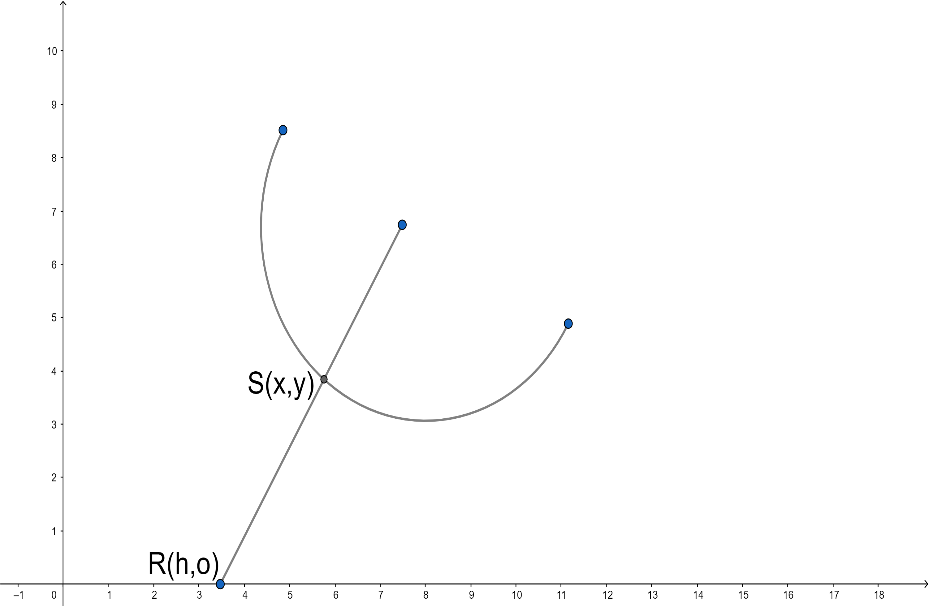
Now we have considered a point$R$on $x$-axis such that $R(h,0)$,
Now we have to find that the curve is of which type,
So, now we should find the distance of $SR,$ to find the distance of $SR$let us use distance formula,
Given the two points$({{x}_{1}},{{y}_{1}})$and$({{x}_{2}},{{y}_{2}})$, the distance d between these points is given by the distance formula,
$d=\sqrt{{{({{x}_{2}}-{{x}_{1}})}^{2}}+{{({{y}_{2}}-{{y}_{1}})}^{2}}}$
They only indicate that there is a "first" point and a "second" point; that is, that you have two points. Whichever one you call "first" or "second" is up to you. The distance will be the same, regardless.
Using distance formula to find distance for$SR,$i.e., points are$(x,y)$and$(h,0)$, we get
\[d(SR)=\sqrt{{{(x-h)}^{2}}+{{(y-0)}^{2}}}\]
\[d(SR)=\sqrt{{{(x-h)}^{2}}+{{y}^{2}}}\]
So, substituting$l(SR)=d(SR)=\lambda $in above we get,
\[\lambda =\sqrt{{{(x-h)}^{2}}+{{y}^{2}}}\]
Squaring both sides we get,
\[{{\lambda }^{2}}={{(x-h)}^{2}}+{{y}^{2}}\]
Now rearranging we get,
\[{{(x-h)}^{2}}+{{y}^{2}}={{\lambda }^{2}}\] ………..(1)
Now let us find the value of$(x-h)$, from above equation we get the value of$(x-h)$,
\[(x-h)=\pm \sqrt{{{\lambda }^{2}}-{{y}^{2}}}\]………… (2)
Now differentiating equation (1) w.r.t $x$ we get,
$2(x-h)+2y{{y}^{'}}=0$
Now dividing above equation by $2$ we get,
$(x-h)+y{{y}^{'}}=0$
$(x-h)=-y{{y}^{'}}$
So, from equation (2), we get,
$\pm \sqrt{{{\lambda }^{2}}-{{y}^{2}}}=-y{{y}^{'}}$
So simplifying we get,
$\pm \sqrt{{{\lambda }^{2}}-{{y}^{2}}}=y{{y}^{'}}$
Now there are two conditions, i.e., $\sqrt{{{\lambda }^{2}}-{{y}^{2}}}=y{{y}^{'}}$ and
$-\sqrt{{{\lambda }^{2}}-{{y}^{2}}}=y{{y}^{'}}$,
Now consider,
$\sqrt{{{\lambda }^{2}}-{{y}^{2}}}=y{{y}^{'}}$
So putting integration on both sides, ${{y}^{'}}=\dfrac{dy}{dx}$ we get,
\[\begin{align}
& \int{\sqrt{{{\lambda }^{2}}-{{y}^{2}}}}=\int{y\dfrac{dy}{dx}} \\
& \int{\dfrac{y}{\sqrt{{{\lambda }^{2}}-{{y}^{2}}}}}dy=\int{dx} \\
\end{align}\]
Now simplifying we get,
\[-\dfrac{1}{2}\int{\dfrac{-2y}{\sqrt{{{\lambda }^{2}}-{{y}^{2}}}}}dy=\int{dx}\]
So, taking \[{{\lambda }^{2}}-{{y}^{2}}=t\], and differentiating we get,
\[-2ydy=dt\]
\[-\dfrac{1}{2}\int{\dfrac{dt}{\sqrt{t}}}=\int{dx}\] ………………(We
know$\int{\dfrac{1}{\sqrt{x}}}dx=2\left[ {{x}^{\dfrac{1}{2}}} \right]+c$)
So simplifying we get,
\[-\dfrac{1}{2}\left[ \dfrac{{{t}^{\dfrac{1}{2}}}}{\dfrac{1}{2}} \right]=x+c\]
\[-{{t}^{\dfrac{1}{2}}}=x+c\]
Now replacing value of $t$, we get,
\[-\sqrt{{{\lambda }^{2}}-{{y}^{2}}}=x+c\]
Now it is given, in question that it passes through $(0,\lambda )$, so substituting we get,
\[\begin{align}
& -\sqrt{{{\lambda }^{2}}-{{\lambda }^{2}}}=0+c \\
& c=0 \\
\end{align}\],
So we get the equation as,
\[-\sqrt{{{\lambda }^{2}}-{{y}^{2}}}=x\]
Squaring both sides we get,
\[{{\lambda }^{2}}-{{y}^{2}}={{x}^{2}}\]
Now rearranging we get,
\[{{x}^{2}}+{{y}^{2}}={{\lambda }^{2}}\] ………………. (2)
So now taking$-\sqrt{{{\lambda }^{2}}-{{y}^{2}}}=y{{y}^{'}}$
So integrating both sides, we get,
\[\begin{align}
& -\int{\sqrt{{{\lambda }^{2}}-{{y}^{2}}}}=\int{y\dfrac{dy}{dx}} \\
& -\int{\dfrac{y}{\sqrt{{{\lambda }^{2}}-{{y}^{2}}}}}dy=\int{dx} \\
\end{align}\]
So now simplifying we get,
\[\dfrac{1}{2}\int{\dfrac{-2y}{\sqrt{{{\lambda }^{2}}-{{y}^{2}}}}}dy=\int{dx}\]
So taking\[{{\lambda }^{2}}-{{y}^{2}}=t\], and differentiating we get,
\[-2ydy=dt\]
\[\dfrac{1}{2}\int{\dfrac{dt}{\sqrt{t}}}=\int{dx}\]
So simplifying we get,
\[\dfrac{1}{2}\left[ \dfrac{{{t}^{\dfrac{1}{2}}}}{\dfrac{1}{2}} \right]=x+c\]
\[{{t}^{\dfrac{1}{2}}}=x+c\]
Now replacing value of $t$, we get,
\[\sqrt{{{\lambda }^{2}}-{{y}^{2}}}=x+c\]
Now it is given, in question that it passes through$(0,\lambda )$.so substituting we get,
\[\begin{align}
& \sqrt{{{\lambda }^{2}}-{{\lambda }^{2}}}=0+c \\
& c=0 \\
\end{align}\],
We get the equation as,
\[\sqrt{{{\lambda }^{2}}-{{y}^{2}}}=x\]
Squaring both sides we get,
\[{{\lambda }^{2}}-{{y}^{2}}={{x}^{2}}\]
On rearranging we get,
\[{{x}^{2}}+{{y}^{2}}={{\lambda }^{2}}\] ………………. (3)
From (2) and (3), we get the same equation. The equation of curve as,
\[{{x}^{2}}+{{y}^{2}}={{\lambda }^{2}}\]
The equation we can see is the equation of the circle with radius $\lambda $.
So, we get the correct answer as option (a).
Note: Read the question carefully. Use distance formulas in the proper manner. Assumption of point $R$ is necessary. Be familiar with the integration. You should also know the integration. Also necessary substitution is done, don't confuse yourself while solving or integrating. After this \[\sqrt{{{\lambda }^{2}}-{{y}^{2}}}=x+c\] don’t forget to find the value of $c$, for that don’t forget to substitute $(0,\lambda )$.
Complete step-by-step answer:
Now it is mentioned in the question that a normal is drawn at a point$S(x,y)$of a curve and meets $x$-axis at $R$. So you can see below we had assumed a curve, and a normal drawn at point$S(x,y)$.
So it is given in question that $l(SR)=\lambda $.
Now we have considered a point$R$on $x$-axis such that $R(h,0)$,
Now we have to find that the curve is of which type,
So, now we should find the distance of $SR,$ to find the distance of $SR$let us use distance formula,
Given the two points$({{x}_{1}},{{y}_{1}})$and$({{x}_{2}},{{y}_{2}})$, the distance d between these points is given by the distance formula,
$d=\sqrt{{{({{x}_{2}}-{{x}_{1}})}^{2}}+{{({{y}_{2}}-{{y}_{1}})}^{2}}}$
They only indicate that there is a "first" point and a "second" point; that is, that you have two points. Whichever one you call "first" or "second" is up to you. The distance will be the same, regardless.
Using distance formula to find distance for$SR,$i.e., points are$(x,y)$and$(h,0)$, we get
\[d(SR)=\sqrt{{{(x-h)}^{2}}+{{(y-0)}^{2}}}\]
\[d(SR)=\sqrt{{{(x-h)}^{2}}+{{y}^{2}}}\]
So, substituting$l(SR)=d(SR)=\lambda $in above we get,
\[\lambda =\sqrt{{{(x-h)}^{2}}+{{y}^{2}}}\]
Squaring both sides we get,
\[{{\lambda }^{2}}={{(x-h)}^{2}}+{{y}^{2}}\]
Now rearranging we get,
\[{{(x-h)}^{2}}+{{y}^{2}}={{\lambda }^{2}}\] ………..(1)
Now let us find the value of$(x-h)$, from above equation we get the value of$(x-h)$,
\[(x-h)=\pm \sqrt{{{\lambda }^{2}}-{{y}^{2}}}\]………… (2)
Now differentiating equation (1) w.r.t $x$ we get,
$2(x-h)+2y{{y}^{'}}=0$
Now dividing above equation by $2$ we get,
$(x-h)+y{{y}^{'}}=0$
$(x-h)=-y{{y}^{'}}$
So, from equation (2), we get,
$\pm \sqrt{{{\lambda }^{2}}-{{y}^{2}}}=-y{{y}^{'}}$
So simplifying we get,
$\pm \sqrt{{{\lambda }^{2}}-{{y}^{2}}}=y{{y}^{'}}$
Now there are two conditions, i.e., $\sqrt{{{\lambda }^{2}}-{{y}^{2}}}=y{{y}^{'}}$ and
$-\sqrt{{{\lambda }^{2}}-{{y}^{2}}}=y{{y}^{'}}$,
Now consider,
$\sqrt{{{\lambda }^{2}}-{{y}^{2}}}=y{{y}^{'}}$
So putting integration on both sides, ${{y}^{'}}=\dfrac{dy}{dx}$ we get,
\[\begin{align}
& \int{\sqrt{{{\lambda }^{2}}-{{y}^{2}}}}=\int{y\dfrac{dy}{dx}} \\
& \int{\dfrac{y}{\sqrt{{{\lambda }^{2}}-{{y}^{2}}}}}dy=\int{dx} \\
\end{align}\]
Now simplifying we get,
\[-\dfrac{1}{2}\int{\dfrac{-2y}{\sqrt{{{\lambda }^{2}}-{{y}^{2}}}}}dy=\int{dx}\]
So, taking \[{{\lambda }^{2}}-{{y}^{2}}=t\], and differentiating we get,
\[-2ydy=dt\]
\[-\dfrac{1}{2}\int{\dfrac{dt}{\sqrt{t}}}=\int{dx}\] ………………(We
know$\int{\dfrac{1}{\sqrt{x}}}dx=2\left[ {{x}^{\dfrac{1}{2}}} \right]+c$)
So simplifying we get,
\[-\dfrac{1}{2}\left[ \dfrac{{{t}^{\dfrac{1}{2}}}}{\dfrac{1}{2}} \right]=x+c\]
\[-{{t}^{\dfrac{1}{2}}}=x+c\]
Now replacing value of $t$, we get,
\[-\sqrt{{{\lambda }^{2}}-{{y}^{2}}}=x+c\]
Now it is given, in question that it passes through $(0,\lambda )$, so substituting we get,
\[\begin{align}
& -\sqrt{{{\lambda }^{2}}-{{\lambda }^{2}}}=0+c \\
& c=0 \\
\end{align}\],
So we get the equation as,
\[-\sqrt{{{\lambda }^{2}}-{{y}^{2}}}=x\]
Squaring both sides we get,
\[{{\lambda }^{2}}-{{y}^{2}}={{x}^{2}}\]
Now rearranging we get,
\[{{x}^{2}}+{{y}^{2}}={{\lambda }^{2}}\] ………………. (2)
So now taking$-\sqrt{{{\lambda }^{2}}-{{y}^{2}}}=y{{y}^{'}}$
So integrating both sides, we get,
\[\begin{align}
& -\int{\sqrt{{{\lambda }^{2}}-{{y}^{2}}}}=\int{y\dfrac{dy}{dx}} \\
& -\int{\dfrac{y}{\sqrt{{{\lambda }^{2}}-{{y}^{2}}}}}dy=\int{dx} \\
\end{align}\]
So now simplifying we get,
\[\dfrac{1}{2}\int{\dfrac{-2y}{\sqrt{{{\lambda }^{2}}-{{y}^{2}}}}}dy=\int{dx}\]
So taking\[{{\lambda }^{2}}-{{y}^{2}}=t\], and differentiating we get,
\[-2ydy=dt\]
\[\dfrac{1}{2}\int{\dfrac{dt}{\sqrt{t}}}=\int{dx}\]
So simplifying we get,
\[\dfrac{1}{2}\left[ \dfrac{{{t}^{\dfrac{1}{2}}}}{\dfrac{1}{2}} \right]=x+c\]
\[{{t}^{\dfrac{1}{2}}}=x+c\]
Now replacing value of $t$, we get,
\[\sqrt{{{\lambda }^{2}}-{{y}^{2}}}=x+c\]
Now it is given, in question that it passes through$(0,\lambda )$.so substituting we get,
\[\begin{align}
& \sqrt{{{\lambda }^{2}}-{{\lambda }^{2}}}=0+c \\
& c=0 \\
\end{align}\],
We get the equation as,
\[\sqrt{{{\lambda }^{2}}-{{y}^{2}}}=x\]
Squaring both sides we get,
\[{{\lambda }^{2}}-{{y}^{2}}={{x}^{2}}\]
On rearranging we get,
\[{{x}^{2}}+{{y}^{2}}={{\lambda }^{2}}\] ………………. (3)
From (2) and (3), we get the same equation. The equation of curve as,
\[{{x}^{2}}+{{y}^{2}}={{\lambda }^{2}}\]
The equation we can see is the equation of the circle with radius $\lambda $.
So, we get the correct answer as option (a).
Note: Read the question carefully. Use distance formulas in the proper manner. Assumption of point $R$ is necessary. Be familiar with the integration. You should also know the integration. Also necessary substitution is done, don't confuse yourself while solving or integrating. After this \[\sqrt{{{\lambda }^{2}}-{{y}^{2}}}=x+c\] don’t forget to find the value of $c$, for that don’t forget to substitute $(0,\lambda )$.
Recently Updated Pages
Three beakers labelled as A B and C each containing 25 mL of water were taken A small amount of NaOH anhydrous CuSO4 and NaCl were added to the beakers A B and C respectively It was observed that there was an increase in the temperature of the solutions contained in beakers A and B whereas in case of beaker C the temperature of the solution falls Which one of the following statements isarecorrect i In beakers A and B exothermic process has occurred ii In beakers A and B endothermic process has occurred iii In beaker C exothermic process has occurred iv In beaker C endothermic process has occurred

Master Class 10 Social Science: Engaging Questions & Answers for Success
Master Class 10 Science: Engaging Questions & Answers for Success
Master Class 10 Maths: Engaging Questions & Answers for Success
Master Class 10 General Knowledge: Engaging Questions & Answers for Success
Master Class 10 Computer Science: Engaging Questions & Answers for Success
Three beakers labelled as A B and C each containing 25 mL of water were taken A small amount of NaOH anhydrous CuSO4 and NaCl were added to the beakers A B and C respectively It was observed that there was an increase in the temperature of the solutions contained in beakers A and B whereas in case of beaker C the temperature of the solution falls Which one of the following statements isarecorrect i In beakers A and B exothermic process has occurred ii In beakers A and B endothermic process has occurred iii In beaker C exothermic process has occurred iv In beaker C endothermic process has occurred
Master Class 10 Social Science: Engaging Questions & Answers for Success
Master Class 10 Science: Engaging Questions & Answers for Success
Trending doubts
Explain the Treaty of Vienna of 1815 class 10 social science CBSE
In cricket, what is the term for a bowler taking five wickets in an innings?
Who Won 36 Oscar Awards? Record Holder Revealed
What is the median of the first 10 natural numbers class 10 maths CBSE
Why is it 530 pm in india when it is 1200 afternoon class 10 social science CBSE
What is deficiency disease class 10 biology CBSE