




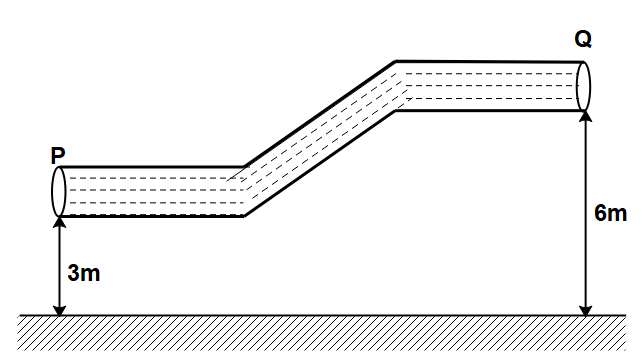
A non-viscous liquid of constant density $500kg/{m^3}$ flows in a variable cross-sectional tube. The area of cross-section of the tube at two points P and Q at heights of $3m$ and $6m$ are $2 \times {10^{ - 3}}{m^2}$ and $4 \times {10^{ - 3}}{m^2}$ respectively. The work done per unit volume by the forces of gravity as the fluid flows from point P to Q, is:
A. $29.4J/{m^3}$
B. $ - 1.47 \times {10^4}J/{m^3}$
C. $ - 2.94 \times {10^4}J/{m^3}$
D. none of these
Answer
 Verified
585.9k+ views
Hint: To find the work done per unit volume by the forces of gravity, we can use Bernoulli's principle. Initially the height of the liquid is less, but we have increased the height. Thus, increasing the potential energy. So, in Bernoulli's principle the potential energy per unit volume of the liquid is the work done.
Formula used:
${W_g} = - \rho g\left( {{h_2} - {h_1}} \right)$
Complete step-by-step answer:
In the above question, they’ve given that a non-viscous fluid is flowing in a tube whose area of cross-section varies. They’ve asked us to find the work done per unit volume by the forces of gravity.
From Bernoulli’s equation we have,
${P_1} - {P_2} = \dfrac{1}{2}\rho \left( {v_2^2 - v_1^2} \right) + \rho g\left( {{h_2} - {h_1}} \right)$
Here,
${P_1} - {P_2}$ is the pressure energy density of the fluid
$\dfrac{1}{2}\rho \left( {v_2^2 - v_1^2} \right)$ is the kinetic energy density of the fluid
$\rho g\left( {{h_2} - {h_1}} \right)$ is the potential energy density of the fluid
In this problem we’re only concerned with the work done by gravity per unit volume which is the potential energy per unit volume of the fluid. It is given by
${W_g} = - \rho g\left( {{h_2} - {h_1}} \right)$
Where,
${W_g}$ is the work done by gravity per unit volume
$\rho $ is the density of the fluid
$g$ is the acceleration due to gravity
${h_2}$ and ${h_1}$ are the heights attained by the fluid
Here, the negative symbol indicates that we are doing the work against gravity by increasing its potential energy i.e., the gravity is pulling the fluid towards earth but we’re doing work (by applying force) in the opposite direction.
$\eqalign{
& {W_g} = - \rho g\left( {{h_Q} - {h_P}} \right) \cr
& \Rightarrow {W_g} = - 500kg/{m^3} \times 9.8m/{s^2} \times \left( {6m - 3m} \right) \cr
& \Rightarrow {W_g} = - \left( {4900 \times 3} \right)J/{m^3} = - 14700J/{m^3} \cr
& \therefore {W_g} = - 1.47 \times {10^4}J/{m^3} \cr} $
Thus, the work done by gravity per unit volume is ${W_g} = - 1.47 \times {10^4}J/{m^3}$.
So, the correct answer is “Option B”.
Note: You can notice, in the question that, the area and velocity of the fluid are also given. With the help of these, we can find the kinetic energy density of the fluid. Here, the energy density is nothing but the energy per unit volume of the fluid.
In the problem, we’ve interchangeably used the word fluid and liquid. It is because Bernoulli's principle applies to all fluids. And the fluids are mainly categorized into liquids, gases and plasma, though we primarily deal only with liquids and gases.
Formula used:
${W_g} = - \rho g\left( {{h_2} - {h_1}} \right)$
Complete step-by-step answer:
In the above question, they’ve given that a non-viscous fluid is flowing in a tube whose area of cross-section varies. They’ve asked us to find the work done per unit volume by the forces of gravity.
From Bernoulli’s equation we have,
${P_1} - {P_2} = \dfrac{1}{2}\rho \left( {v_2^2 - v_1^2} \right) + \rho g\left( {{h_2} - {h_1}} \right)$
Here,
${P_1} - {P_2}$ is the pressure energy density of the fluid
$\dfrac{1}{2}\rho \left( {v_2^2 - v_1^2} \right)$ is the kinetic energy density of the fluid
$\rho g\left( {{h_2} - {h_1}} \right)$ is the potential energy density of the fluid
In this problem we’re only concerned with the work done by gravity per unit volume which is the potential energy per unit volume of the fluid. It is given by
${W_g} = - \rho g\left( {{h_2} - {h_1}} \right)$
Where,
${W_g}$ is the work done by gravity per unit volume
$\rho $ is the density of the fluid
$g$ is the acceleration due to gravity
${h_2}$ and ${h_1}$ are the heights attained by the fluid
Here, the negative symbol indicates that we are doing the work against gravity by increasing its potential energy i.e., the gravity is pulling the fluid towards earth but we’re doing work (by applying force) in the opposite direction.
$\eqalign{
& {W_g} = - \rho g\left( {{h_Q} - {h_P}} \right) \cr
& \Rightarrow {W_g} = - 500kg/{m^3} \times 9.8m/{s^2} \times \left( {6m - 3m} \right) \cr
& \Rightarrow {W_g} = - \left( {4900 \times 3} \right)J/{m^3} = - 14700J/{m^3} \cr
& \therefore {W_g} = - 1.47 \times {10^4}J/{m^3} \cr} $
Thus, the work done by gravity per unit volume is ${W_g} = - 1.47 \times {10^4}J/{m^3}$.
So, the correct answer is “Option B”.
Note: You can notice, in the question that, the area and velocity of the fluid are also given. With the help of these, we can find the kinetic energy density of the fluid. Here, the energy density is nothing but the energy per unit volume of the fluid.
In the problem, we’ve interchangeably used the word fluid and liquid. It is because Bernoulli's principle applies to all fluids. And the fluids are mainly categorized into liquids, gases and plasma, though we primarily deal only with liquids and gases.
Recently Updated Pages
Master Class 11 Computer Science: Engaging Questions & Answers for Success

Master Class 11 Business Studies: Engaging Questions & Answers for Success
Master Class 11 Economics: Engaging Questions & Answers for Success
Master Class 11 English: Engaging Questions & Answers for Success
Master Class 11 Maths: Engaging Questions & Answers for Success
Master Class 11 Biology: Engaging Questions & Answers for Success
Trending doubts
One Metric ton is equal to kg A 10000 B 1000 C 100 class 11 physics CBSE
There are 720 permutations of the digits 1 2 3 4 5 class 11 maths CBSE
Discuss the various forms of bacteria class 11 biology CBSE
Draw a diagram of a plant cell and label at least eight class 11 biology CBSE
State the laws of reflection of light
Explain zero factorial class 11 maths CBSE