




A non-uniform rod $AB$ has a mass and length $2l$ the mass per unit length of the rod is $mx$ at a point of rod distant $x$ from. Find the moment of inertia of this rod about an perpendicular to the rod (a) through $A$ (b) through the midpoint of $AB$
Answer
 Verified
601.2k+ views
Hint: Here they have given the mass of the rod $M$ and they also given the length of the rod that is $2l$ here in the question they have mentioned that mass per unit length of rod = $mx$ of a point distance $x$ from $A$
We have to find the moment of inertia of this rod about a perpendicular axis (a) through $A$ (b) through the midpoint of $AB$
Complete step by step solution:
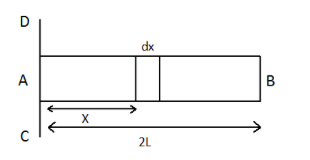
Given that the mass of the rod is $M$ and the length of the rod that is $2l$
Consider the small mass of a length $dx$ and mass $dm$ from the point $A$, then the mass per unit length can be given as:
\[dM = {\text{ }}mxdx\]
On integrating the above equation we will get total mass of rod on LHS and RHS can be integrated from \[x = 0\]to \[x = 2l.\]Then the Equation becomes,
\[\int {dM} = {\text{ }}\int\limits_0^{2l} {mxdx} \]
After integrating the above equation we get
$M = m\left[ {\dfrac{{{x^2}}}{2}} \right]_0^{2l}$
Now apply the limit to the above equation
$M = m\left[ {\dfrac{{{{(2l)}^2}}}{2}} \right]$
Then after further simplifying the above equation we get
\[M{\text{ }} = {\text{ }}2m{l^2}\]
Now take $m$ outside then the equation becomes
$m = \dfrac{M}{{2{l^2}}}..........(1)$
Now the moment of inertia of rod is given by
\[dI{\text{ }} = {\text{ }}mx{x^2}dx\]
For the inertia at $A$, we have to integrate from $0$to $2l$
$I = \int\limits_0^{2l} {m{x^3}} dx$
After integrating we get
$I = m\left[ {\dfrac{{{x^4}}}{4}} \right]_0^{2l}$
After applying limits we get
$I = 4m{l^4}$
Now substitute the value of $m$from equation $(1)$so we get
$I = 4\left( {\dfrac{M}{{2{l^2}}}} \right){l^4}$
After simplifying above equation we get
\[I = 2M{l^2}\]
For part B
Consider the midpoint as a origin and the length of the rod is from $ - L$ to $ + L$ and element of mass is \[dm\]and length \[dx\]at \[\left( {L - x} \right)\]
Now the Mass of the element is given as
\[dM = {\text{ }}m\left( {L - x} \right)dx\]
Now the Moment of inertia of the rod can be taken as
\[dI = {\text{ }}m\left( {L - x} \right){x^2}{\text{ }}dx.\]
Now integrate the above equation for the limits $ - L$ to $ + L$ we get
$I = \int\limits_{ - L}^{ + L} {\left( {L{x^2} - {x^3}} \right)} dx$
After integrating the above equation we get
$I = \left( {\dfrac{{L{x^3}}}{3} - \dfrac{{{x^4}}}{4}} \right)_{ - L}^{ + L}$
Now apply the limits
$I = m\left[ {\left( {\dfrac{{{L^4}}}{3} - \dfrac{{{L^4}}}{4}} \right) - \left( { - \dfrac{{{L^4}}}{3} - \dfrac{{{L^4}}}{4}} \right)} \right]$
We have to substitute the value of m from (1) and after simplifying we get
$I = \dfrac{{M{L^3}}}{3}$
Note: The Moment of inertia is defined as the quantity expressed by the body resisting an angular acceleration which is the sum of the product of mass of every particle.
We have to find the moment of inertia of this rod about a perpendicular axis (a) through $A$ (b) through the midpoint of $AB$
Complete step by step solution:
Given that the mass of the rod is $M$ and the length of the rod that is $2l$
Consider the small mass of a length $dx$ and mass $dm$ from the point $A$, then the mass per unit length can be given as:
\[dM = {\text{ }}mxdx\]
On integrating the above equation we will get total mass of rod on LHS and RHS can be integrated from \[x = 0\]to \[x = 2l.\]Then the Equation becomes,
\[\int {dM} = {\text{ }}\int\limits_0^{2l} {mxdx} \]
After integrating the above equation we get
$M = m\left[ {\dfrac{{{x^2}}}{2}} \right]_0^{2l}$
Now apply the limit to the above equation
$M = m\left[ {\dfrac{{{{(2l)}^2}}}{2}} \right]$
Then after further simplifying the above equation we get
\[M{\text{ }} = {\text{ }}2m{l^2}\]
Now take $m$ outside then the equation becomes
$m = \dfrac{M}{{2{l^2}}}..........(1)$
Now the moment of inertia of rod is given by
\[dI{\text{ }} = {\text{ }}mx{x^2}dx\]
For the inertia at $A$, we have to integrate from $0$to $2l$
$I = \int\limits_0^{2l} {m{x^3}} dx$
After integrating we get
$I = m\left[ {\dfrac{{{x^4}}}{4}} \right]_0^{2l}$
After applying limits we get
$I = 4m{l^4}$
Now substitute the value of $m$from equation $(1)$so we get
$I = 4\left( {\dfrac{M}{{2{l^2}}}} \right){l^4}$
After simplifying above equation we get
\[I = 2M{l^2}\]
For part B
Consider the midpoint as a origin and the length of the rod is from $ - L$ to $ + L$ and element of mass is \[dm\]and length \[dx\]at \[\left( {L - x} \right)\]
Now the Mass of the element is given as
\[dM = {\text{ }}m\left( {L - x} \right)dx\]
Now the Moment of inertia of the rod can be taken as
\[dI = {\text{ }}m\left( {L - x} \right){x^2}{\text{ }}dx.\]
Now integrate the above equation for the limits $ - L$ to $ + L$ we get
$I = \int\limits_{ - L}^{ + L} {\left( {L{x^2} - {x^3}} \right)} dx$
After integrating the above equation we get
$I = \left( {\dfrac{{L{x^3}}}{3} - \dfrac{{{x^4}}}{4}} \right)_{ - L}^{ + L}$
Now apply the limits
$I = m\left[ {\left( {\dfrac{{{L^4}}}{3} - \dfrac{{{L^4}}}{4}} \right) - \left( { - \dfrac{{{L^4}}}{3} - \dfrac{{{L^4}}}{4}} \right)} \right]$
We have to substitute the value of m from (1) and after simplifying we get
$I = \dfrac{{M{L^3}}}{3}$
Note: The Moment of inertia is defined as the quantity expressed by the body resisting an angular acceleration which is the sum of the product of mass of every particle.
Recently Updated Pages
Master Class 12 Economics: Engaging Questions & Answers for Success

Master Class 12 English: Engaging Questions & Answers for Success
Master Class 12 Social Science: Engaging Questions & Answers for Success
Master Class 12 Maths: Engaging Questions & Answers for Success
Master Class 12 Physics: Engaging Questions & Answers for Success
Master Class 9 General Knowledge: Engaging Questions & Answers for Success
Trending doubts
One Metric ton is equal to kg A 10000 B 1000 C 100 class 11 physics CBSE
Difference Between Prokaryotic Cells and Eukaryotic Cells
Two of the body parts which do not appear in MRI are class 11 biology CBSE
Find the value of the expression given below sin 30circ class 11 maths CBSE
1 ton equals to A 100 kg B 1000 kg C 10 kg D 10000 class 11 physics CBSE
Draw a diagram of nephron and explain its structur class 11 biology CBSE