



A non-metal ‘M’ forms ${\text{MC}}{{\text{l}}_{\text{3}}}$, ${{\text{M}}_{\text{2}}}{{\text{O}}_{\text{5}}}$ and ${\text{M}}{{\text{g}}_{\text{3}}}{{\text{M}}_{\text{2}}}$ but does not form ${\text{M}}{{\text{I}}_{\text{6}}}$. The incorrect statement regarding non-metal ‘M’ is-
A.M can form multiple bond
B.M is of second period element
C.Atomicity of non-metal is 4
D.The range of oxidation number for M is +5 to -3
Answer
 Verified
578.1k+ views
Hint: In the compounds ${\text{MC}}{{\text{l}}_{\text{3}}}$, ${{\text{M}}_{\text{2}}}{{\text{O}}_{\text{5}}}$ and ${\text{M}}{{\text{g}}_{\text{3}}}{{\text{M}}_{\text{2}}}$, determine the oxidation number of ‘M’. Also, determine the structures of ${\text{MC}}{{\text{l}}_{\text{3}}}$, ${{\text{M}}_{\text{2}}}{{\text{O}}_{\text{5}}}$ and ${\text{M}}{{\text{g}}_{\text{3}}}{{\text{M}}_{\text{2}}}$ so that we can determine the bonds formed by the non-metal.
Complete step by step answer:
We are given compounds formed by non-metal ‘M’ which are ${\text{MC}}{{\text{l}}_{\text{3}}}$, ${{\text{M}}_{\text{2}}}{{\text{O}}_{\text{5}}}$ and ${\text{M}}{{\text{g}}_{\text{3}}}{{\text{M}}_{\text{2}}}$.
In compounds ${\text{MC}}{{\text{l}}_{\text{3}}}$, we can see that non-metal ‘M’ forms three bonds with three chlorine atoms, in compound ${{\text{M}}_{\text{2}}}{{\text{O}}_{\text{5}}}$ non-metal ‘M’ forms more than one bond with the five oxygen atoms and in compound ${\text{M}}{{\text{g}}_{\text{3}}}{{\text{M}}_{\text{2}}}$ non-metal ‘M’ forms more than one bond with the three magnesium atoms.
We can determine the valency of non-metal ‘M’ by drawing the structures of the compounds ${\text{MC}}{{\text{l}}_{\text{3}}}$, ${{\text{M}}_{\text{2}}}{{\text{O}}_{\text{5}}}$ and ${\text{M}}{{\text{g}}_{\text{3}}}{{\text{M}}_{\text{2}}}$.
The structures of ${\text{MC}}{{\text{l}}_{\text{3}}}$, ${{\text{M}}_{\text{2}}}{{\text{O}}_{\text{5}}}$ and ${\text{M}}{{\text{g}}_{\text{3}}}{{\text{M}}_{\text{2}}}$ are as follows:
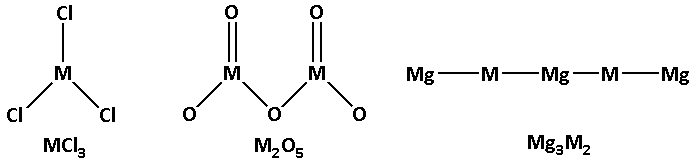
From the structures we can see that the non-metal ‘M’ forms multiple bonds. Thus, the statement ‘M can form multiple bonds’ is correct. Thus, option (A) is not correct.
The compounds formed by the non-metal ‘M’ are ${\text{MC}}{{\text{l}}_{\text{3}}}$, ${{\text{M}}_{\text{2}}}{{\text{O}}_{\text{5}}}$ and ${\text{M}}{{\text{g}}_{\text{3}}}{{\text{M}}_{\text{2}}}$.
The oxidation state of the non-metal ‘M’ in ${\text{MC}}{{\text{l}}_{\text{3}}}$ is +3. The oxidation state of the non-metal ‘M’ in ${{\text{M}}_{\text{2}}}{{\text{O}}_{\text{5}}}$ is +5. And the oxidation state of the non-metal ‘M’ in ${\text{M}}{{\text{g}}_{\text{3}}}{{\text{M}}_{\text{2}}}$ is -3
Thus, the statement ‘the range of oxidation numbers for M is +5 to -3’ is correct. Thus, option (D) is correct.
If the non-metal ‘M’ is a second period element then the atomicity of the non-metal ‘M’ is 2.
Thus, the statement ‘M is of second period element’ is correct. Thus, option (B) is not correct.
Thus, the statement ‘atomicity of non-metal is 4’ is incorrect.
Thus, the correct option is option (C).
Note:
The number of atoms that make up or compose its molecule is known as atomicity. The non-metal ‘M’ is a second period element and thus, the atomicity of the non-metal ‘M’ is 2. Thus, the molecule of non-metal is ${{\text{M}}_2}$.
Complete step by step answer:
We are given compounds formed by non-metal ‘M’ which are ${\text{MC}}{{\text{l}}_{\text{3}}}$, ${{\text{M}}_{\text{2}}}{{\text{O}}_{\text{5}}}$ and ${\text{M}}{{\text{g}}_{\text{3}}}{{\text{M}}_{\text{2}}}$.
In compounds ${\text{MC}}{{\text{l}}_{\text{3}}}$, we can see that non-metal ‘M’ forms three bonds with three chlorine atoms, in compound ${{\text{M}}_{\text{2}}}{{\text{O}}_{\text{5}}}$ non-metal ‘M’ forms more than one bond with the five oxygen atoms and in compound ${\text{M}}{{\text{g}}_{\text{3}}}{{\text{M}}_{\text{2}}}$ non-metal ‘M’ forms more than one bond with the three magnesium atoms.
We can determine the valency of non-metal ‘M’ by drawing the structures of the compounds ${\text{MC}}{{\text{l}}_{\text{3}}}$, ${{\text{M}}_{\text{2}}}{{\text{O}}_{\text{5}}}$ and ${\text{M}}{{\text{g}}_{\text{3}}}{{\text{M}}_{\text{2}}}$.
The structures of ${\text{MC}}{{\text{l}}_{\text{3}}}$, ${{\text{M}}_{\text{2}}}{{\text{O}}_{\text{5}}}$ and ${\text{M}}{{\text{g}}_{\text{3}}}{{\text{M}}_{\text{2}}}$ are as follows:
From the structures we can see that the non-metal ‘M’ forms multiple bonds. Thus, the statement ‘M can form multiple bonds’ is correct. Thus, option (A) is not correct.
The compounds formed by the non-metal ‘M’ are ${\text{MC}}{{\text{l}}_{\text{3}}}$, ${{\text{M}}_{\text{2}}}{{\text{O}}_{\text{5}}}$ and ${\text{M}}{{\text{g}}_{\text{3}}}{{\text{M}}_{\text{2}}}$.
The oxidation state of the non-metal ‘M’ in ${\text{MC}}{{\text{l}}_{\text{3}}}$ is +3. The oxidation state of the non-metal ‘M’ in ${{\text{M}}_{\text{2}}}{{\text{O}}_{\text{5}}}$ is +5. And the oxidation state of the non-metal ‘M’ in ${\text{M}}{{\text{g}}_{\text{3}}}{{\text{M}}_{\text{2}}}$ is -3
Thus, the statement ‘the range of oxidation numbers for M is +5 to -3’ is correct. Thus, option (D) is correct.
If the non-metal ‘M’ is a second period element then the atomicity of the non-metal ‘M’ is 2.
Thus, the statement ‘M is of second period element’ is correct. Thus, option (B) is not correct.
Thus, the statement ‘atomicity of non-metal is 4’ is incorrect.
Thus, the correct option is option (C).
Note:
The number of atoms that make up or compose its molecule is known as atomicity. The non-metal ‘M’ is a second period element and thus, the atomicity of the non-metal ‘M’ is 2. Thus, the molecule of non-metal is ${{\text{M}}_2}$.
Recently Updated Pages
Master Class 12 Economics: Engaging Questions & Answers for Success

Master Class 12 Physics: Engaging Questions & Answers for Success
Master Class 12 English: Engaging Questions & Answers for Success
Master Class 12 Social Science: Engaging Questions & Answers for Success
Master Class 12 Maths: Engaging Questions & Answers for Success
Master Class 12 Business Studies: Engaging Questions & Answers for Success
Trending doubts
What are the major means of transport Explain each class 12 social science CBSE
India is a sovereign socialist secular democratic republic class 12 social science CBSE
How many states of matter are there in total class 12 chemistry CBSE
What are the advantages of vegetative propagation class 12 biology CBSE
Suicide bags of cells are aEndoplasmic reticulum bLysosome class 12 biology CBSE
What is the Full Form of PVC, PET, HDPE, LDPE, PP and PS ?