




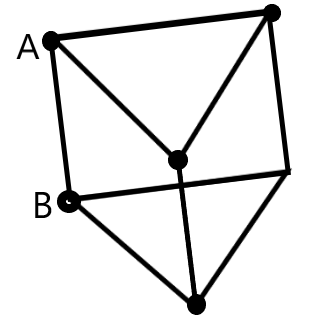
A nine similar resistors of resistance R are connected as shown in the figure. Find the equivalent resistance between points A and B.
Answer
 Verified
608.4k+ views
Hint: We are given a combination of resistances. We have to resolve them as in series or as in parallel to find the equivalent resistance of the circuit across the points A and B. We can resolve them easily by identifying the circuit closely.
Complete answer:
We need to resolve the resistors to understand whether they are in series or parallel to each other. Let us get a clearer idea of the network as –
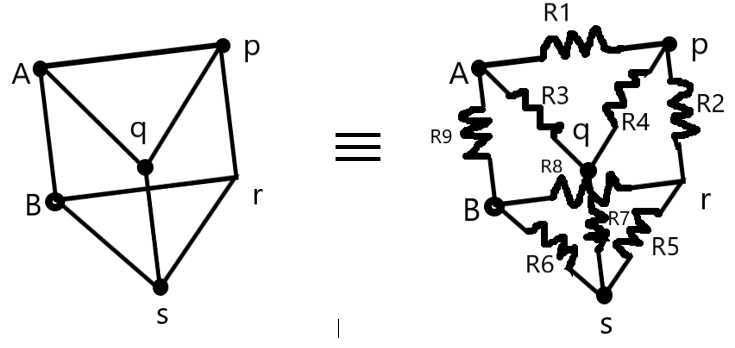
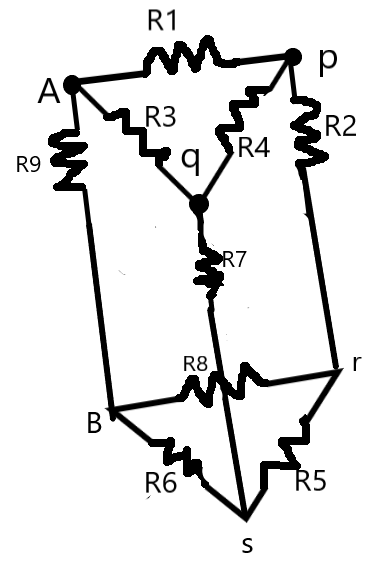
We can elaborate the connections as shown in the above diagram.
A closer approach to circuit will help us find two pairs of equipotential points in the circuit. From the Wheatstone’s bridge condition, we know that, a resistor in between two equipotential points due not play a role in the circuit, i.e., there will be no potential drop or current flow across these resistors.
The points p and q on the left arm of the circuit are at equal potentials as a result, the current through R4 is zero and thus, we can neglect the resistance R4.
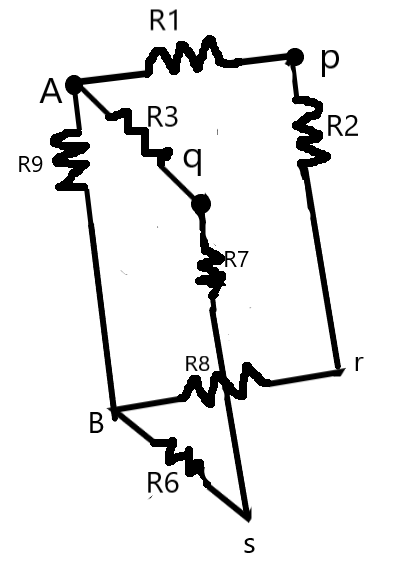
Similarly, the points r and s are also at equal potentials, i.e., we can neglect the resistor R5. We get the resultant circuit as –
 .
.
Now, we can find that the resistances (R1, R2, R8), (R3, R7, R6) are pairs of series resistors parallel to each other and to R9.
We can compute the equivalent resistance as –
\[\begin{align}
& {{R}_{s1}}=R1+R2+R8=3R \\
& {{R}_{s2}}=R3+R7+R6=3R \\
& \text{Now, R9 }\!\!|\!\!\text{ }\!\!|\!\!\text{ }{{\text{R}}_{s1}}||{{R}_{s2}}, \\
& \Rightarrow \text{ }\dfrac{1}{{{R}_{eq}}}=\dfrac{1}{R}+\dfrac{1}{3R}+\dfrac{1}{3R} \\
& \Rightarrow \text{ }\dfrac{1}{{{R}_{eq}}}=\dfrac{5}{3R} \\
& \therefore \text{ }{{R}_{eq}}=\dfrac{3R}{5}\Omega \\
\end{align}\]
The required equivalent resistance across A and B is \[\dfrac{3R}{5}\Omega \].
Note:
The Wheatstone’s bridge condition is very helpful in resolving many series-parallel circuits, as there will be mostly equipotential nodes in the circuit which will add error to the theoretical calculations by involving additional resistance in the circuit.
Complete answer:
We need to resolve the resistors to understand whether they are in series or parallel to each other. Let us get a clearer idea of the network as –
We can elaborate the connections as shown in the above diagram.
A closer approach to circuit will help us find two pairs of equipotential points in the circuit. From the Wheatstone’s bridge condition, we know that, a resistor in between two equipotential points due not play a role in the circuit, i.e., there will be no potential drop or current flow across these resistors.
The points p and q on the left arm of the circuit are at equal potentials as a result, the current through R4 is zero and thus, we can neglect the resistance R4.
Similarly, the points r and s are also at equal potentials, i.e., we can neglect the resistor R5. We get the resultant circuit as –
Now, we can find that the resistances (R1, R2, R8), (R3, R7, R6) are pairs of series resistors parallel to each other and to R9.
We can compute the equivalent resistance as –
\[\begin{align}
& {{R}_{s1}}=R1+R2+R8=3R \\
& {{R}_{s2}}=R3+R7+R6=3R \\
& \text{Now, R9 }\!\!|\!\!\text{ }\!\!|\!\!\text{ }{{\text{R}}_{s1}}||{{R}_{s2}}, \\
& \Rightarrow \text{ }\dfrac{1}{{{R}_{eq}}}=\dfrac{1}{R}+\dfrac{1}{3R}+\dfrac{1}{3R} \\
& \Rightarrow \text{ }\dfrac{1}{{{R}_{eq}}}=\dfrac{5}{3R} \\
& \therefore \text{ }{{R}_{eq}}=\dfrac{3R}{5}\Omega \\
\end{align}\]
The required equivalent resistance across A and B is \[\dfrac{3R}{5}\Omega \].
Note:
The Wheatstone’s bridge condition is very helpful in resolving many series-parallel circuits, as there will be mostly equipotential nodes in the circuit which will add error to the theoretical calculations by involving additional resistance in the circuit.
Recently Updated Pages
Master Class 11 English: Engaging Questions & Answers for Success

Master Class 11 Social Science: Engaging Questions & Answers for Success
Master Class 11 Maths: Engaging Questions & Answers for Success
Master Class 11 Biology: Engaging Questions & Answers for Success
Master Class 11 Physics: Engaging Questions & Answers for Success
Master Class 11 Chemistry: Engaging Questions & Answers for Success
Trending doubts
One Metric ton is equal to kg A 10000 B 1000 C 100 class 11 physics CBSE
Difference Between Prokaryotic Cells and Eukaryotic Cells
Find the value of the expression given below sin 30circ class 11 maths CBSE
Difference between physical and chemical change class 11 chemistry CBSE
Two of the body parts which do not appear in MRI are class 11 biology CBSE
Draw a diagram of a plant cell and label at least eight class 11 biology CBSE