




A natural method of birth control assumes that sperms live for three days after intercourse, ovulation occurs between days 13- 15 of the menstrual cycle and released ova live for 36 hours.
On which day of the cycle should intercourse not result in pregnancy?
A. Day 7
B. Day 10
C. Day 12
D. Day 16
Answer
 Verified
595.5k+ views
Hint: Estrogen levels are at a peak during the time of ovulation and start rising from day 8 of the menstrual cycle. High levels of estrogen help the vascularization of the uterus.
Step by step answer:Option A) Logically, if intercourse is held at Day 7, then the sperm can live up to three days i.e., till day 10 and the ovum can live up to 36 hours after released i.e., till day 14-16 and it won’t lead to pregnancy as the ovulation will occur between days 13-15 and sperm don’t get ovum for fertilization till day 10 it won’t survive either. Also, Levels of estrogen, progesterone, and follicular stimulating hormone are low on day 7.
Option B) If intercourse is held at Day 10, then the sperm can live up to three days i.e., till day 13 and the ovum can live up to 36 hours i.e., till day 14-16 after its release and this can lead to pregnancy as the ovulation will occur between days 13-15 and the estrogen levels will be at peak during this time. The ovum formed on day 13 can be fertilized as the sperm will survive till day 13.
Option C) If intercourse is held at Day 12, then the sperm can live up to three days i.e., till day 15 and the ovum can live up to 36 hours i.e., till day 14-16 after its release and this can lead to pregnancy as the ovulation will occur between days 13-15 and the estrogen levels will be at peak during this time. Sol the ovum can be fertilized by the sperm if it has survived till day 15.
Option D) If intercourse is held at Day 16, then the sperm can live up to three days i.e., till day 19 and the ovum can live up to 36 hours i.e., till day 14-16 after its release. So, the presence of ovum and sperm on day 16 can lead to pregnancy.
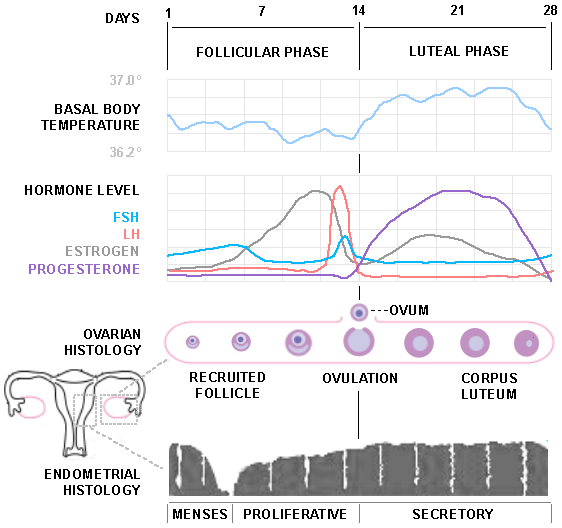
Hence, the correct answer is an option (A).
Note: Ovulation occurs when the mature egg is released from the ovary. The mature ova if interacts with the sperm can lead to the fertilization of the ovum and cause pregnancy. During the ovulation, the endometrium wall of the uterus also thickens to provide a suitable environment for the zygote formation if fertilization occurs.
Step by step answer:Option A) Logically, if intercourse is held at Day 7, then the sperm can live up to three days i.e., till day 10 and the ovum can live up to 36 hours after released i.e., till day 14-16 and it won’t lead to pregnancy as the ovulation will occur between days 13-15 and sperm don’t get ovum for fertilization till day 10 it won’t survive either. Also, Levels of estrogen, progesterone, and follicular stimulating hormone are low on day 7.
Option B) If intercourse is held at Day 10, then the sperm can live up to three days i.e., till day 13 and the ovum can live up to 36 hours i.e., till day 14-16 after its release and this can lead to pregnancy as the ovulation will occur between days 13-15 and the estrogen levels will be at peak during this time. The ovum formed on day 13 can be fertilized as the sperm will survive till day 13.
Option C) If intercourse is held at Day 12, then the sperm can live up to three days i.e., till day 15 and the ovum can live up to 36 hours i.e., till day 14-16 after its release and this can lead to pregnancy as the ovulation will occur between days 13-15 and the estrogen levels will be at peak during this time. Sol the ovum can be fertilized by the sperm if it has survived till day 15.
Option D) If intercourse is held at Day 16, then the sperm can live up to three days i.e., till day 19 and the ovum can live up to 36 hours i.e., till day 14-16 after its release. So, the presence of ovum and sperm on day 16 can lead to pregnancy.
Hence, the correct answer is an option (A).
Note: Ovulation occurs when the mature egg is released from the ovary. The mature ova if interacts with the sperm can lead to the fertilization of the ovum and cause pregnancy. During the ovulation, the endometrium wall of the uterus also thickens to provide a suitable environment for the zygote formation if fertilization occurs.
Recently Updated Pages
Master Class 12 Social Science: Engaging Questions & Answers for Success

Master Class 12 Physics: Engaging Questions & Answers for Success
Master Class 12 Maths: Engaging Questions & Answers for Success
Master Class 12 Economics: Engaging Questions & Answers for Success
Master Class 12 Chemistry: Engaging Questions & Answers for Success
Master Class 12 Business Studies: Engaging Questions & Answers for Success
Trending doubts
Which are the Top 10 Largest Countries of the World?
Draw a labelled sketch of the human eye class 12 physics CBSE
Explain the structure of megasporangium class 12 biology CBSE
What are the major means of transport Explain each class 12 social science CBSE
How many chromosomes are found in human ovum a 46 b class 12 biology CBSE
The diagram of the section of a maize grain is given class 12 biology CBSE