




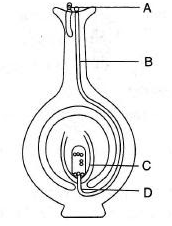
(A) Name the part marked. 'A' in the diagram.
(B) How does 'A' reach part 'B?
(C) State the importance of the part 'C'.
(D) What happens to the part marked 'D' after fertilization is over?
Answer
 Verified
594.6k+ views
Hint: In the plants, reproduction in general happens by fertilization, to tell in detail the plants have double fertilization, and this process of double fertilization is a little complex process where fusion of one female gametophyte takes place with two male gametes.
Complete answer:
A) Once the pollination occurs, the pollen lands on the stigma of the flower, where the pollination should happen, On the surface of the stigma. So A in the above given diagram represents pollen grain.
B) This pollen tube starts germinating, they grow and form long pollen tubes. During the formation of the pollen tube, a haploid generative cell travels down through the tube behind the tube nucleus. As we know that the generative cell which is formed by the unequal division microspore further divides by mitosis to produce two haploid (n) sperm cells. As the pollen tube grows, it makes its way to the sperms and they pass through the stigma and from the stigma down the style it passes into the ovary.
C) After reaching the ovary, the pollen tube reaches the micropyle end of the ovule Later the pollen tube digests and gives way to the sperm and when they reach the synergid, all the content of the pollen tube is released. The synergid where the sperm cells were released into degenerates and one sperm makes its way to go and fertilize the egg cell, producing a diploid (2n) zygote.
D) Double fertilization is a process where two sperm cells fertilize the female gamete, that is ovule.The second sperm cell fuses with both central cell nuclei, producing a triploid (3n) cell.
Note: There are some advantages because of double fertilization, there are chances of polyembryony and double fertilization produce endosperm, which provides nourishment to the embryo. And females utilize both sperm cells during this process.
Complete answer:
A) Once the pollination occurs, the pollen lands on the stigma of the flower, where the pollination should happen, On the surface of the stigma. So A in the above given diagram represents pollen grain.
B) This pollen tube starts germinating, they grow and form long pollen tubes. During the formation of the pollen tube, a haploid generative cell travels down through the tube behind the tube nucleus. As we know that the generative cell which is formed by the unequal division microspore further divides by mitosis to produce two haploid (n) sperm cells. As the pollen tube grows, it makes its way to the sperms and they pass through the stigma and from the stigma down the style it passes into the ovary.
C) After reaching the ovary, the pollen tube reaches the micropyle end of the ovule Later the pollen tube digests and gives way to the sperm and when they reach the synergid, all the content of the pollen tube is released. The synergid where the sperm cells were released into degenerates and one sperm makes its way to go and fertilize the egg cell, producing a diploid (2n) zygote.
D) Double fertilization is a process where two sperm cells fertilize the female gamete, that is ovule.The second sperm cell fuses with both central cell nuclei, producing a triploid (3n) cell.
Note: There are some advantages because of double fertilization, there are chances of polyembryony and double fertilization produce endosperm, which provides nourishment to the embryo. And females utilize both sperm cells during this process.
Recently Updated Pages
Master Class 12 Social Science: Engaging Questions & Answers for Success

Master Class 12 Physics: Engaging Questions & Answers for Success
Master Class 12 Maths: Engaging Questions & Answers for Success
Master Class 12 Economics: Engaging Questions & Answers for Success
Master Class 12 Chemistry: Engaging Questions & Answers for Success
Master Class 12 Business Studies: Engaging Questions & Answers for Success
Trending doubts
Which are the Top 10 Largest Countries of the World?
Draw a labelled sketch of the human eye class 12 physics CBSE
Explain the structure of megasporangium class 12 biology CBSE
What are the major means of transport Explain each class 12 social science CBSE
How many chromosomes are found in human ovum a 46 b class 12 biology CBSE
The diagram of the section of a maize grain is given class 12 biology CBSE