




A mollusc with parapodia is
(a) Aplysia
(b) Doris
(c) Chiton
(d) Pila
Answer
 Verified
608.4k+ views
Hint: Parapodia can usually be found in marine gastropods. A parapodia mollusc is a genus of large sea slug. It's named the spotted sea hare, too. It is suspected that this species, when attacked, often releases clouds of ink to blind the attacker.
Complete step by step answer:
Aplysia belongs to the family Aplysiidae and is a marine gastropod mollusc. It has parapodia. Parapodia are fleshy protrusions on Aplysia's sides that are present. The foot, called parapodia, is wide and bears lateral projections. The foot at the posterior end gives rise to a very short, distinct tail. It can be used for breathing and for locomotion as well. There are parapodia for sea snails and sea slugs that are used for swimming.
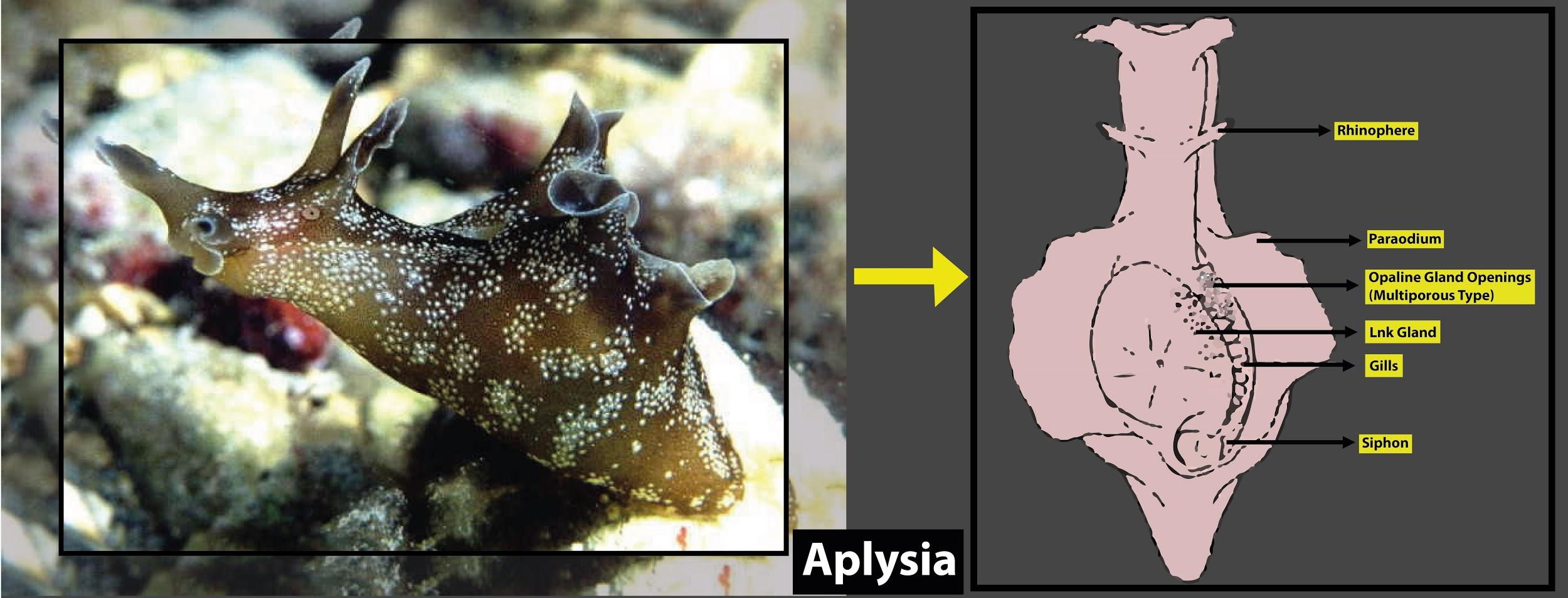
Snails and slugs are usually called gastropods. Within the phylum Mollusca, they belong to a broad taxonomic class of invertebrates called Gastropods. The term "gastropod" is derived from the Ancient Greek word gastro (stomach) and poda (foot) , a reference to the fact that the "foot" of the animal is situated below its gut.
Aplysia is a genus of gastropod molluscs well-known in neuroscience as 'model organisms,' particularly working on learning and memory cell biology. Large neurons that promote physiological, biochemical, and genomic studies at the level of single cells and their compartments are the most obvious advantage of Aplysia.
So, the correct answer is, ‘Aplysia’.
Note: Aplasia has almost a cosmopolitan distribution and is a very rare gastropod. It is known that it is around 1 m long in dimension. It is commonly referred to as the 'Sea-hare' because of the superficial similarity to the hare, especially in the head area. Two pairs of tentacles carry the head. Most species live with a variety of seaweeds in subtropical and tropical tide zones.
Complete step by step answer:
Aplysia belongs to the family Aplysiidae and is a marine gastropod mollusc. It has parapodia. Parapodia are fleshy protrusions on Aplysia's sides that are present. The foot, called parapodia, is wide and bears lateral projections. The foot at the posterior end gives rise to a very short, distinct tail. It can be used for breathing and for locomotion as well. There are parapodia for sea snails and sea slugs that are used for swimming.
Snails and slugs are usually called gastropods. Within the phylum Mollusca, they belong to a broad taxonomic class of invertebrates called Gastropods. The term "gastropod" is derived from the Ancient Greek word gastro (stomach) and poda (foot) , a reference to the fact that the "foot" of the animal is situated below its gut.
Aplysia is a genus of gastropod molluscs well-known in neuroscience as 'model organisms,' particularly working on learning and memory cell biology. Large neurons that promote physiological, biochemical, and genomic studies at the level of single cells and their compartments are the most obvious advantage of Aplysia.
So, the correct answer is, ‘Aplysia’.
Note: Aplasia has almost a cosmopolitan distribution and is a very rare gastropod. It is known that it is around 1 m long in dimension. It is commonly referred to as the 'Sea-hare' because of the superficial similarity to the hare, especially in the head area. Two pairs of tentacles carry the head. Most species live with a variety of seaweeds in subtropical and tropical tide zones.
Recently Updated Pages
Master Class 11 Social Science: Engaging Questions & Answers for Success

Master Class 11 English: Engaging Questions & Answers for Success
Master Class 11 Maths: Engaging Questions & Answers for Success
Master Class 11 Chemistry: Engaging Questions & Answers for Success
Master Class 11 Biology: Engaging Questions & Answers for Success
Master Class 11 Physics: Engaging Questions & Answers for Success
Trending doubts
Differentiate between an exothermic and an endothermic class 11 chemistry CBSE
One Metric ton is equal to kg A 10000 B 1000 C 100 class 11 physics CBSE
Difference Between Prokaryotic Cells and Eukaryotic Cells
There are 720 permutations of the digits 1 2 3 4 5 class 11 maths CBSE
Two of the body parts which do not appear in MRI are class 11 biology CBSE
Which gas is abundant in air class 11 chemistry CBSE