




When a mixture of benzaldehyde and acetophenone is treated with dilute ${{NaOH}}$ at $293{{K}}$, it forms
A. A. $2,3 - $ phenylpropanal
B. $1,1 - $diphenylpropan $ - 2 - $ one $ - 1 - $ ol
C. $1,3 - $ diphenylprop $ - 2 - $ ene $ - 1 - $ one
D. $1,2 - $ diphenylprop $ - 2 - $ en $ - 1 - $ one
E. $1,3 - $ diphenylprop $ - 2 - $ en $ - 1 - $ al
Answer
 Verified
592.6k+ views
Hint:Aldol condensation is a property of compounds having carbonyl groups which have $\alpha - $ hydrogen. This reaction is a reversible reaction. The given reaction can be termed as cross-aldol condensation reaction.
Complete step by step solution:
Aldol means the formation of aldehyde and alcohols on the same molecule. When two or more molecules are combined, there is a loss of small molecules like water or alcohol. This involves nucleophilic addition of enolate ions to the carbonyl group.
The given reaction is known as Claisen-Schmidt condensation reaction. In this reaction, addition of ketone enolate to the aldehyde occurs since the ketone enolate has lower energy and it is formed faster.
This reaction produces, generally, $\alpha ,\beta - $ unsaturated ketones. The ${{C - C}}$ bond is formed in aldol condensation. This formation is facilitated by electron withdrawing groups and stopped by electron releasing groups on the carbonyl group of ketones.
The complete chemical equation of this reaction is given below:
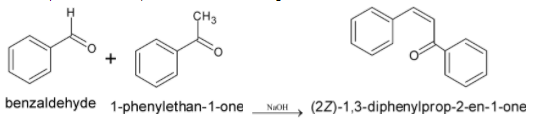
When molecules with $\alpha - $ hydrogen to the carbonyl group are reacted with an alkali, enolate ions are formed. The product formed still has $\alpha - $ hydrogen and a $ - {{OH}}$ group attached to an aromatic ring. Thus it rapidly undergoes condensation reaction by removing water molecules.
Thus the product formed is $1,3 - $ diphenylprop $ - 2 - $ ene $ - 1 - $ one. This compound is also known as benzylideneacetophenone.
Hence, the correct option is C.
Note:
Aldol condensation reaction occurs between two aldehydes or two ketones. When aldol condensation occurs between one aldehyde and one ketone, it is called cross-aldol condensation reaction. The product obtained from the given reaction is also known as chalcone.
Complete step by step solution:
Aldol means the formation of aldehyde and alcohols on the same molecule. When two or more molecules are combined, there is a loss of small molecules like water or alcohol. This involves nucleophilic addition of enolate ions to the carbonyl group.
The given reaction is known as Claisen-Schmidt condensation reaction. In this reaction, addition of ketone enolate to the aldehyde occurs since the ketone enolate has lower energy and it is formed faster.
This reaction produces, generally, $\alpha ,\beta - $ unsaturated ketones. The ${{C - C}}$ bond is formed in aldol condensation. This formation is facilitated by electron withdrawing groups and stopped by electron releasing groups on the carbonyl group of ketones.
The complete chemical equation of this reaction is given below:
When molecules with $\alpha - $ hydrogen to the carbonyl group are reacted with an alkali, enolate ions are formed. The product formed still has $\alpha - $ hydrogen and a $ - {{OH}}$ group attached to an aromatic ring. Thus it rapidly undergoes condensation reaction by removing water molecules.
Thus the product formed is $1,3 - $ diphenylprop $ - 2 - $ ene $ - 1 - $ one. This compound is also known as benzylideneacetophenone.
Hence, the correct option is C.
Note:
Aldol condensation reaction occurs between two aldehydes or two ketones. When aldol condensation occurs between one aldehyde and one ketone, it is called cross-aldol condensation reaction. The product obtained from the given reaction is also known as chalcone.
Recently Updated Pages
Which of the following graphs shows the variation of class 12 physics CBSE

Draw a labelled diagram of the human male reproductive class 12 biology CBSE
Describe the experiment to compare the emf of two cells class 12 physics CBSE
What is standard hydrogen electrode
What is conventional current and electric current class 12 physics CBSE
2Bromopentane is treated with an alcoholic KOH solution class 12 chemistry CBSE
Trending doubts
Draw a labelled sketch of the human eye class 12 physics CBSE
Which are the Top 10 Largest Countries of the World?
Differentiate between homogeneous and heterogeneous class 12 chemistry CBSE
Draw ray diagrams each showing i myopic eye and ii class 12 physics CBSE
Which is the correct genotypic ratio of mendel dihybrid class 12 biology CBSE
What is the Full Form of PVC, PET, HDPE, LDPE, PP and PS ?