




A milk vendor has 2 cans of milk. The first container 25% water and rest milk. The second contains 50% water. How much milk should be mixed from each of the containers so as to get 12 litres of milk such that the ratio of water to milk is 3:5?
Answer
 Verified
540.6k+ views
Hint:
Consider 1 litre of milk’s cost to be Re. 1. Thus find the cost price of 1 litre mix in the 1st can and the 2nd can. Find the mean price and find the ratio by the rules of alligation.
Complete step-by-step answer:
Let us assume the cost of 1 litre milk to be Re. 1.
Now the milk in 1 litre mix in the 1st can is equal to \[{}^{3}/{}_{4}\] litre.
Out of 1 litre 25% is \[{{{}^{3}/{}_{4}}^{th}}\] of the 1st can will be \[={}^{3}/{}_{4}\times \operatorname{Re}.1=\operatorname{Re}.{}^{3}/{}_{4}\].
Now let us consider the 2nd can.
The milk in 1 litre mix in 2nd can contains 50% of water, i.e. \[{}^{1}/{}_{2}\].
Milk in 1 litre mixin 2nd can = \[{}^{1}/{}_{2}\] litre.
Thus the cost price of 1 litre mix in the 2nd can = Re. \[{}^{1}/{}_{2}\].
The milk in 1 litre of final mix \[=\left( \dfrac{{}^{3}/{}_{4}+{}^{1}/{}_{2}}{2} \right)={}^{5}/{}_{8}\].
Thus the mean price = Re. \[{}^{5}/{}_{8}\].
By the rule of alligation, when different quantities of different ingredients are mixed together to produce a mixture of a mean value, the ratio of their quantities is inversely proportional to the difference in their cost from the mean value.
Thus by rule of alligation, we have \[{}^{x}/{}_{y}\].
\[\dfrac{x}{y}=\dfrac{CP\text{ }of\text{ }1\text{ }litre\text{ }mix\text{ }in\text{ }the\text{
}{{1}^{st}}can-Mean\text{ }price}{Mean\text{ }price-CP\text{ }of\text{ }1\text{ }litre\text{
}mix\text{ }in\text{ }the\text{ }{{2}^{nd}}can}\]
\[\dfrac{x}{y}=\dfrac{{}^{3}/{}_{4}-{}^{5}/{}_{8}}{{}^{5}/{}_{8}-{}^{1}/{}_{2}}=\dfrac{\dfrac{6-5}{
8}}{\dfrac{5-4}{8}}=\dfrac{{}^{1}/{}_{8}}{{}^{1}/{}_{8}}=\dfrac{1}{1}\].
Thus we can say that,
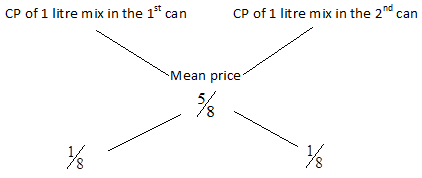
Thus ratio of the 2 mixtures = 1:1
So, quantity of mixture taken from each can = \[{}^{1}/{}_{2}\] litres of milk =
\[{}^{1}/{}_{2}\times 12=6\] litres of milk.
Thus mix 6 litres of water and 6 litres of milk to get the required mixture.
Note:Keep in mind the important points while applying the alligation method. While comparing the extreme values and mean price, you have to take the ‘difference’ between the two values, i.e. it is always positive, you have to subtract the smaller value from the larger value.
Consider 1 litre of milk’s cost to be Re. 1. Thus find the cost price of 1 litre mix in the 1st can and the 2nd can. Find the mean price and find the ratio by the rules of alligation.
Complete step-by-step answer:
Let us assume the cost of 1 litre milk to be Re. 1.
Now the milk in 1 litre mix in the 1st can is equal to \[{}^{3}/{}_{4}\] litre.
Out of 1 litre 25% is \[{{{}^{3}/{}_{4}}^{th}}\] of the 1st can will be \[={}^{3}/{}_{4}\times \operatorname{Re}.1=\operatorname{Re}.{}^{3}/{}_{4}\].
Now let us consider the 2nd can.
The milk in 1 litre mix in 2nd can contains 50% of water, i.e. \[{}^{1}/{}_{2}\].
Milk in 1 litre mixin 2nd can = \[{}^{1}/{}_{2}\] litre.
Thus the cost price of 1 litre mix in the 2nd can = Re. \[{}^{1}/{}_{2}\].
The milk in 1 litre of final mix \[=\left( \dfrac{{}^{3}/{}_{4}+{}^{1}/{}_{2}}{2} \right)={}^{5}/{}_{8}\].
Thus the mean price = Re. \[{}^{5}/{}_{8}\].
By the rule of alligation, when different quantities of different ingredients are mixed together to produce a mixture of a mean value, the ratio of their quantities is inversely proportional to the difference in their cost from the mean value.
Thus by rule of alligation, we have \[{}^{x}/{}_{y}\].
\[\dfrac{x}{y}=\dfrac{CP\text{ }of\text{ }1\text{ }litre\text{ }mix\text{ }in\text{ }the\text{
}{{1}^{st}}can-Mean\text{ }price}{Mean\text{ }price-CP\text{ }of\text{ }1\text{ }litre\text{
}mix\text{ }in\text{ }the\text{ }{{2}^{nd}}can}\]
\[\dfrac{x}{y}=\dfrac{{}^{3}/{}_{4}-{}^{5}/{}_{8}}{{}^{5}/{}_{8}-{}^{1}/{}_{2}}=\dfrac{\dfrac{6-5}{
8}}{\dfrac{5-4}{8}}=\dfrac{{}^{1}/{}_{8}}{{}^{1}/{}_{8}}=\dfrac{1}{1}\].
Thus we can say that,
Thus ratio of the 2 mixtures = 1:1
So, quantity of mixture taken from each can = \[{}^{1}/{}_{2}\] litres of milk =
\[{}^{1}/{}_{2}\times 12=6\] litres of milk.
Thus mix 6 litres of water and 6 litres of milk to get the required mixture.
Note:Keep in mind the important points while applying the alligation method. While comparing the extreme values and mean price, you have to take the ‘difference’ between the two values, i.e. it is always positive, you have to subtract the smaller value from the larger value.
Recently Updated Pages
Three beakers labelled as A B and C each containing 25 mL of water were taken A small amount of NaOH anhydrous CuSO4 and NaCl were added to the beakers A B and C respectively It was observed that there was an increase in the temperature of the solutions contained in beakers A and B whereas in case of beaker C the temperature of the solution falls Which one of the following statements isarecorrect i In beakers A and B exothermic process has occurred ii In beakers A and B endothermic process has occurred iii In beaker C exothermic process has occurred iv In beaker C endothermic process has occurred

Master Class 10 Social Science: Engaging Questions & Answers for Success
Master Class 10 Science: Engaging Questions & Answers for Success
Master Class 10 Maths: Engaging Questions & Answers for Success
Master Class 10 General Knowledge: Engaging Questions & Answers for Success
Master Class 10 Computer Science: Engaging Questions & Answers for Success
Three beakers labelled as A B and C each containing 25 mL of water were taken A small amount of NaOH anhydrous CuSO4 and NaCl were added to the beakers A B and C respectively It was observed that there was an increase in the temperature of the solutions contained in beakers A and B whereas in case of beaker C the temperature of the solution falls Which one of the following statements isarecorrect i In beakers A and B exothermic process has occurred ii In beakers A and B endothermic process has occurred iii In beaker C exothermic process has occurred iv In beaker C endothermic process has occurred
Master Class 10 Social Science: Engaging Questions & Answers for Success
Master Class 10 Science: Engaging Questions & Answers for Success
Trending doubts
Explain the Treaty of Vienna of 1815 class 10 social science CBSE
In cricket, what is the term for a bowler taking five wickets in an innings?
Who Won 36 Oscar Awards? Record Holder Revealed
What is the median of the first 10 natural numbers class 10 maths CBSE
Why is it 530 pm in india when it is 1200 afternoon class 10 social science CBSE
What is deficiency disease class 10 biology CBSE