




A metre-long tube open at one end, with a movable piston at the other end, shows resonance with a fixed frequency source (a tuning fork of frequency 340 Hz) when the tube length is 25.5 cm or 79.3 cm. Estimate the speed of sound in air at the temperature of the experiment. The edge effect may be neglected.
Answer
 Verified
585.6k+ views
Hint: Here, ‘movable piston’ blocks one end of the tube and thus make it the case of a resonance tube with on end closed. We will use the condition for this case to find the speed of sound. In this case, only odd harmonics are allowed to flow in the tube.
Formula Used:
${{l}_{1}}=\dfrac{\lambda }{4}$
$v=\lambda f$
Complete step by step answer:
Resonance is the phenomenon where the externally applied frequency becomes equal to the natural frequency of the body upon which it is applied. Resonance has various applications. The finding of the speed of sound using a resonance tube is one of them.
It is clearly mentioned in the question that one end of the tube is supported by a movable piston. This directly implies that it is the case of the resonance tube closed at one end.
In the resonance tube closed at one end, only odd harmonics are allowed to flow along with the fundamental frequency. This can be represented by the following diagram:
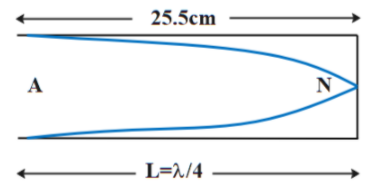
Also, the fundamental note in a closed tube is found using:
${{l}_{1}}=\dfrac{\lambda }{4}$
$\Rightarrow \lambda =4{{l}_{1}}$ ----(i)
Also, we know that for any given wave:
$v=\dfrac{\lambda }{T}$
$\Rightarrow v=\lambda f$ -----(ii)
Where $f$ is the frequency of the tuning fork or the fundamental frequency.
Thus, the speed can be found out using the above two formulae.
For ${{l}_{1}}=25.5cm=0.255m$
$\lambda =4\times 0.255m$
$\Rightarrow \lambda =1.02m$
Now, speed of sound:
$v=1.02\times 340$
$\Rightarrow v=346.8m/s$
Thus, the speed of sound in air is $346.8m/s$.
Note:
The speed of sound varies with respect to various parameters. It changes with the medium in which it is traveling. For example, the speed of sound is more in water than in air. It is because of the fact that air molecules are way apart from one another while the water molecules are closer to each other. This proximity of molecules makes the sound wave easy to be transmitted.
Formula Used:
${{l}_{1}}=\dfrac{\lambda }{4}$
$v=\lambda f$
Complete step by step answer:
Resonance is the phenomenon where the externally applied frequency becomes equal to the natural frequency of the body upon which it is applied. Resonance has various applications. The finding of the speed of sound using a resonance tube is one of them.
It is clearly mentioned in the question that one end of the tube is supported by a movable piston. This directly implies that it is the case of the resonance tube closed at one end.
In the resonance tube closed at one end, only odd harmonics are allowed to flow along with the fundamental frequency. This can be represented by the following diagram:
Also, the fundamental note in a closed tube is found using:
${{l}_{1}}=\dfrac{\lambda }{4}$
$\Rightarrow \lambda =4{{l}_{1}}$ ----(i)
Also, we know that for any given wave:
$v=\dfrac{\lambda }{T}$
$\Rightarrow v=\lambda f$ -----(ii)
Where $f$ is the frequency of the tuning fork or the fundamental frequency.
Thus, the speed can be found out using the above two formulae.
For ${{l}_{1}}=25.5cm=0.255m$
$\lambda =4\times 0.255m$
$\Rightarrow \lambda =1.02m$
Now, speed of sound:
$v=1.02\times 340$
$\Rightarrow v=346.8m/s$
Thus, the speed of sound in air is $346.8m/s$.
Note:
The speed of sound varies with respect to various parameters. It changes with the medium in which it is traveling. For example, the speed of sound is more in water than in air. It is because of the fact that air molecules are way apart from one another while the water molecules are closer to each other. This proximity of molecules makes the sound wave easy to be transmitted.
Recently Updated Pages
Master Class 11 Computer Science: Engaging Questions & Answers for Success

Master Class 11 Business Studies: Engaging Questions & Answers for Success
Master Class 11 Economics: Engaging Questions & Answers for Success
Master Class 11 English: Engaging Questions & Answers for Success
Master Class 11 Maths: Engaging Questions & Answers for Success
Master Class 11 Biology: Engaging Questions & Answers for Success
Trending doubts
One Metric ton is equal to kg A 10000 B 1000 C 100 class 11 physics CBSE
There are 720 permutations of the digits 1 2 3 4 5 class 11 maths CBSE
Discuss the various forms of bacteria class 11 biology CBSE
Draw a diagram of a plant cell and label at least eight class 11 biology CBSE
State the laws of reflection of light
Explain zero factorial class 11 maths CBSE