




A meter stick is placed vertically at the origin on a frictionless surface. A gentle push in $ + X$ direction is given to the top most point of the rod when it has fallen completely $X$ coordinate of center of rod is at:
(a) Origin
(b) $ - 0.5m$
(c) $ - 1m$
(d) $ + 0.5m$
Answer
 Verified
573.9k+ views
Hint: A meter stick is placed in a vertical direction at the origin on a frictionless surface. A gentle push in positive $X$-direction is given to the topmost point of the rod when it has fallen completely, $X$- coordinate of the center of mass of rod
Complete step by step solution:
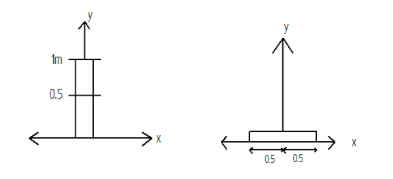
It looks like there is no external force applied on the rod along the x-axis.
After reading the statement “A gentle push in positive x-direction is given to the topmost point of the rod.”
But we know, if the external force acting on the particle is zero, the position of the center of mass remains the same. It doesn't change.
So, new $X$- coordinate of the center of mass of rod = initial x - coordinate of the center of mass of the rod.
We have the initial center of the mass \[ = {\text{ }}\left( {0,{\text{ }}0.5} \right)\]
That is initial $X$- coordinate of com \[ = {\text{ }}0\]
So, new $X$ - coordinate of com \[ = {\text{ }}0\]
But \[y\]-coordinate has changed because of a gravitational force acting along the \[y\]-axis. And it will be changed from \[0.5\] to zero as shown in the figure.
\[{\text{X }} = {\text{ }}0\] and \[{\text{Y }} = {\text{ }}0\] that is origin
Therefore the new center of mass of the rod is at the origin.
Hence, the correct answer is option (a).
Note:To know the frictionless surface we have to take the example of a skater. If there are no forces acting upon the skater and he is on a frictionless surface, then that means he has no net acceleration. If an object moves with the velocity and if there is no acceleration, then the velocity remains constant.
Complete step by step solution:
It looks like there is no external force applied on the rod along the x-axis.
After reading the statement “A gentle push in positive x-direction is given to the topmost point of the rod.”
But we know, if the external force acting on the particle is zero, the position of the center of mass remains the same. It doesn't change.
So, new $X$- coordinate of the center of mass of rod = initial x - coordinate of the center of mass of the rod.
We have the initial center of the mass \[ = {\text{ }}\left( {0,{\text{ }}0.5} \right)\]
That is initial $X$- coordinate of com \[ = {\text{ }}0\]
So, new $X$ - coordinate of com \[ = {\text{ }}0\]
But \[y\]-coordinate has changed because of a gravitational force acting along the \[y\]-axis. And it will be changed from \[0.5\] to zero as shown in the figure.
\[{\text{X }} = {\text{ }}0\] and \[{\text{Y }} = {\text{ }}0\] that is origin
Therefore the new center of mass of the rod is at the origin.
Hence, the correct answer is option (a).
Note:To know the frictionless surface we have to take the example of a skater. If there are no forces acting upon the skater and he is on a frictionless surface, then that means he has no net acceleration. If an object moves with the velocity and if there is no acceleration, then the velocity remains constant.
Recently Updated Pages
Master Class 11 Computer Science: Engaging Questions & Answers for Success

Master Class 11 Business Studies: Engaging Questions & Answers for Success
Master Class 11 Economics: Engaging Questions & Answers for Success
Master Class 11 English: Engaging Questions & Answers for Success
Master Class 11 Maths: Engaging Questions & Answers for Success
Master Class 11 Biology: Engaging Questions & Answers for Success
Trending doubts
One Metric ton is equal to kg A 10000 B 1000 C 100 class 11 physics CBSE
There are 720 permutations of the digits 1 2 3 4 5 class 11 maths CBSE
Discuss the various forms of bacteria class 11 biology CBSE
Draw a diagram of a plant cell and label at least eight class 11 biology CBSE
State the laws of reflection of light
Explain zero factorial class 11 maths CBSE