




A metallic sphere of radius 10.5 cm is melted and then recast into small cones each of radius 3.5 cm and height 3 cm. Find the number of cones thus formed
\[
{\text{A}}{\text{. }}216 \\
{\text{B}}{\text{. }}621 \\
{\text{C}}{\text{. }}162 \\
{\text{D}}{\text{. }}126 \\
\]
Answer
 Verified
631.5k+ views
Hint:- Whenever any object is converted into the other without any addition or reduction of the material used in it then the volume of both the object (i.e. before conversion and after conversion ) will be same and by keeping this in mind we can solve the questions by using the basic formulas of volume of sphere \[\left( {{\text{i}}{\text{.e}}{\text{. }}\dfrac{{\text{4}}}{{\text{3}}}{\pi }{{\text{r}}^3}} \right)\] and volume of cone \[\left( {\dfrac{{\text{1}}}{{\text{3}}}{\pi }{{\text{r}}^{\text{2}}}{\text{h}}} \right)\].
Complete step by step solution:
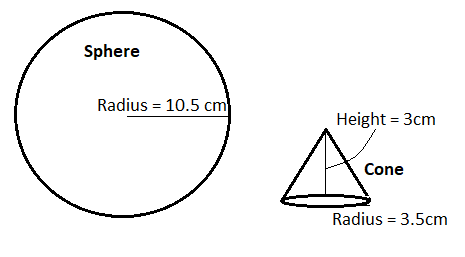
As we know that volume of sphere = \[\left( {{\text{i}}{\text{.e}}{\text{. }}\dfrac{{\text{4}}}{{\text{3}}}{\pi }{{\text{r}}^3}} \right)\]
Let us say that the radius of the sphere as \[{r_1}\].
So \[{r_1}\] = 10.5 cm
Now putting the value of \[{r_1}\] and \[\pi \]( i.e. \[\dfrac{{22}}{7}\]) in \[\left( {{\text{i}}{\text{.e}}{\text{. }}\dfrac{{\text{4}}}{{\text{3}}}{\pi }{{\text{r}}^3}} \right)\]
So, \[\left( {{\text{i}}{\text{.e}}{\text{. }}\dfrac{{\text{4}}}{{\text{3}}}{\pi }{{\text{r}}^3}} \right)\] = \[\left( {{\text{ }}\dfrac{{\text{4}}}{{\text{3}}} \times \dfrac{{22}}{7} \times {{(10.5)}^3}} \right)\]
Now by further solving the R.H.S of the above we will get
\[{\text{441}} \times {\text{11}}\] = \[{\text{4851c}}{{\text{m}}^{\text{3}}}\]
Now as we all know that the volume of cone = \[\left( {{\text{i}}{\text{.e}}{\text{. }}\dfrac{{\text{4}}}{{\text{3}}}{\pi }{{\text{r}}^3}} \right)\]
Let the radius of the cone be \[{r_2}\].
So, \[{r_2}\] = 3.5 cm and h = 3 cm
Now putting the value of \[{r_2}\]and h in \[\left( {\dfrac{{\text{1}}}{{\text{3}}}{\pi }{{\text{r}}^{\text{2}}}{\text{h}}} \right)\]
So, \[\left( {\dfrac{{\text{1}}}{{\text{3}}}{\pi }{{\text{r}}^{\text{2}}}{\text{h}}} \right)\] = \[\left( {{\text{ }}\dfrac{{\text{1}}}{{\text{3}}} \times \dfrac{{22}}{7} \times {{(3.5)}^{\text{2}}} \times 3} \right)\]
Now further solving the above R.H.S we will get
\[\left( {{\text{ }}\dfrac{{\text{1}}}{{\text{3}}} \times \pi \times {{{\text{(r)}}}^{\text{2}}} \times {\text{h}}} \right) = {\text{38}}{\text{.5c}}{{\text{m}}^{\text{3}}}\]
Now on dividing the values of volumes of both ( i.e. sphere and cones ) we will get the no of cones formed
So \[
\left( {{\text{number of cones formed = }}\dfrac{{{\text{volume of sphere}}}}{{{\text{volume of cone}}}}} \right) \\
\dfrac{{{\text{4851}}}}{{{\text{38}}{\text{.5}}}}{\text{ = 126}} \\
\]
By putting the values and further solving we will get
\[\dfrac{{{\text{4851}}}}{{{\text{38}}{\text{.5}}}}{\text{ = 126}}\]
So, the number of cones formed is 126 cones.
Hence, the correct option of this question is D.
NOTE:- Whenever we come up with this type of problem where we are given all the dimensions then first, we had to find the volume of sphere using the formula \[\left( {{\text{i}}{\text{.e}}{\text{. }}\dfrac{{\text{4}}}{{\text{3}}}{\pi }{{\text{r}}^3}} \right)\]. And after that we had to find the volume of the cone using the formula \[\left( {\dfrac{{\text{1}}}{{\text{3}}}{\pi }{{\text{r}}^{\text{2}}}{\text{h}}} \right)\]. Then after that we had to simply divide the volume of one cone from the volume to sphere to find the number of cones that can be formed. This will be the easiest and efficient way to find the solution of the problem.
Complete step by step solution:
As we know that volume of sphere = \[\left( {{\text{i}}{\text{.e}}{\text{. }}\dfrac{{\text{4}}}{{\text{3}}}{\pi }{{\text{r}}^3}} \right)\]
Let us say that the radius of the sphere as \[{r_1}\].
So \[{r_1}\] = 10.5 cm
Now putting the value of \[{r_1}\] and \[\pi \]( i.e. \[\dfrac{{22}}{7}\]) in \[\left( {{\text{i}}{\text{.e}}{\text{. }}\dfrac{{\text{4}}}{{\text{3}}}{\pi }{{\text{r}}^3}} \right)\]
So, \[\left( {{\text{i}}{\text{.e}}{\text{. }}\dfrac{{\text{4}}}{{\text{3}}}{\pi }{{\text{r}}^3}} \right)\] = \[\left( {{\text{ }}\dfrac{{\text{4}}}{{\text{3}}} \times \dfrac{{22}}{7} \times {{(10.5)}^3}} \right)\]
Now by further solving the R.H.S of the above we will get
\[{\text{441}} \times {\text{11}}\] = \[{\text{4851c}}{{\text{m}}^{\text{3}}}\]
Now as we all know that the volume of cone = \[\left( {{\text{i}}{\text{.e}}{\text{. }}\dfrac{{\text{4}}}{{\text{3}}}{\pi }{{\text{r}}^3}} \right)\]
Let the radius of the cone be \[{r_2}\].
So, \[{r_2}\] = 3.5 cm and h = 3 cm
Now putting the value of \[{r_2}\]and h in \[\left( {\dfrac{{\text{1}}}{{\text{3}}}{\pi }{{\text{r}}^{\text{2}}}{\text{h}}} \right)\]
So, \[\left( {\dfrac{{\text{1}}}{{\text{3}}}{\pi }{{\text{r}}^{\text{2}}}{\text{h}}} \right)\] = \[\left( {{\text{ }}\dfrac{{\text{1}}}{{\text{3}}} \times \dfrac{{22}}{7} \times {{(3.5)}^{\text{2}}} \times 3} \right)\]
Now further solving the above R.H.S we will get
\[\left( {{\text{ }}\dfrac{{\text{1}}}{{\text{3}}} \times \pi \times {{{\text{(r)}}}^{\text{2}}} \times {\text{h}}} \right) = {\text{38}}{\text{.5c}}{{\text{m}}^{\text{3}}}\]
Now on dividing the values of volumes of both ( i.e. sphere and cones ) we will get the no of cones formed
So \[
\left( {{\text{number of cones formed = }}\dfrac{{{\text{volume of sphere}}}}{{{\text{volume of cone}}}}} \right) \\
\dfrac{{{\text{4851}}}}{{{\text{38}}{\text{.5}}}}{\text{ = 126}} \\
\]
By putting the values and further solving we will get
\[\dfrac{{{\text{4851}}}}{{{\text{38}}{\text{.5}}}}{\text{ = 126}}\]
So, the number of cones formed is 126 cones.
Hence, the correct option of this question is D.
NOTE:- Whenever we come up with this type of problem where we are given all the dimensions then first, we had to find the volume of sphere using the formula \[\left( {{\text{i}}{\text{.e}}{\text{. }}\dfrac{{\text{4}}}{{\text{3}}}{\pi }{{\text{r}}^3}} \right)\]. And after that we had to find the volume of the cone using the formula \[\left( {\dfrac{{\text{1}}}{{\text{3}}}{\pi }{{\text{r}}^{\text{2}}}{\text{h}}} \right)\]. Then after that we had to simply divide the volume of one cone from the volume to sphere to find the number of cones that can be formed. This will be the easiest and efficient way to find the solution of the problem.
Recently Updated Pages
Master Class 12 Economics: Engaging Questions & Answers for Success

Master Class 12 English: Engaging Questions & Answers for Success
Master Class 12 Social Science: Engaging Questions & Answers for Success
Master Class 12 Maths: Engaging Questions & Answers for Success
Master Class 12 Physics: Engaging Questions & Answers for Success
Master Class 10 English: Engaging Questions & Answers for Success
Trending doubts
Explain the Treaty of Vienna of 1815 class 10 social science CBSE
Why is it 530 pm in india when it is 1200 afternoon class 10 social science CBSE
What is the full form of POSCO class 10 social science CBSE
Define Potential, Developed, Stock and Reserved resources
The speaker of the Lok Sabha is elected by the APresident class 10 social science CBSE
Complete the sentence with the most appropriate word class 10 english CBSE