




A metallic rod of length ′ℓ′ is tied to a string of length 2ℓ and made to rotate with angular speed ω on a horizontal table with one end of the string fixed. If there is a vertical magnetic field ′B′ in the region, the e.m.f. induced across the ends of the rod is:
A. $\dfrac{{3B\omega {l^2}}}{2}$
B. $\dfrac{{4B\omega {l^2}}}{2}$
C. $\dfrac{{5B\omega {l^2}}}{2}$
D. $\dfrac{{2B\omega {l^2}}}{2}$
Answer
 Verified
580.2k+ views
Hint: In electromagnetic induction when a conductor is moving with certain velocity in the presence of magnetic field then voltage will be generated across the conductor and this is called the induced emf. This happens due to change in the flux which is associated with that conductor. This problem is related to the induced emf.
Formula used:
$e = \dfrac{{B\omega {x^2}}}{2}$
Complete answer:
We have a term called the motional emf which is induced by the motion of a body in a constant magnetic field. The emf generated in this case is motional emf and its formula generally is given by $e = \dfrac{{B\omega {x^2}}}{2}$
Here e is the induced motional emf and $B$ is the magnetic flux density and $\omega $ is the angular velocity and $x$ is the effective length.
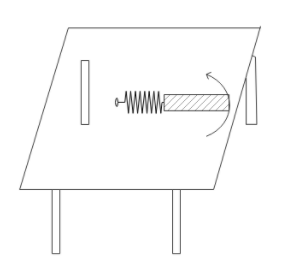
When the rod is rotating and if we see clearly we are asked to find out the emf between ends of the rod.
String is of length 2l and rod is of length l. Total length will be 3l and rod will be from 2l to 3l whereas from 0 to l there is a string. so in the formula $e = \dfrac{{B\omega {x^2}}}{2}$ we should apply the limits of effective length from 2l to 3l.
By applying limits we get as
Potential at 3l will be
${e_1} = \dfrac{{B\omega {x^2}}}{2}$
$\eqalign{
& \Rightarrow {e_1} = \dfrac{{B\omega {{(3L)}^2}}}{2} \cr
& \Rightarrow {e_1} = \dfrac{{9B\omega {{(L)}^2}}}{2} \cr} $
Potential at 2l will be
${e_2} = \dfrac{{B\omega {x^2}}}{2}$
$\eqalign{
& \Rightarrow {e_2} = \dfrac{{B\omega {{(2L)}^2}}}{2} \cr
& \Rightarrow {e_2} = \dfrac{{4B\omega {{(L)}^2}}}{2} \cr} $
So potential difference between to ends of rod will be
$\eqalign{
& {e_1} - {e_2} \cr
& \Rightarrow \dfrac{{9B\omega {{(L)}^2}}}{2} - \dfrac{{4B\omega {{(L)}^2}}}{2} \cr
& \Rightarrow \dfrac{{5B\omega {{(L)}^2}}}{2} \cr} $
Hence option C will be the answer.
Note:
The axis of rotation passes through the starting point of the string whereas the other end of the string is connected to the rod. If we directly apply limits from 0 to 3l we won’t get the correct answer because the rod lies from 2l to 3l but not from l to 3l .
Formula used:
$e = \dfrac{{B\omega {x^2}}}{2}$
Complete answer:
We have a term called the motional emf which is induced by the motion of a body in a constant magnetic field. The emf generated in this case is motional emf and its formula generally is given by $e = \dfrac{{B\omega {x^2}}}{2}$
Here e is the induced motional emf and $B$ is the magnetic flux density and $\omega $ is the angular velocity and $x$ is the effective length.
When the rod is rotating and if we see clearly we are asked to find out the emf between ends of the rod.
String is of length 2l and rod is of length l. Total length will be 3l and rod will be from 2l to 3l whereas from 0 to l there is a string. so in the formula $e = \dfrac{{B\omega {x^2}}}{2}$ we should apply the limits of effective length from 2l to 3l.
By applying limits we get as
Potential at 3l will be
${e_1} = \dfrac{{B\omega {x^2}}}{2}$
$\eqalign{
& \Rightarrow {e_1} = \dfrac{{B\omega {{(3L)}^2}}}{2} \cr
& \Rightarrow {e_1} = \dfrac{{9B\omega {{(L)}^2}}}{2} \cr} $
Potential at 2l will be
${e_2} = \dfrac{{B\omega {x^2}}}{2}$
$\eqalign{
& \Rightarrow {e_2} = \dfrac{{B\omega {{(2L)}^2}}}{2} \cr
& \Rightarrow {e_2} = \dfrac{{4B\omega {{(L)}^2}}}{2} \cr} $
So potential difference between to ends of rod will be
$\eqalign{
& {e_1} - {e_2} \cr
& \Rightarrow \dfrac{{9B\omega {{(L)}^2}}}{2} - \dfrac{{4B\omega {{(L)}^2}}}{2} \cr
& \Rightarrow \dfrac{{5B\omega {{(L)}^2}}}{2} \cr} $
Hence option C will be the answer.
Note:
The axis of rotation passes through the starting point of the string whereas the other end of the string is connected to the rod. If we directly apply limits from 0 to 3l we won’t get the correct answer because the rod lies from 2l to 3l but not from l to 3l .
Recently Updated Pages
Master Class 11 Computer Science: Engaging Questions & Answers for Success

Master Class 11 Business Studies: Engaging Questions & Answers for Success
Master Class 11 Economics: Engaging Questions & Answers for Success
Master Class 11 English: Engaging Questions & Answers for Success
Master Class 11 Maths: Engaging Questions & Answers for Success
Master Class 11 Biology: Engaging Questions & Answers for Success
Trending doubts
One Metric ton is equal to kg A 10000 B 1000 C 100 class 11 physics CBSE
There are 720 permutations of the digits 1 2 3 4 5 class 11 maths CBSE
Discuss the various forms of bacteria class 11 biology CBSE
Draw a diagram of a plant cell and label at least eight class 11 biology CBSE
State the laws of reflection of light
10 examples of friction in our daily life