




A metallic pipe 0.7 cm thick. Inner radius of the pipe is 3.5 cm and length is 5 dm. Find its total surface area.
Answer
 Verified
639.9k+ views
Hint: The total surface area of a cylindrical pipe is equal to the sum of inner curved surface area, outer curved surface area and the area of the rims at both the ends of the pipe. Don’t forget to convert all the quantities to proper units before using them in the formulas.
Complete step-by-step answer:
To start with the question let us draw the diagram of the pipe.
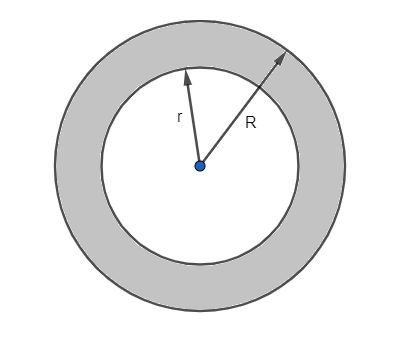
The above diagram shows the view of the pipe if we see it from one end.
Now first let us find the inner curved surface area of the cylindrical pipe. It is given that the inner radius r of the pipe is 3.5 cm and length of the cylinder is 5 dm, which is equal to 50 cm.
$\text{Inner curved surface area =2}\pi rh$ .
Also, the outer curved surface area of the cylindrical pipe can be found using the outer radius, which is equal to r + thickness = 3.5+07=4.2 cm. Height in this case also remains the same.
$\text{Outer curved surface area =2}\pi {{R}}h=2\pi \left( r+0.7 \right)h$
We can also see from the figure that the area of the rim on one side is equal to the area of the larger circle minus the area of the smaller circle, and there are 2 such rims, one at each end.
$\text{Area of the 2 rims =2}\left( \pi {{R}^{2}}-\pi {{r}^{2}} \right)=2\left( \pi {{\left( r+0.7 \right)}^{2}}-\pi {{r}^{2}} \right)$
Now the total surface area of a cylindrical pipe is equal to the sum of inner curved surface area, outer curved surface area and the area of the rims at both the ends of the pipe.
$\therefore \text{Total surface area=2}\pi rh+2\pi \left( r+0.7 \right)h-2\pi {{r}^{2}}+2\pi {{\left( r+0.7 \right)}^{2}}$
$\Rightarrow \text{Total surface area=}\left( 3.5\times 50+\left( 3.5+0.7 \right)\times 50-{{\left( 3.5 \right)}^{2}}+{{\left( 3.5+0.7 \right)}^{2}} \right)2\pi $
$\Rightarrow \text{Total surface area=}\left( 175+210-12.25+17.64 \right)2\pi $
\[\Rightarrow \text{Total surface area=780}\text{.78}\pi \]
Now if we put the value of $\pi =3.14$ , we get
\[\text{Total surface area=2451}\text{.65c}{{\text{m}}^{2}}\]
Therefore, the answer to the above question is 2451.65 sq. cm.
Note: The first thing to keep in mind in such questions is that the area of the rim must be considered and cannot be neglected. Also, be careful about the calculation part as there is a high chance of making a mistake in the calculation part.
Complete step-by-step answer:
To start with the question let us draw the diagram of the pipe.
The above diagram shows the view of the pipe if we see it from one end.
Now first let us find the inner curved surface area of the cylindrical pipe. It is given that the inner radius r of the pipe is 3.5 cm and length of the cylinder is 5 dm, which is equal to 50 cm.
$\text{Inner curved surface area =2}\pi rh$ .
Also, the outer curved surface area of the cylindrical pipe can be found using the outer radius, which is equal to r + thickness = 3.5+07=4.2 cm. Height in this case also remains the same.
$\text{Outer curved surface area =2}\pi {{R}}h=2\pi \left( r+0.7 \right)h$
We can also see from the figure that the area of the rim on one side is equal to the area of the larger circle minus the area of the smaller circle, and there are 2 such rims, one at each end.
$\text{Area of the 2 rims =2}\left( \pi {{R}^{2}}-\pi {{r}^{2}} \right)=2\left( \pi {{\left( r+0.7 \right)}^{2}}-\pi {{r}^{2}} \right)$
Now the total surface area of a cylindrical pipe is equal to the sum of inner curved surface area, outer curved surface area and the area of the rims at both the ends of the pipe.
$\therefore \text{Total surface area=2}\pi rh+2\pi \left( r+0.7 \right)h-2\pi {{r}^{2}}+2\pi {{\left( r+0.7 \right)}^{2}}$
$\Rightarrow \text{Total surface area=}\left( 3.5\times 50+\left( 3.5+0.7 \right)\times 50-{{\left( 3.5 \right)}^{2}}+{{\left( 3.5+0.7 \right)}^{2}} \right)2\pi $
$\Rightarrow \text{Total surface area=}\left( 175+210-12.25+17.64 \right)2\pi $
\[\Rightarrow \text{Total surface area=780}\text{.78}\pi \]
Now if we put the value of $\pi =3.14$ , we get
\[\text{Total surface area=2451}\text{.65c}{{\text{m}}^{2}}\]
Therefore, the answer to the above question is 2451.65 sq. cm.
Note: The first thing to keep in mind in such questions is that the area of the rim must be considered and cannot be neglected. Also, be careful about the calculation part as there is a high chance of making a mistake in the calculation part.
Recently Updated Pages
Master Class 12 Economics: Engaging Questions & Answers for Success

Master Class 12 English: Engaging Questions & Answers for Success
Master Class 12 Social Science: Engaging Questions & Answers for Success
Master Class 12 Maths: Engaging Questions & Answers for Success
Master Class 12 Physics: Engaging Questions & Answers for Success
Master Class 9 General Knowledge: Engaging Questions & Answers for Success
Trending doubts
Explain the Treaty of Vienna of 1815 class 10 social science CBSE
Why is it 530 pm in india when it is 1200 afternoon class 10 social science CBSE
What is the full form of POSCO class 10 social science CBSE
Define Potential, Developed, Stock and Reserved resources
Which Country Has the Largest Border with India?
Complete the sentence with the most appropriate word class 10 english CBSE