




A metallic chain 1m long lies on a horizontal surface of a table. The chain starts sliding on the table if $25cm$ (or more of it) hangs over the edge of a table. The correct value of the coefficient of friction between the table and the chain is
\[(A)\dfrac{1}{3}\]
\[(B)\dfrac{2}{3}\]
\[(C)\dfrac{1}{4}\]
\[(D)\dfrac{1}{5}\]
Answer
 Verified
558k+ views
Hint: In order to find the correct value of the coefficient of friction between the table and the chain, we need to equate the forces which are acting on the metallic chain. The force is the force of gravity which is acting on the part of the chain which is hanging. The other force is the force of friction and this acts on the part of the chain which is lying on the table. On equating these two forces, we will get the answer.
Complete step by step solution:
The diagram for the given question is:
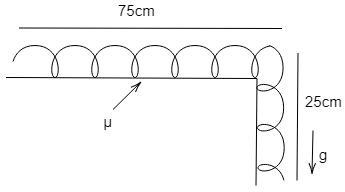
According to the question,
Let us consider the mass of this particular chain be $m$
In the question, it is given that the chain starts sliding on the table if $25cm$ (or more of it) hangs over the edge of a table. The chain starts moving, which means that the force of gravity becomes equal to the force of friction.
So, we can write that,
Force of gravity on $25cm$ of chain = Force of friction on the rest $75cm$ of chain (equation 1)
Force of gravity on $25cm$ of chain $ = 0.25mg$
Similarly, Force of friction on the rest $75cm$ of chain $ = 0.75\mu mg$
On putting the value of the above two forces in equation 1, we get,
$0.25mg = 0.75\mu mg$
On cancelling the common terms on both the sides,
$0.25 = 0.75\mu $
$\mu = \dfrac{{0.25}}{{0.75}}$
On simplifying the fraction,
$\mu = \dfrac{1}{3}$
The correct value of the coefficient of friction between the table and the chain is $\mu = \dfrac{1}{3}$.
So, the final answer is \[(A)\dfrac{1}{3}\].
Note:
It is important to note that there are basically two types of forces of friction. The first force of friction is the static force of friction and this force of friction acts on a body when the body is in a state of rest. The other type of force of friction is the kinetic force of friction and this force of friction acts on a body which is in motion.
Complete step by step solution:
The diagram for the given question is:
According to the question,
Let us consider the mass of this particular chain be $m$
In the question, it is given that the chain starts sliding on the table if $25cm$ (or more of it) hangs over the edge of a table. The chain starts moving, which means that the force of gravity becomes equal to the force of friction.
So, we can write that,
Force of gravity on $25cm$ of chain = Force of friction on the rest $75cm$ of chain (equation 1)
Force of gravity on $25cm$ of chain $ = 0.25mg$
Similarly, Force of friction on the rest $75cm$ of chain $ = 0.75\mu mg$
On putting the value of the above two forces in equation 1, we get,
$0.25mg = 0.75\mu mg$
On cancelling the common terms on both the sides,
$0.25 = 0.75\mu $
$\mu = \dfrac{{0.25}}{{0.75}}$
On simplifying the fraction,
$\mu = \dfrac{1}{3}$
The correct value of the coefficient of friction between the table and the chain is $\mu = \dfrac{1}{3}$.
So, the final answer is \[(A)\dfrac{1}{3}\].
Note:
It is important to note that there are basically two types of forces of friction. The first force of friction is the static force of friction and this force of friction acts on a body when the body is in a state of rest. The other type of force of friction is the kinetic force of friction and this force of friction acts on a body which is in motion.
Recently Updated Pages
If x a + bt + ct2 where x is in meters and t is in class 11 physics CBSE

A car covers the first half distance between two places class 11 physics CBSE
The resultant of two vectors overrightarrow P and overrightarrow class 11 physics CBSE
Find the value of cos 135 class 11 maths CBSE
A mass M is held in place by an applied force F and class 11 physics CBSE
A solution of glucose in water is labelled as 10 dfracwv class 11 chemistry CBSE
Trending doubts
One Metric ton is equal to kg A 10000 B 1000 C 100 class 11 physics CBSE
Find the value of the expression given below sin 30circ class 11 maths CBSE
What do you mean by retardation What is its SI uni class 11 physics CBSE
Draw a diagram of nephron and explain its structur class 11 biology CBSE
10 examples of friction in our daily life
Difference between physical and chemical change class 11 chemistry CBSE