




A metallic block of density 5 gm/${cm}^{3}$ and having dimensions \[5cm\times 5cm\times 5cm\] is weighed in water. Its apparent weight will be.
A. \[5\times 5\times 5\times 5\]gf
B. \[4\times 4\times 4\times 4\] gf
C. \[5\times 4\times 4\times 4\] gf
D. \[4\times 5\times 5\times 5\]gf
Answer
 Verified
577.5k+ views
Hint: To find the apparent weight of the given block, we will first find the actual weight of the block using the given density of the block. We will then substitute this value in the formula for the apparent weight of a body. We know, that buoyant force is the force exerted on an object that is fully or partially submerged in liquid. This force is equal to the weight of the liquid dispersed by the body.
Formula Used: - \[W=v\rho g\], Where $v$=voume of liquid, $\rho$= density of block
\[{{W}_{0}}=W\left[ 1-\dfrac{1}{\sigma } \right]\]
Complete step-by-step solution:
We know that the relative density of the material is the ratio of the density of the material over a reference material such as water for liquid and solid, and air for gas
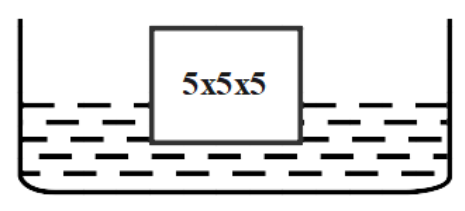
Let us first write the given parameters,
\[\rho =5gm/c{{m}^{3}}\] …………….. (1)
\[volume(v)=5\times 5\times 5\] ……………….. (2)
The actual weight say W is given by,
\[W=mg\]
We know, that weight is terms of density is given by,
\[W=v\rho g\] ……………………… (\[\because \rho =\dfrac{m}{v} \]) …………… (3)
From (1), (2) and (3)
We get,
\[W=5\times 5\times 5\times 5\times g\] dyne
We have not substituted the value of g as in option it is still unsubstituted.
Now,
We know the formula to for the apparent weight is given by,
\[{{W}_{0}}=W\left[ 1-\dfrac{1}{\sigma } \right]\] dyne
After substituting the values,
We get,
\[{{W}_{0}}=5\times 5\times 5\times 5\times g\left[ 1-\dfrac{1}{5} \right]\] dyne
On solving the equation, we get,
\[{{W}_{0=}}5\times 5\times 5\times 5\times \dfrac{4}{5}g\] dyne
Rearrange the terms,
\[{{W}_{0}}=4\times 5\times 5\times 5g\] dyne
We know that,
\[1dyne={{10}^{-5}}N\]
Let,
\[f={{10}^{-5}}\]
Therefore,
\[{{W}_{0}}=4\times 5\times 5\times 5gf\] N.
Therefore, the correct answer is option D.
Note: Apparent weight is a property of an object which determines how heavy the given object is. The difference between actual weight and apparent weight is that true weight is the mass of the object times the gravity and apparent weight is the sum of net force when submerged in liquid or other cases like standing in an elevator or floating in the lower of the earth. The concept of apparent weight is mostly used to find the apparent weight of a body in an elevator. It is also useful when applied in fluidization.
Formula Used: - \[W=v\rho g\], Where $v$=voume of liquid, $\rho$= density of block
\[{{W}_{0}}=W\left[ 1-\dfrac{1}{\sigma } \right]\]
Complete step-by-step solution:
We know that the relative density of the material is the ratio of the density of the material over a reference material such as water for liquid and solid, and air for gas
Let us first write the given parameters,
\[\rho =5gm/c{{m}^{3}}\] …………….. (1)
\[volume(v)=5\times 5\times 5\] ……………….. (2)
The actual weight say W is given by,
\[W=mg\]
We know, that weight is terms of density is given by,
\[W=v\rho g\] ……………………… (\[\because \rho =\dfrac{m}{v} \]) …………… (3)
From (1), (2) and (3)
We get,
\[W=5\times 5\times 5\times 5\times g\] dyne
We have not substituted the value of g as in option it is still unsubstituted.
Now,
We know the formula to for the apparent weight is given by,
\[{{W}_{0}}=W\left[ 1-\dfrac{1}{\sigma } \right]\] dyne
After substituting the values,
We get,
\[{{W}_{0}}=5\times 5\times 5\times 5\times g\left[ 1-\dfrac{1}{5} \right]\] dyne
On solving the equation, we get,
\[{{W}_{0=}}5\times 5\times 5\times 5\times \dfrac{4}{5}g\] dyne
Rearrange the terms,
\[{{W}_{0}}=4\times 5\times 5\times 5g\] dyne
We know that,
\[1dyne={{10}^{-5}}N\]
Let,
\[f={{10}^{-5}}\]
Therefore,
\[{{W}_{0}}=4\times 5\times 5\times 5gf\] N.
Therefore, the correct answer is option D.
Note: Apparent weight is a property of an object which determines how heavy the given object is. The difference between actual weight and apparent weight is that true weight is the mass of the object times the gravity and apparent weight is the sum of net force when submerged in liquid or other cases like standing in an elevator or floating in the lower of the earth. The concept of apparent weight is mostly used to find the apparent weight of a body in an elevator. It is also useful when applied in fluidization.
Recently Updated Pages
Master Class 11 Computer Science: Engaging Questions & Answers for Success

Master Class 11 Business Studies: Engaging Questions & Answers for Success
Master Class 11 Economics: Engaging Questions & Answers for Success
Master Class 11 English: Engaging Questions & Answers for Success
Master Class 11 Maths: Engaging Questions & Answers for Success
Master Class 11 Biology: Engaging Questions & Answers for Success
Trending doubts
One Metric ton is equal to kg A 10000 B 1000 C 100 class 11 physics CBSE
There are 720 permutations of the digits 1 2 3 4 5 class 11 maths CBSE
Discuss the various forms of bacteria class 11 biology CBSE
Draw a diagram of a plant cell and label at least eight class 11 biology CBSE
State the laws of reflection of light
Explain zero factorial class 11 maths CBSE