




A metal pipe is 77 cm long. The inner diameter of a cross-section is 4 cm, the outer diameter being 4.4 cm (see figure). Find its
(i). Inner curved surface area
(ii). Outer curved surface area
(iii). Total surface area
Answer
 Verified
609.6k+ views
Hint: To solve this question one should have knowledge of shapes and also remember that Inner curved surface area =$2\pi rl$, where r is inner radius and curved surface area =$2\pi Rl$, where R is the outer radius.
Complete step-by-step solution
And total surface area of a hollow cylindrical pipe =$2\pi (R + r)(R - r + h)$, where h is the height or length of the pipe.
According to question, length of cylindrical pipe = 77cm
Since, Inner diameter = 4cm
Therefore, Inner radius = $\dfrac{4}{2} = 2cm$
Also, Outer diameter is given = 4.4cm
So, Outer radius = $\dfrac{{4.4cm}}{2} = 2.2cm$
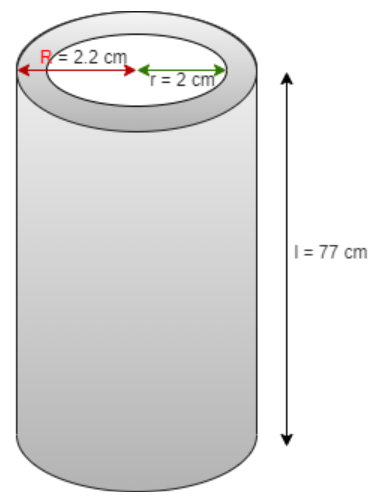
We know that formula of Inner curved surface area = $2\pi rl$ here r is the inner radius and l is the length of the metal pipe
So, substituting the values in the above formula, we get
Inner curved surface area = $2 \times \dfrac{{22}}{7} \times 2 \times 77 = 968c{m^2}$
Also, we know that formula of Outer curved surface area = $2\pi Rl$ here R is the outer radius and l is the length of the metal pipe
Now substituting the values in the above formula, we get
Outer curved surface area = $2 \times \dfrac{{22}}{7} \times 2.2 \times 77 = 1064.8c{m^2}$
So, to find the Total surface area which is equal to inner surface area of metal pipe + outer surface area of metal pipe + surface area of both bases
And we know that surface area of base can be found as; area of outer circle – area of inner circle
And we know that area of circle is equal to $\pi {r^2}$here r is the radius
Therefore, surface area of base = \[\pi {R^2} - \pi {r^2}\]
So, Total surface area = $2\pi (R + r)(R - r + h)$
Now substituting the values in the above formula, we get
Total surface area = $2 \times \dfrac{{22}}{7}(2.2 + 2)(2.2 - 2 + 77)c{m^2}$= $\dfrac{{44}}{7} \times 4.2 \times 77.2c{m^2} = 2038.08c{m^2}$
(i). Hence, Inner curved surface area = $968c{m^2}$
(ii). Outer curved surface area = $1064.8c{m^2}$
(iii). And, total surface area = $2038.08c{m^2}$
Note: Total surface area can also be calculated by adding inner curved surface area, outer curved surface, and twice the area of the concentric circle which was formed by outer radius and inner radius. Area of concentric circle =$\pi {R^2} - \pi {r^2}$, where R = radius of outer circle and r = radius of inner circle.
Complete step-by-step solution
And total surface area of a hollow cylindrical pipe =$2\pi (R + r)(R - r + h)$, where h is the height or length of the pipe.
According to question, length of cylindrical pipe = 77cm
Since, Inner diameter = 4cm
Therefore, Inner radius = $\dfrac{4}{2} = 2cm$
Also, Outer diameter is given = 4.4cm
So, Outer radius = $\dfrac{{4.4cm}}{2} = 2.2cm$
We know that formula of Inner curved surface area = $2\pi rl$ here r is the inner radius and l is the length of the metal pipe
So, substituting the values in the above formula, we get
Inner curved surface area = $2 \times \dfrac{{22}}{7} \times 2 \times 77 = 968c{m^2}$
Also, we know that formula of Outer curved surface area = $2\pi Rl$ here R is the outer radius and l is the length of the metal pipe
Now substituting the values in the above formula, we get
Outer curved surface area = $2 \times \dfrac{{22}}{7} \times 2.2 \times 77 = 1064.8c{m^2}$
So, to find the Total surface area which is equal to inner surface area of metal pipe + outer surface area of metal pipe + surface area of both bases
And we know that surface area of base can be found as; area of outer circle – area of inner circle
And we know that area of circle is equal to $\pi {r^2}$here r is the radius
Therefore, surface area of base = \[\pi {R^2} - \pi {r^2}\]
So, Total surface area = $2\pi (R + r)(R - r + h)$
Now substituting the values in the above formula, we get
Total surface area = $2 \times \dfrac{{22}}{7}(2.2 + 2)(2.2 - 2 + 77)c{m^2}$= $\dfrac{{44}}{7} \times 4.2 \times 77.2c{m^2} = 2038.08c{m^2}$
(i). Hence, Inner curved surface area = $968c{m^2}$
(ii). Outer curved surface area = $1064.8c{m^2}$
(iii). And, total surface area = $2038.08c{m^2}$
Note: Total surface area can also be calculated by adding inner curved surface area, outer curved surface, and twice the area of the concentric circle which was formed by outer radius and inner radius. Area of concentric circle =$\pi {R^2} - \pi {r^2}$, where R = radius of outer circle and r = radius of inner circle.
Recently Updated Pages
Master Class 11 Social Science: Engaging Questions & Answers for Success

Master Class 11 Chemistry: Engaging Questions & Answers for Success
Master Class 12 Business Studies: Engaging Questions & Answers for Success
Master Class 12 Chemistry: Engaging Questions & Answers for Success
Master Class 12 Biology: Engaging Questions & Answers for Success
Class 12 Question and Answer - Your Ultimate Solutions Guide
Trending doubts
What is the situation called when no party gets the class 9 social science CBSE
Find the sum of series 1 + 2 + 3 + 4 + 5 + + 100 class 9 maths CBSE
Fill the blanks with the suitable prepositions 1 The class 9 english CBSE
Difference Between Plant Cell and Animal Cell
What is pollution? How many types of pollution? Define it
Name 10 Living and Non living things class 9 biology CBSE