




A metal cylinder with height 10cm and diameter of base 70 cm is melted to make a number of small discs with radius 1cm and thickness 0.5cm. How many such discs could be made from the cylinder?
Answer
 Verified
649.5k+ views
Hint- Here, the metal cylinder is melted to make discs. So, discs will be made from the same amount of material which is used to make the cylinder. So we will calculate the volume of the cylinder and we will calculate the volume of one disc. After this, we will do simple mathematics to get the number of discs.
Complete step-by-step solution -
Here, first of all we have to find the volume of the cylinder
Given, the diameter of the base is 70cm
So radius=$70/2 = 35{\text{ cm}}$
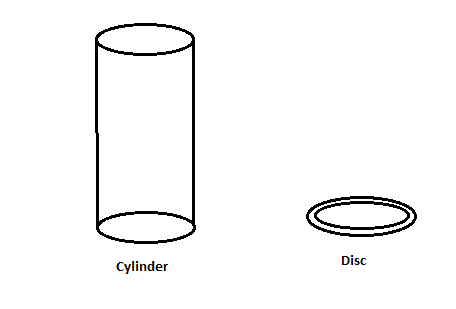
And the height of the cylinder is 10cm.
So, the volume of the cylinder is given by
$
{\text{V = (base area * height)}} \\
{\text{V = (}}\pi {r^2}*10) \\
{\text{V = 10}}\pi {{\text{r}}^2} \\
$
${\text{V = 10}}\pi {{\text{(35)}}^2}$
Now, the cylinder is melted to make small discs of radius 1 cm and thickness 0.5 cm.
So, the volume of discs is given by
$
= ({\text{area of the disc )*(thickness of the disc)}} \\
{\text{ = (}}\pi {{\text{r}}^2})*(0.5) \\
= (\pi *{1^2})*(0.5) \\
= \pi /2 \\
$
The number of such discs that can be made from the material of cylinder will be equal to
$
= \dfrac{{{\text{Volume of cylinder}}}}{{{\text{Volume of 1 disc}}}} \\
= \dfrac{{10\pi * 35 * 35}}{{\dfrac{\pi }{2}}} \\
= 2 * 10 * 35 * 35 \\
= 24,500{\text{ discs}} \\
$
Note- In these types of questions, the main idea is to balance the entity before starting any process and after ending the process. It is like balancing the equation. In the above question, we calculated the volume before melting. So, the volume should remain the same after melting is the key idea for solving the question.
Complete step-by-step solution -
Here, first of all we have to find the volume of the cylinder
Given, the diameter of the base is 70cm
So radius=$70/2 = 35{\text{ cm}}$
And the height of the cylinder is 10cm.
So, the volume of the cylinder is given by
$
{\text{V = (base area * height)}} \\
{\text{V = (}}\pi {r^2}*10) \\
{\text{V = 10}}\pi {{\text{r}}^2} \\
$
${\text{V = 10}}\pi {{\text{(35)}}^2}$
Now, the cylinder is melted to make small discs of radius 1 cm and thickness 0.5 cm.
So, the volume of discs is given by
$
= ({\text{area of the disc )*(thickness of the disc)}} \\
{\text{ = (}}\pi {{\text{r}}^2})*(0.5) \\
= (\pi *{1^2})*(0.5) \\
= \pi /2 \\
$
The number of such discs that can be made from the material of cylinder will be equal to
$
= \dfrac{{{\text{Volume of cylinder}}}}{{{\text{Volume of 1 disc}}}} \\
= \dfrac{{10\pi * 35 * 35}}{{\dfrac{\pi }{2}}} \\
= 2 * 10 * 35 * 35 \\
= 24,500{\text{ discs}} \\
$
Note- In these types of questions, the main idea is to balance the entity before starting any process and after ending the process. It is like balancing the equation. In the above question, we calculated the volume before melting. So, the volume should remain the same after melting is the key idea for solving the question.
Recently Updated Pages
Master Class 11 English: Engaging Questions & Answers for Success

Master Class 11 Social Science: Engaging Questions & Answers for Success
Master Class 11 Maths: Engaging Questions & Answers for Success
Master Class 11 Biology: Engaging Questions & Answers for Success
Master Class 11 Physics: Engaging Questions & Answers for Success
Master Class 11 Chemistry: Engaging Questions & Answers for Success
Trending doubts
Explain the Treaty of Vienna of 1815 class 10 social science CBSE
What is the full form of CNG A Complete Natural Gas class 10 social science CBSE
In cricket, what is a "Yorker" designed to do?
What is the full form of POSCO class 10 social science CBSE
Define Potential, Developed, Stock and Reserved resources
What were the majoritarian measures taken in Sri Lanka class 10 social science CBSE