




A metal cube of side $11cm$ is completely submerged in water contained in a cylindrical vessel with the diameter $28cm$. Find the rise in the level of water.
Answer
 Verified
653.4k+ views
Hint: If some volume is dipped in any cylindrical vessel containing water, its volume will increase by the volume that is dipped. And we can find the rise in the level of water easily.
Complete step-by-step answer: Question is saying that there is a cylindrical vessel with diameter $28cm$ containing water at some height. Now if we completely submerge the metal cube of side $11cm$, the level of water rises. We need to find how much that water level rises.
So let us assume initially water level in the cylindrical vessel will be $h$ and as we submerged the metal cube its level increases to a total height say $L$
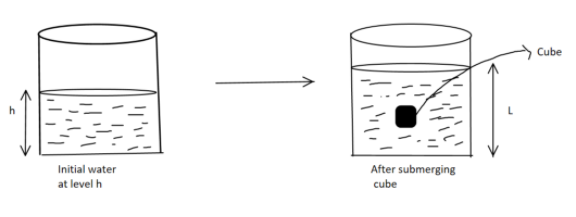
So we can say that the change in volume of a cylindrical vessel from level $h\,to\,L$ must be equal to the volume of metal added.
Now we need to find the initial and final volume of the vessel containing water.
Initial volume of cylindrical vessel $ = \pi {r^2}h$
Here water level is at $h$
$ \Rightarrow $ Now according to question diameter are given equal to $28 cm$. Hence we know that radius is equal to half the diameter that means
$r = \dfrac{{28}}{2} cm = 14 cm$.
$ * $ Now, final volume of cylindrical vessel containing cube and water $ = \pi {r^2}L$
Here water level rises to length $L$
$ * $And we also require to find out the value of metal cube that is submerged in the cylindrical vessel $ = {a^3}$
Here $a$ is the side of cube which is $11 cm$ in our question
Now we know
Final volume of cylindrical vessel $ - $ Initial volume of cylindrical vessel $ = $ Volume of metal cube
$\pi {r^2}L - \pi {r^2}h = {a^3}$
Now we know
$
r = 14cm \\
a = 11cm \\
\pi = \dfrac{{22}}{7} \\
$
$
\therefore \,\dfrac{{22}}{7} \times 14 \times 14 \times L - \dfrac{{22}}{7} \times 14 \times 14 \times h = {\left( {11} \right)^3} \\
616L - 616h = 1331 \\
616(L - h) = 1331 \\
(L - h) = \dfrac{{1331}}{{616}} \\
L - h = 2.16 cm \\
$
Here $L - h$ is the rise in water level
Hence the rise of water level by submerging metal cube of side $11cm$ is $2.16 cm$
Note: We can also do this question by using
Area of cylindrical vessel $ \times $ Height of rise in water level $ = $ Area of metal cube submerged
$
\pi {r^2}h = {a^3} \\
\dfrac{{22}}{7} \times 14 \times 14 \times h = {11^3} \\
h = \dfrac{{1331}}{{616}} = 2.16 cm \\
$
$h$ is the height of rise in water level in a cylindrical vessel.
Complete step-by-step answer: Question is saying that there is a cylindrical vessel with diameter $28cm$ containing water at some height. Now if we completely submerge the metal cube of side $11cm$, the level of water rises. We need to find how much that water level rises.
So let us assume initially water level in the cylindrical vessel will be $h$ and as we submerged the metal cube its level increases to a total height say $L$
So we can say that the change in volume of a cylindrical vessel from level $h\,to\,L$ must be equal to the volume of metal added.
Now we need to find the initial and final volume of the vessel containing water.
Initial volume of cylindrical vessel $ = \pi {r^2}h$
Here water level is at $h$
$ \Rightarrow $ Now according to question diameter are given equal to $28 cm$. Hence we know that radius is equal to half the diameter that means
$r = \dfrac{{28}}{2} cm = 14 cm$.
$ * $ Now, final volume of cylindrical vessel containing cube and water $ = \pi {r^2}L$
Here water level rises to length $L$
$ * $And we also require to find out the value of metal cube that is submerged in the cylindrical vessel $ = {a^3}$
Here $a$ is the side of cube which is $11 cm$ in our question
Now we know
Final volume of cylindrical vessel $ - $ Initial volume of cylindrical vessel $ = $ Volume of metal cube
$\pi {r^2}L - \pi {r^2}h = {a^3}$
Now we know
$
r = 14cm \\
a = 11cm \\
\pi = \dfrac{{22}}{7} \\
$
$
\therefore \,\dfrac{{22}}{7} \times 14 \times 14 \times L - \dfrac{{22}}{7} \times 14 \times 14 \times h = {\left( {11} \right)^3} \\
616L - 616h = 1331 \\
616(L - h) = 1331 \\
(L - h) = \dfrac{{1331}}{{616}} \\
L - h = 2.16 cm \\
$
Here $L - h$ is the rise in water level
Hence the rise of water level by submerging metal cube of side $11cm$ is $2.16 cm$
Note: We can also do this question by using
Area of cylindrical vessel $ \times $ Height of rise in water level $ = $ Area of metal cube submerged
$
\pi {r^2}h = {a^3} \\
\dfrac{{22}}{7} \times 14 \times 14 \times h = {11^3} \\
h = \dfrac{{1331}}{{616}} = 2.16 cm \\
$
$h$ is the height of rise in water level in a cylindrical vessel.
Recently Updated Pages
Differentiate between voluntary action and reflex class 10 biology CBSE

The uses of bleaching powder are A It is used bleaching class 10 chemistry CBSE
Fill in the blanks with abstract nouns of the words class 10 english CBSE
How many threedigit numbers are there class 10 maths CBSE
What is a reflex arc class 10 biology CBSE
Construct a square whose diagonal is 6cm Measure the class 10 maths CBSE
Trending doubts
Explain the Treaty of Vienna of 1815 class 10 social science CBSE
The slogan Jai Hind was given by A Lal Bahadur Shastri class 10 social science CBSE
10 examples of evaporation in daily life with explanations
What is the full form of POSCO class 10 social science CBSE
Identify the feminine form of noun nephew a shenephew class 10 english CBSE
CSIR full form?