




A metal container is in the form of a cylinder surmounted by a hemisphere of the same radius. The internal height of the cylinder is 7 m and the internal radius of the cylinder is 3.5 m. Calculate the total surface area of the container.
Answer
 Verified
619.8k+ views
Hint: otal surface area of the container will be sum of total surface area of cylinder and total surface area of hemisphere. Can be calculated using formula $2\pi {{r}^{2}}$and total surface area of cylinder will be $\left( 2\pi rh+\pi {{r}^{2}} \right)$.
Complete step-by-step solution:
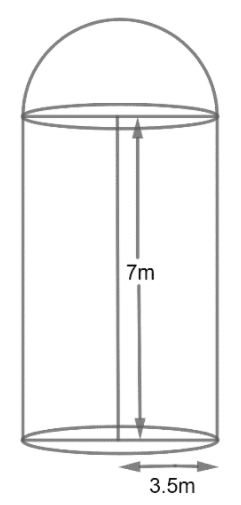
According to the question, we have to find the total surface area of this container.
The total surface area of this container will be the sum of the total surface area of the hemispherical part and the total surface area of the cylindrical part.
The total surface area of the hemispherical part will be the curved surface area of the hemispherical part as the base of the hemisphere is open.
i.e. TSA of the hemispherical part = CSA of the hemisphere
= $2\pi {{r}^{2}}...........\left( 1 \right)$
Where ‘r’ is the radius of the sphere.
Now, for the cylindrical part,
TSA of cylindrical part will be the sum of curved surface area of the cylinder and area of the base as top of the cylinder is open.
i.e. TSA of cylindrical part = CSA of cylinder + area of base
$=2\pi rh+\pi {{r}^{2}}................\left( 2 \right)$
As we know, formula for;
$\begin{align}
& \text{CSA of cylinder}=2\pi rh \\
& and \\
& \text{Area of circle}=\pi {{r}^{2}}\left( \text{base will be circular} \right) \\
\end{align}$
From equation (1) and (2), we can write that;
\[\text{TSA of hemispherical part}+\text{TSA of cylindrical part}=2\pi {{r}^{2}}+2\pi rh+\pi {{r}^{2}}\]
On putting r = 3.5 and h = 7 m, we will get; \[\left( \text{TSA of hemispherical part} \right)+\left( \text{TSA of cylindrical part} \right)=2\pi {{\left( 3.5 \right)}^{2}}+2\pi \left( 3.5 \right)\left( 7 \right)+\pi {{\left( 3.5 \right)}^{2}}\] And we know that;
TSA of container = (TSA of hemispherical part) + (TSA of cylindrical part)
$\Rightarrow \text{TSA of container} =2\pi {{\left( 3.5 \right)}^{2}}+2\pi \left( 3.5 \right)\left( 7 \right)+\pi \left( 3.5 \right)\left( 3.5 \right)$
Taking $\pi $ common in RHS, we will get;
\[\begin{align}
&\text{TSA of container}=\pi \left[ 2{{\left( 3.5 \right)}^{2}}+\left( 2 \right)\left( 3.5 \right)\left( 7 \right)+\left( 3.5 \right)\left( 3.5 \right) \right] \\
& =\pi \left[ 24.50+49+12.25 \right] \\
& =\pi \left[ 35.75 \right] \\
\end{align}\]
Taking \[\pi =3.14\], we will get;
$\begin{align}
& \text{TSA of container}=3.14\times 35.75 \\
& \text{TSA of container} =269.255{{m}^{2}} \\
\end{align}$
Total surface area of the container will be twice of the above calculated value. As, total surface include total surface area of the inner surface of the container as well as outer surface area of the container.
Hence, the required total surface area of the container
$\begin{align}
& =\left( 2\times 269.255 \right){{m}^{2}} \\
& =538.51{{m}^{2}} \\
\end{align}$
Note: A student can do a mistake by calculating the total surface area of one side of the container. But in question, it is clearly mentioned that we need to find the total surface area of the container. So, the total surface area will include the outer surface area as well as the inner surface area of the container.
Complete step-by-step solution:
According to the question, we have to find the total surface area of this container.
The total surface area of this container will be the sum of the total surface area of the hemispherical part and the total surface area of the cylindrical part.
The total surface area of the hemispherical part will be the curved surface area of the hemispherical part as the base of the hemisphere is open.
i.e. TSA of the hemispherical part = CSA of the hemisphere
= $2\pi {{r}^{2}}...........\left( 1 \right)$
Where ‘r’ is the radius of the sphere.
Now, for the cylindrical part,
TSA of cylindrical part will be the sum of curved surface area of the cylinder and area of the base as top of the cylinder is open.
i.e. TSA of cylindrical part = CSA of cylinder + area of base
$=2\pi rh+\pi {{r}^{2}}................\left( 2 \right)$
As we know, formula for;
$\begin{align}
& \text{CSA of cylinder}=2\pi rh \\
& and \\
& \text{Area of circle}=\pi {{r}^{2}}\left( \text{base will be circular} \right) \\
\end{align}$
From equation (1) and (2), we can write that;
\[\text{TSA of hemispherical part}+\text{TSA of cylindrical part}=2\pi {{r}^{2}}+2\pi rh+\pi {{r}^{2}}\]
On putting r = 3.5 and h = 7 m, we will get; \[\left( \text{TSA of hemispherical part} \right)+\left( \text{TSA of cylindrical part} \right)=2\pi {{\left( 3.5 \right)}^{2}}+2\pi \left( 3.5 \right)\left( 7 \right)+\pi {{\left( 3.5 \right)}^{2}}\] And we know that;
TSA of container = (TSA of hemispherical part) + (TSA of cylindrical part)
$\Rightarrow \text{TSA of container} =2\pi {{\left( 3.5 \right)}^{2}}+2\pi \left( 3.5 \right)\left( 7 \right)+\pi \left( 3.5 \right)\left( 3.5 \right)$
Taking $\pi $ common in RHS, we will get;
\[\begin{align}
&\text{TSA of container}=\pi \left[ 2{{\left( 3.5 \right)}^{2}}+\left( 2 \right)\left( 3.5 \right)\left( 7 \right)+\left( 3.5 \right)\left( 3.5 \right) \right] \\
& =\pi \left[ 24.50+49+12.25 \right] \\
& =\pi \left[ 35.75 \right] \\
\end{align}\]
Taking \[\pi =3.14\], we will get;
$\begin{align}
& \text{TSA of container}=3.14\times 35.75 \\
& \text{TSA of container} =269.255{{m}^{2}} \\
\end{align}$
Total surface area of the container will be twice of the above calculated value. As, total surface include total surface area of the inner surface of the container as well as outer surface area of the container.
Hence, the required total surface area of the container
$\begin{align}
& =\left( 2\times 269.255 \right){{m}^{2}} \\
& =538.51{{m}^{2}} \\
\end{align}$
Note: A student can do a mistake by calculating the total surface area of one side of the container. But in question, it is clearly mentioned that we need to find the total surface area of the container. So, the total surface area will include the outer surface area as well as the inner surface area of the container.
Recently Updated Pages
Master Class 11 Social Science: Engaging Questions & Answers for Success

Master Class 11 English: Engaging Questions & Answers for Success
Master Class 11 Maths: Engaging Questions & Answers for Success
Master Class 11 Chemistry: Engaging Questions & Answers for Success
Master Class 11 Biology: Engaging Questions & Answers for Success
Class 11 Question and Answer - Your Ultimate Solutions Guide
Trending doubts
Explain the Treaty of Vienna of 1815 class 10 social science CBSE
Why is it 530 pm in india when it is 1200 afternoon class 10 social science CBSE
What is the full form of POSCO class 10 social science CBSE
Define Potential, Developed, Stock and Reserved resources
Which Country Has the Largest Border with India?
Choose the feminine form of the given noun Fox AFoxess class 10 english CBSE