




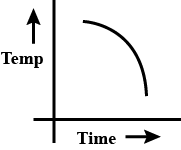
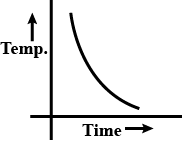
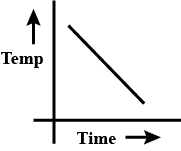
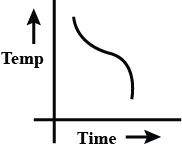
A metal block is heated well above the room temperature and then left to cool in the room. Choose the correct graph which shows the rate of cooling.
a.
b.
c.
d.
Answer
 Verified
531.9k+ views
Hint: When expressed in terms of temperature differences, Newton's law (along with a few additional simplifying assumptions including a low Biot number and a temperature-independent heat capacity) yields a simple differential equation that expresses temperature difference as a function of time. The solution to that equation represents a reduction in temperature differential over time that is exponential. Newton's law of cooling is also linked to this signature decay of the temperature difference.
Complete step-by-step answer:
The rate at which an exposed body changes temperature by radiation is roughly proportional to the difference between the object's temperature and its environment, given the difference is slight, according to Newton's law of cooling. The rate of heat loss from a body is directly proportional to the difference in temperature between the body and its surroundings, according to Newton's law of cooling.
It Is given by the formula
${\text{dT}}/{\text{dt}} = {\text{k}}\left( {{{\text{T}}_{\text{t}}} - {{\text{T}}_{\text{s}}}} \right)$
${{\text{T}}_{\text{t}}} = $temperature of the body at time t and
${{\text{T}}_{\text{s}}} = $temperature of the surrounding,
K = The area and function of the body's surface under consideration determine the positive constant.
Now according to the Newton's law of cooling
$ \Rightarrow {\text{ rate of cooling }}\alpha {\text{ temperature}}$
$\theta \to {\text{ temp }}$
$\dfrac{{d\theta }}{{dt}}\alpha \left( {\theta - {\theta _0}} \right)$
$\dfrac{{d\theta }}{{dt}} = \alpha \left( {\theta - {\theta _0}} \right)\quad (\alpha = {\text{ constant }})$
$\int_{{\theta _i}}^\theta {\dfrac{{d\theta }}{{\left( {\theta - {\theta _0}} \right)}}} = \int_0^t \alpha dt$
$ \Rightarrow \theta = {\theta _0} + \left( {{\theta _1} - {\theta _0}} \right){e^{ - \alpha t}}$
From this we deduce the graph is exponential
So, the correct answer is “Option B”.
Note: When the internal thermal resistance inside the material is minimal in contrast to the resistance to heat transfer away from the object's surface (by external conduction or convection), which is the case for which the Biot number is less than about 0.1, simple methods for temporary cooling of an object can be obtained. This condition allows for the assumption of a single, roughly uniform body temperature that varies with time but not with location. (Otherwise, the body will be at a variety of temperatures at any given time.) As time passes, the temperature of this single object can change exponentially.
Complete step-by-step answer:
The rate at which an exposed body changes temperature by radiation is roughly proportional to the difference between the object's temperature and its environment, given the difference is slight, according to Newton's law of cooling. The rate of heat loss from a body is directly proportional to the difference in temperature between the body and its surroundings, according to Newton's law of cooling.
It Is given by the formula
${\text{dT}}/{\text{dt}} = {\text{k}}\left( {{{\text{T}}_{\text{t}}} - {{\text{T}}_{\text{s}}}} \right)$
${{\text{T}}_{\text{t}}} = $temperature of the body at time t and
${{\text{T}}_{\text{s}}} = $temperature of the surrounding,
K = The area and function of the body's surface under consideration determine the positive constant.
Now according to the Newton's law of cooling
$ \Rightarrow {\text{ rate of cooling }}\alpha {\text{ temperature}}$
$\theta \to {\text{ temp }}$
$\dfrac{{d\theta }}{{dt}}\alpha \left( {\theta - {\theta _0}} \right)$
$\dfrac{{d\theta }}{{dt}} = \alpha \left( {\theta - {\theta _0}} \right)\quad (\alpha = {\text{ constant }})$
$\int_{{\theta _i}}^\theta {\dfrac{{d\theta }}{{\left( {\theta - {\theta _0}} \right)}}} = \int_0^t \alpha dt$
$ \Rightarrow \theta = {\theta _0} + \left( {{\theta _1} - {\theta _0}} \right){e^{ - \alpha t}}$
From this we deduce the graph is exponential
So, the correct answer is “Option B”.
Note: When the internal thermal resistance inside the material is minimal in contrast to the resistance to heat transfer away from the object's surface (by external conduction or convection), which is the case for which the Biot number is less than about 0.1, simple methods for temporary cooling of an object can be obtained. This condition allows for the assumption of a single, roughly uniform body temperature that varies with time but not with location. (Otherwise, the body will be at a variety of temperatures at any given time.) As time passes, the temperature of this single object can change exponentially.
Recently Updated Pages
Master Class 12 Social Science: Engaging Questions & Answers for Success

Master Class 12 Physics: Engaging Questions & Answers for Success
Master Class 12 Maths: Engaging Questions & Answers for Success
Master Class 12 Economics: Engaging Questions & Answers for Success
Master Class 12 Chemistry: Engaging Questions & Answers for Success
Master Class 12 Business Studies: Engaging Questions & Answers for Success
Trending doubts
Which are the Top 10 Largest Countries of the World?
Draw a labelled sketch of the human eye class 12 physics CBSE
Explain the structure of megasporangium class 12 biology CBSE
What are the major means of transport Explain each class 12 social science CBSE
How many chromosomes are found in human ovum a 46 b class 12 biology CBSE
The diagram of the section of a maize grain is given class 12 biology CBSE