




(A) Mention any two conditions for liquefying a gas.
(B) What happens to the intermolecular distances during liquefaction of gas?
Answer
 Verified
559.5k+ views
Hint: In the given question we need to mention conditions for liquefying a gas. Liquefying a gas is defined as the change in the state or the conversion of gas into liquid. So, we can focus on the parameters which are changing during the conversion of gas into liquid. For the next part of the question we can consider some force acting on a molecule. So, by observing the changes in some parameters we can easily solve the question.
Complete step by step answer:
First, we know that according to Kinetic theory of gases, gases are made up of molecules which are always in continuous motion and the molecules are separated from each other by large empty spaces.
The conditions for liquefying a gas are:
By lowering the temperature,
By increasing the pressure,
Or by application of both.
Now let’s try understand the concept,
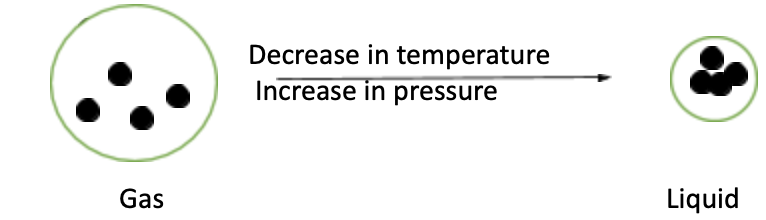
When the pressure is high and temperature is low, molecules slow down and move into smaller areas and occupy small volumes. If we decrease the temperature molecules will move more closely to each other and the gas changes into a liquid state.
After understanding the above concept it’s very easy to understand that during liquefaction there is an increase in pressure or decrease in temperature or both. At that time molecules come closer to each other and the intermolecular force of attraction increases and which also leads to decrease in intermolecular distances during liquefaction of gas.
Note: The minimum pressure required to liquefy the gas at its critical temperature is called its critical temperature. It is denoted by \[{P_C}\] . For example critical pressure for \[C{O_2} = 72.8atm\]. The parameters \[{P_C},{T_C},{V_C}\] for a gas are collectively called as critical constants.
Complete step by step answer:
First, we know that according to Kinetic theory of gases, gases are made up of molecules which are always in continuous motion and the molecules are separated from each other by large empty spaces.
The conditions for liquefying a gas are:
By lowering the temperature,
By increasing the pressure,
Or by application of both.
Now let’s try understand the concept,
When the pressure is high and temperature is low, molecules slow down and move into smaller areas and occupy small volumes. If we decrease the temperature molecules will move more closely to each other and the gas changes into a liquid state.
After understanding the above concept it’s very easy to understand that during liquefaction there is an increase in pressure or decrease in temperature or both. At that time molecules come closer to each other and the intermolecular force of attraction increases and which also leads to decrease in intermolecular distances during liquefaction of gas.
Note: The minimum pressure required to liquefy the gas at its critical temperature is called its critical temperature. It is denoted by \[{P_C}\] . For example critical pressure for \[C{O_2} = 72.8atm\]. The parameters \[{P_C},{T_C},{V_C}\] for a gas are collectively called as critical constants.
Recently Updated Pages
Master Class 11 Computer Science: Engaging Questions & Answers for Success

Master Class 11 Business Studies: Engaging Questions & Answers for Success
Master Class 11 Economics: Engaging Questions & Answers for Success
Master Class 11 English: Engaging Questions & Answers for Success
Master Class 11 Maths: Engaging Questions & Answers for Success
Master Class 11 Biology: Engaging Questions & Answers for Success
Trending doubts
One Metric ton is equal to kg A 10000 B 1000 C 100 class 11 physics CBSE
There are 720 permutations of the digits 1 2 3 4 5 class 11 maths CBSE
Discuss the various forms of bacteria class 11 biology CBSE
Draw a diagram of a plant cell and label at least eight class 11 biology CBSE
State the laws of reflection of light
Explain zero factorial class 11 maths CBSE