




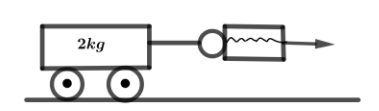
A massless spring balance is attached to a $2\,kg$ trolley and is used to pull the trolley along a flat surface as shown in figure. The reading on the spring balance remains at $10\,kg$ during the motion. The acceleration of the trolley is (use $g = 9.8\,m{s^{ - 2}}$)
A. $4.9\,m{s^{ - 2}}$
B. $9.8\,m{s^{ - 2}}$
C. $49\,m{s^{ - 2}}$
D. $98\,m{s^{ - 2}}$
Answer
 Verified
532.8k+ views
Hint: In the above data given the massless spring is attached to a trolley to pull the trolley on a flat surface. The spring balance remains some weight while the trolley is in motion. For this they have been given to calculate the acceleration of the body. For calculating the given data we are using Newton's second law of motion.
Formula used:
$F = ma$
Where $m$ is mass of the body, $F$ is force and $A$ is acceleration.
Complete step by step answer:
Given data, $g = 9.8\,m{s^{ - 2}}$, Mass of the spring, $m = 10\,kg$. For calculating acceleration from Newton's second law of motion. In the above formula we have all the values except force $F$ , for this now we are going to calculate the force $F$ value.For calculating force $F$, we are using the formula force of gravity
That means $F = mg$
We have mass value and given in the question, $g$ value already we written the values of $g$ and $m$ in given data,
So $F = 10 \times 9.8$
Force, $F = 98$
We have calculated force value, now we are going to calculate the acceleration value from newton’s second law of motion,
$F = ma \\
\Rightarrow a = \dfrac{F}{m} \\ $
Where $F$ is force already calculated, $m$ is the mass of the trolley that means,
$m = 2\,kg$
Now substitute the values in acceleration formula, we get
$a = \dfrac{{98}}{2}$
Therefore, $a = 49\,m{s^{ - 2}}$
We have calculated the acceleration of the trolley.
Hence the correct option is C.
Note: From the given data only we have calculated the acceleration of the trolley.For this we have the formula Newton’s second law of motion. Before calculating the acceleration we have calculated the force value from the force of gravity formula and then we have calculated the acceleration value.
Formula used:
$F = ma$
Where $m$ is mass of the body, $F$ is force and $A$ is acceleration.
Complete step by step answer:
Given data, $g = 9.8\,m{s^{ - 2}}$, Mass of the spring, $m = 10\,kg$. For calculating acceleration from Newton's second law of motion. In the above formula we have all the values except force $F$ , for this now we are going to calculate the force $F$ value.For calculating force $F$, we are using the formula force of gravity
That means $F = mg$
We have mass value and given in the question, $g$ value already we written the values of $g$ and $m$ in given data,
So $F = 10 \times 9.8$
Force, $F = 98$
We have calculated force value, now we are going to calculate the acceleration value from newton’s second law of motion,
$F = ma \\
\Rightarrow a = \dfrac{F}{m} \\ $
Where $F$ is force already calculated, $m$ is the mass of the trolley that means,
$m = 2\,kg$
Now substitute the values in acceleration formula, we get
$a = \dfrac{{98}}{2}$
Therefore, $a = 49\,m{s^{ - 2}}$
We have calculated the acceleration of the trolley.
Hence the correct option is C.
Note: From the given data only we have calculated the acceleration of the trolley.For this we have the formula Newton’s second law of motion. Before calculating the acceleration we have calculated the force value from the force of gravity formula and then we have calculated the acceleration value.
Recently Updated Pages
Master Class 11 Social Science: Engaging Questions & Answers for Success

Master Class 11 English: Engaging Questions & Answers for Success
Master Class 11 Maths: Engaging Questions & Answers for Success
Master Class 11 Chemistry: Engaging Questions & Answers for Success
Master Class 11 Biology: Engaging Questions & Answers for Success
Master Class 11 Physics: Engaging Questions & Answers for Success
Trending doubts
Differentiate between an exothermic and an endothermic class 11 chemistry CBSE
One Metric ton is equal to kg A 10000 B 1000 C 100 class 11 physics CBSE
Difference Between Prokaryotic Cells and Eukaryotic Cells
There are 720 permutations of the digits 1 2 3 4 5 class 11 maths CBSE
Draw a diagram of a plant cell and label at least eight class 11 biology CBSE
1 Quintal is equal to a 110 kg b 10 kg c 100kg d 1000 class 11 physics CBSE