




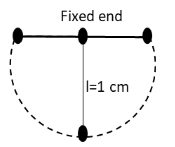
A mass of 2kg is suspended from a steel wire of length 1m and cross-sectional area \[{10^{ - 6}}\,{\text{mete}}{{\text{r}}^2}\] to form a pendulum arrangement. If the mass is moved to one side and released from the horizontal position of wire then find the maximum extension in the length of the wire.
Answer
 Verified
588.9k+ views
Hint: Use the formula for Young’s modulus for the material of an object. Calculate the force acting on the mass suspended by the steel wire which is the weight of the mass and centripetal force acting on this mass suspended. Use the value of the Young’s modulus for the steel. Substitute all the values in the formula and calculate the extension of the steel wire.
Formulae used:
The Young’s modulus \[Y\] for the material of an object is given by
\[Y = \dfrac{{FL}}{{A\Delta L}}\] …… (1)
Here, \[F\] is the force acting on the object, \[L\] is the original length of the object, \[A\] is the cross sectional area of the object and \[\Delta L\] is the change in length of the object.
The centripetal force \[{F_C}\] acting on an object is
\[{F_C} = \dfrac{{m{v^2}}}{R}\] …… (2)
Here, \[m\] is the mass of the object, \[v\] is the velocity of the object and \[R\] is the radius of the circular path.
Complete step by step solution:
We have given that the mass of \[2\,{\text{kg}}\] suspended from the steel wire is and the length of the steel wire is \[1\,{\text{m}}\].
\[m = 2\,{\text{kg}}\]
\[L = 1\,{\text{m}}\]
The cross-sectional area of the steel wire is \[{10^{ - 6}}\,{{\text{m}}^2}\].
\[A = {10^{ - 6}}\,{{\text{m}}^2}\]
The Young’s modulus for the steel material is \[2 \times {10^{11}}\,{\text{N}} \cdot {{\text{m}}^2}\].
\[Y = 2 \times {10^{11}}\,{\text{N}} \cdot {{\text{m}}^2}\]
We have asked to calculate the extension in the length of the steel wire.
The weight of the mass suspended is given by
\[W = mg\]
Substitute \[2\,{\text{kg}}\] for \[m\] and \[10\,{\text{m/}}{{\text{s}}^2}\] for \[g\] in the above equation.
\[W = \left( {2\,{\text{kg}}} \right)\left( {10\,{\text{m/}}{{\text{s}}^2}} \right)\]
\[ \Rightarrow W = 20\,{\text{N}}\]
Hence, the weight of the mass suspended is \[20\,{\text{N}}\].
The centripetal force acting on the suspended mass is given by
\[{F_C} = \dfrac{{m{v^2}}}{l}\]
Substitute \[\sqrt {2gl} \] for \[v\] in the above equation.
\[{F_C} = \dfrac{{m{{\left( {\sqrt {2gl} } \right)}^2}}}{l}\]
\[ \Rightarrow {F_C} = 2mg\]
Substitute \[20\,{\text{N}}\] for \[mg\] in the above equation.
\[ \Rightarrow {F_C} = 2\left( {20\,{\text{N}}} \right)\]
\[ \Rightarrow {F_C} = 40\,{\text{N}}\]
The force acting on the steel wire is the sum of weight of the mass suspended and centripetal force acting on the suspended mass.
\[F = W + {F_C}\]
Let us calculate the extension in the steel wire.
Substitute \[W + {F_C}\] for \[F\] in equation (1).
\[Y = \dfrac{{\left( {W + {F_C}} \right)L}}{{A\Delta L}}\]
Rearrange the above equation for \[\Delta L\].
\[\Delta L = \dfrac{{WL}}{{AY}}\]
Substitute \[20\,{\text{N}}\] for \[W\], \[40\,{\text{N}}\] for \[{F_C}\], \[1\,{\text{m}}\] for \[L\], \[{10^{ - 6}}\,{{\text{m}}^2}\] for \[A\] and \[2 \times {10^{11}}\,{\text{N}} \cdot {{\text{m}}^2}\] for \[Y\] in the above equation.
\[\Delta L = \dfrac{{\left( {20\,{\text{N}} + 40\,{\text{N}}} \right)\left( {1\,{\text{m}}} \right)}}{{\left( {{{10}^{ - 6}}\,{{\text{m}}^2}} \right)\left( {2 \times {{10}^{11}}\,{\text{N}} \cdot {{\text{m}}^2}} \right)}}\]
\[ \Rightarrow \Delta L = 3 \times {10^{ - 4}}\,{\text{m}}\]
\[ \therefore \Delta L = 0.3\,{\text{mm}}\]
Hence, the extension in the length of the steel wire is \[0.3\,{\text{mm}}\].
Note: The students should keep in mind that the force acting on the mass is not only the weight of the mass. Since the mass attached to the steel wire performs circular motion about its mean position. Hence, the net force acting on this mass is the sum of weight of the mass and centripetal force acting on the mass.
Formulae used:
The Young’s modulus \[Y\] for the material of an object is given by
\[Y = \dfrac{{FL}}{{A\Delta L}}\] …… (1)
Here, \[F\] is the force acting on the object, \[L\] is the original length of the object, \[A\] is the cross sectional area of the object and \[\Delta L\] is the change in length of the object.
The centripetal force \[{F_C}\] acting on an object is
\[{F_C} = \dfrac{{m{v^2}}}{R}\] …… (2)
Here, \[m\] is the mass of the object, \[v\] is the velocity of the object and \[R\] is the radius of the circular path.
Complete step by step solution:
We have given that the mass of \[2\,{\text{kg}}\] suspended from the steel wire is and the length of the steel wire is \[1\,{\text{m}}\].
\[m = 2\,{\text{kg}}\]
\[L = 1\,{\text{m}}\]
The cross-sectional area of the steel wire is \[{10^{ - 6}}\,{{\text{m}}^2}\].
\[A = {10^{ - 6}}\,{{\text{m}}^2}\]
The Young’s modulus for the steel material is \[2 \times {10^{11}}\,{\text{N}} \cdot {{\text{m}}^2}\].
\[Y = 2 \times {10^{11}}\,{\text{N}} \cdot {{\text{m}}^2}\]
We have asked to calculate the extension in the length of the steel wire.
The weight of the mass suspended is given by
\[W = mg\]
Substitute \[2\,{\text{kg}}\] for \[m\] and \[10\,{\text{m/}}{{\text{s}}^2}\] for \[g\] in the above equation.
\[W = \left( {2\,{\text{kg}}} \right)\left( {10\,{\text{m/}}{{\text{s}}^2}} \right)\]
\[ \Rightarrow W = 20\,{\text{N}}\]
Hence, the weight of the mass suspended is \[20\,{\text{N}}\].
The centripetal force acting on the suspended mass is given by
\[{F_C} = \dfrac{{m{v^2}}}{l}\]
Substitute \[\sqrt {2gl} \] for \[v\] in the above equation.
\[{F_C} = \dfrac{{m{{\left( {\sqrt {2gl} } \right)}^2}}}{l}\]
\[ \Rightarrow {F_C} = 2mg\]
Substitute \[20\,{\text{N}}\] for \[mg\] in the above equation.
\[ \Rightarrow {F_C} = 2\left( {20\,{\text{N}}} \right)\]
\[ \Rightarrow {F_C} = 40\,{\text{N}}\]
The force acting on the steel wire is the sum of weight of the mass suspended and centripetal force acting on the suspended mass.
\[F = W + {F_C}\]
Let us calculate the extension in the steel wire.
Substitute \[W + {F_C}\] for \[F\] in equation (1).
\[Y = \dfrac{{\left( {W + {F_C}} \right)L}}{{A\Delta L}}\]
Rearrange the above equation for \[\Delta L\].
\[\Delta L = \dfrac{{WL}}{{AY}}\]
Substitute \[20\,{\text{N}}\] for \[W\], \[40\,{\text{N}}\] for \[{F_C}\], \[1\,{\text{m}}\] for \[L\], \[{10^{ - 6}}\,{{\text{m}}^2}\] for \[A\] and \[2 \times {10^{11}}\,{\text{N}} \cdot {{\text{m}}^2}\] for \[Y\] in the above equation.
\[\Delta L = \dfrac{{\left( {20\,{\text{N}} + 40\,{\text{N}}} \right)\left( {1\,{\text{m}}} \right)}}{{\left( {{{10}^{ - 6}}\,{{\text{m}}^2}} \right)\left( {2 \times {{10}^{11}}\,{\text{N}} \cdot {{\text{m}}^2}} \right)}}\]
\[ \Rightarrow \Delta L = 3 \times {10^{ - 4}}\,{\text{m}}\]
\[ \therefore \Delta L = 0.3\,{\text{mm}}\]
Hence, the extension in the length of the steel wire is \[0.3\,{\text{mm}}\].
Note: The students should keep in mind that the force acting on the mass is not only the weight of the mass. Since the mass attached to the steel wire performs circular motion about its mean position. Hence, the net force acting on this mass is the sum of weight of the mass and centripetal force acting on the mass.
Recently Updated Pages
Master Class 11 Social Science: Engaging Questions & Answers for Success

Master Class 11 English: Engaging Questions & Answers for Success
Master Class 11 Maths: Engaging Questions & Answers for Success
Master Class 11 Chemistry: Engaging Questions & Answers for Success
Master Class 11 Biology: Engaging Questions & Answers for Success
Master Class 11 Physics: Engaging Questions & Answers for Success
Trending doubts
Differentiate between an exothermic and an endothermic class 11 chemistry CBSE
One Metric ton is equal to kg A 10000 B 1000 C 100 class 11 physics CBSE
Difference Between Prokaryotic Cells and Eukaryotic Cells
There are 720 permutations of the digits 1 2 3 4 5 class 11 maths CBSE
Two of the body parts which do not appear in MRI are class 11 biology CBSE
Which gas is abundant in air class 11 chemistry CBSE