




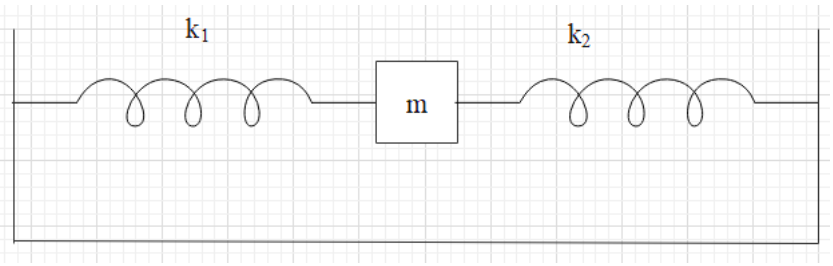
When a mass $m$ which is vibrating with spring of spring constant ${{k}_{1}}$. Its frequency will be \[3Hz\] and with spring of spring constant \[{{k}_{2}}\] and its frequency will be \[6Hz\]. Then what will be the frequency of oscillations when mass is connected with spring as represented in the diagram?
\[\begin{align}
& A.6.7 \\
& B.4.5 \\
& C.9 \\
& D.3 \\
\end{align}\]
Answer
 Verified
576.9k+ views
Hint: The frequency can be found by taking the square root of the ratio of the spring constant to the mass of the spring. Find out the equation for both the spring constant. As these two springs are parallel then their resultant spring constant will be found by taking the sum of both the spring constant. Calculate the resultant frequency also. This will help you in answering this question.
Complete answer:
The frequency can be found by taking the square root of the ratio of the spring constant to the mass of the spring. That is,
\[{{\omega }_{1}}=\sqrt{\dfrac{{{k}_{1}}}{m}}\]
As the frequency has been mentioned to be \[3Hz\], substituting this in the equation will give,
\[\begin{align}
& 3=\sqrt{\dfrac{{{k}_{1}}}{m}} \\
& \Rightarrow {{\left( 3 \right)}^{2}}m={{k}_{1}}=9m \\
\end{align}\]
In the same way, for the spring constant \[{{k}_{2}}\], we can write that,
\[{{\omega }_{2}}=\sqrt{\dfrac{{{k}_{2}}}{m}}\]
As the frequency for this case has been mentioned in the question as,
\[{{\omega }_{2}}=6Hz\]
Substituting this value in the equation will give,
\[\begin{align}
& 6=\sqrt{\dfrac{{{k}_{2}}}{m}} \\
& \Rightarrow {{\left( 6 \right)}^{2}}m={{k}_{2}} \\
& \therefore 36m={{k}_{2}} \\
\end{align}\]
Now both the springs are connected in parallel. Therefore we can write that the resultant spring constant will be found by taking the sum of both the spring constant. That is,
\[{{k}_{net}}={{k}_{1}}+{{k}_{2}}\]
Substituting the values in it will give,
\[{{k}_{net}}=9m+36m=45m\]
Therefore the net frequency can be found by the equation,
\[{{\omega }_{net}}=\sqrt{\dfrac{{{k}_{net}}}{m}}\]
Substituting the values in it will give,
\[{{\omega }_{net}}=\sqrt{\dfrac{45m}{m}}=\sqrt{45}Hz=6.7Hz\]
Hence the correct answer has been obtained as option A.
Note:
The frequency of oscillation has been defined as the total number of complete oscillations a body is performing in a unit time period. It can be found by taking the reciprocal of the time period of the body. The unit can be expressed in hertz.
Complete answer:
The frequency can be found by taking the square root of the ratio of the spring constant to the mass of the spring. That is,
\[{{\omega }_{1}}=\sqrt{\dfrac{{{k}_{1}}}{m}}\]
As the frequency has been mentioned to be \[3Hz\], substituting this in the equation will give,
\[\begin{align}
& 3=\sqrt{\dfrac{{{k}_{1}}}{m}} \\
& \Rightarrow {{\left( 3 \right)}^{2}}m={{k}_{1}}=9m \\
\end{align}\]
In the same way, for the spring constant \[{{k}_{2}}\], we can write that,
\[{{\omega }_{2}}=\sqrt{\dfrac{{{k}_{2}}}{m}}\]
As the frequency for this case has been mentioned in the question as,
\[{{\omega }_{2}}=6Hz\]
Substituting this value in the equation will give,
\[\begin{align}
& 6=\sqrt{\dfrac{{{k}_{2}}}{m}} \\
& \Rightarrow {{\left( 6 \right)}^{2}}m={{k}_{2}} \\
& \therefore 36m={{k}_{2}} \\
\end{align}\]
Now both the springs are connected in parallel. Therefore we can write that the resultant spring constant will be found by taking the sum of both the spring constant. That is,
\[{{k}_{net}}={{k}_{1}}+{{k}_{2}}\]
Substituting the values in it will give,
\[{{k}_{net}}=9m+36m=45m\]
Therefore the net frequency can be found by the equation,
\[{{\omega }_{net}}=\sqrt{\dfrac{{{k}_{net}}}{m}}\]
Substituting the values in it will give,
\[{{\omega }_{net}}=\sqrt{\dfrac{45m}{m}}=\sqrt{45}Hz=6.7Hz\]
Hence the correct answer has been obtained as option A.
Note:
The frequency of oscillation has been defined as the total number of complete oscillations a body is performing in a unit time period. It can be found by taking the reciprocal of the time period of the body. The unit can be expressed in hertz.
Recently Updated Pages
Master Class 11 English: Engaging Questions & Answers for Success

Master Class 11 Maths: Engaging Questions & Answers for Success
Master Class 11 Biology: Engaging Questions & Answers for Success
Master Class 11 Social Science: Engaging Questions & Answers for Success
Master Class 11 Physics: Engaging Questions & Answers for Success
Master Class 11 Accountancy: Engaging Questions & Answers for Success
Trending doubts
One Metric ton is equal to kg A 10000 B 1000 C 100 class 11 physics CBSE
Discuss the various forms of bacteria class 11 biology CBSE
Draw a diagram of a plant cell and label at least eight class 11 biology CBSE
State the laws of reflection of light
Explain zero factorial class 11 maths CBSE
10 examples of friction in our daily life