




A mass $M{\text{ kg}}$ is suspended by a weightless string. The horizontal force that is required to displace it until the string makes an angle of $45^\circ $ with the initial vertical direction will be
A. $Mg\left( {\sqrt 2 + 1} \right)$
B. $Mg\sqrt 2 $
C. $\dfrac{{Mg}}{{\sqrt 2 }}$
D. $Mg\left( {\sqrt 2 - 1} \right)$
Answer
 Verified
526.2k+ views
Hint: We are given a mass suspended by a weightless string and we need to find the horizontal force required to take the string to a point where it makes a required angle with the vertical. We need to balance the forces acting on the mass in opposite directions to keep the mass stable at the required position.
Complete step by step answer:
We know that when two bodies are in contact with each other, some forces known as contact forces act on the bodies. If one of the bodies is a mass suspended from a spring, a force called tension acts on the string.We will draw the diagram for the given situation to get a better understanding.
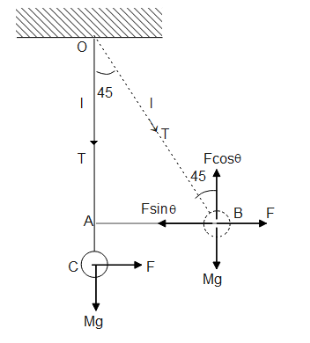
Now as we displace the mass the total work done will be equal to the change in kinetic energy.Therefore using the work-energy theorem we have
$W = \Delta K$
$\Rightarrow {W_T} + {W_{Mg}} + {W_F} = \Delta K$
Where ${W_T}$ is the work done by tension force, ${W_{Mg}}$ is work done by the weight of the mass and ${W_F}$ work done by the horizontal force applied.
Now work done by the tension force of the string will be zero as the tension of the string remains the same even after displacement. The work done by the weight of the mass will be equal to the product of the weight force and the displacement of the mass in the vertical direction. And work done by the force applied will be equal to the product of the horizontal force and horizontal displacement. Substituting the expressions for the three work done we get,
$0 + Mg \times AC + F \times AB = \Delta K$
The initial and the final velocity of the mass will be zero as it is taken from the rest position to another position at rest, therefore the change in kinetic energy of the mass will be zero.Hence,
$F = Mg\dfrac{{AC}}{{AB}}$
Now we can calculate the values of the distances using trigonometric ratios and Pythagoras theorem in the right-angle triangle formed in the figure.
$AC = OC - OA = l - l\cos 45^\circ = l(1 - \dfrac{1}{{\sqrt 2 }})$
And $AB = l\sin 45^\circ = l\dfrac{1}{{\sqrt 2 }}$
$F = Mg\left( {\dfrac{{1 - \dfrac{1}{{\sqrt 2 }}}}{{\dfrac{1}{{\sqrt 2 }}}}} \right)$
$\therefore F = Mg(\sqrt 2 - 1)$
Hence option D is the correct answer.
Note: Note that for calculating the work done by the weight of the mass, we considered the vertical displacement because the weight force of the mass is acting vertically downwards and for horizontal force, we considered the horizontal displacement.
Complete step by step answer:
We know that when two bodies are in contact with each other, some forces known as contact forces act on the bodies. If one of the bodies is a mass suspended from a spring, a force called tension acts on the string.We will draw the diagram for the given situation to get a better understanding.
Now as we displace the mass the total work done will be equal to the change in kinetic energy.Therefore using the work-energy theorem we have
$W = \Delta K$
$\Rightarrow {W_T} + {W_{Mg}} + {W_F} = \Delta K$
Where ${W_T}$ is the work done by tension force, ${W_{Mg}}$ is work done by the weight of the mass and ${W_F}$ work done by the horizontal force applied.
Now work done by the tension force of the string will be zero as the tension of the string remains the same even after displacement. The work done by the weight of the mass will be equal to the product of the weight force and the displacement of the mass in the vertical direction. And work done by the force applied will be equal to the product of the horizontal force and horizontal displacement. Substituting the expressions for the three work done we get,
$0 + Mg \times AC + F \times AB = \Delta K$
The initial and the final velocity of the mass will be zero as it is taken from the rest position to another position at rest, therefore the change in kinetic energy of the mass will be zero.Hence,
$F = Mg\dfrac{{AC}}{{AB}}$
Now we can calculate the values of the distances using trigonometric ratios and Pythagoras theorem in the right-angle triangle formed in the figure.
$AC = OC - OA = l - l\cos 45^\circ = l(1 - \dfrac{1}{{\sqrt 2 }})$
And $AB = l\sin 45^\circ = l\dfrac{1}{{\sqrt 2 }}$
$F = Mg\left( {\dfrac{{1 - \dfrac{1}{{\sqrt 2 }}}}{{\dfrac{1}{{\sqrt 2 }}}}} \right)$
$\therefore F = Mg(\sqrt 2 - 1)$
Hence option D is the correct answer.
Note: Note that for calculating the work done by the weight of the mass, we considered the vertical displacement because the weight force of the mass is acting vertically downwards and for horizontal force, we considered the horizontal displacement.
Recently Updated Pages
Master Class 11 Social Science: Engaging Questions & Answers for Success

Master Class 11 English: Engaging Questions & Answers for Success
Master Class 11 Maths: Engaging Questions & Answers for Success
Master Class 11 Chemistry: Engaging Questions & Answers for Success
Master Class 11 Biology: Engaging Questions & Answers for Success
Master Class 11 Physics: Engaging Questions & Answers for Success
Trending doubts
Differentiate between an exothermic and an endothermic class 11 chemistry CBSE
One Metric ton is equal to kg A 10000 B 1000 C 100 class 11 physics CBSE
Difference Between Prokaryotic Cells and Eukaryotic Cells
There are 720 permutations of the digits 1 2 3 4 5 class 11 maths CBSE
Draw a diagram of a plant cell and label at least eight class 11 biology CBSE
1 Quintal is equal to a 110 kg b 10 kg c 100kg d 1000 class 11 physics CBSE