




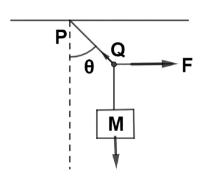
A mass $M$ is suspended by a rope from a rigid support $P$ as shown in figure. Another rope is tied at the end Q and it is pulled horizontally with a force $F$. If the rope PQ makes an angle $\theta $ with the vertical in equilibrium, then the tension in the string PQ is
A. $\dfrac{F}{{\sin \theta }}$
B. $F\sin \theta $
C. $F\cos \theta $
D. $\dfrac{F}{{\cos \theta }}$
Answer
 Verified
535.8k+ views
Hint: It is given that a mass m is suspended from a rigid support P. A force is applied towards the point Q. It is said that the system is in equilibrium and PQ makes an angle $\theta $ with vertical. We have to find the tension in the string PQ. Draw a free body diagram.
Complete step by step answer:
It is given that a mass $m$ is suspended from a rigid support P. A force is applied towards the point Q. It is said that the system is in equilibrium and PQ makes an angle $\theta $ with vertical. We have to find the tension in the string PQ.
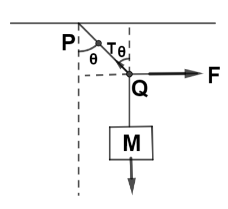
By taking the vertical component at point Q. $mg$ acts upwards at the point Q.Therefore,
$T\cos \theta = F$
$\Rightarrow T = \dfrac{F}{{\cos \theta }}$
Taking the horizontal component,
$T\sin \theta = F$
$\therefore T = \dfrac{F}{{\sin \theta }}$
Then the tension in the string PQ is $\dfrac{F}{{\sin \theta }}$.
Therefore, the correct answer is option A.
Additional information: In physics, the pulling force is generally applied by using a string, link, chain, or any similar one-dimensional continuous item, or by each end of a bar, bracket part, or comparable three-dimensional article is called tension.According to the principle of equilibrium, A body is said to be in equilibrium if the algebraic sum of all forces acting on the body is zero, and also if the algebraic sum of moments of forces about any fixed point is zero.
A body is said to be in equilibrium if there is no translation and no rotation of the body under the application of external forces. Sometimes the resultant of the force system is not equal to zero. That means the body is not in equilibrium. The force which is required to keep the body in equilibrium, is known as equilibrant.
A free-body diagram is the diagram which represents the various forces acting on the body.
Tension in a string is always along the string and away from the object . In an ideal string tension at all points of the string will be the same. In a string or in a chain tension is only extensional. In a rod, tension can be extensional or compressional. Net force acting on an ideal string(massless) is always zero.
Note: To solve this question one should know the concept of equilibrium of forces.The students should deeply understand the question and the figure carefully and implement the formulas at the correct places.
Complete step by step answer:
It is given that a mass $m$ is suspended from a rigid support P. A force is applied towards the point Q. It is said that the system is in equilibrium and PQ makes an angle $\theta $ with vertical. We have to find the tension in the string PQ.
By taking the vertical component at point Q. $mg$ acts upwards at the point Q.Therefore,
$T\cos \theta = F$
$\Rightarrow T = \dfrac{F}{{\cos \theta }}$
Taking the horizontal component,
$T\sin \theta = F$
$\therefore T = \dfrac{F}{{\sin \theta }}$
Then the tension in the string PQ is $\dfrac{F}{{\sin \theta }}$.
Therefore, the correct answer is option A.
Additional information: In physics, the pulling force is generally applied by using a string, link, chain, or any similar one-dimensional continuous item, or by each end of a bar, bracket part, or comparable three-dimensional article is called tension.According to the principle of equilibrium, A body is said to be in equilibrium if the algebraic sum of all forces acting on the body is zero, and also if the algebraic sum of moments of forces about any fixed point is zero.
A body is said to be in equilibrium if there is no translation and no rotation of the body under the application of external forces. Sometimes the resultant of the force system is not equal to zero. That means the body is not in equilibrium. The force which is required to keep the body in equilibrium, is known as equilibrant.
A free-body diagram is the diagram which represents the various forces acting on the body.
Tension in a string is always along the string and away from the object . In an ideal string tension at all points of the string will be the same. In a string or in a chain tension is only extensional. In a rod, tension can be extensional or compressional. Net force acting on an ideal string(massless) is always zero.
Note: To solve this question one should know the concept of equilibrium of forces.The students should deeply understand the question and the figure carefully and implement the formulas at the correct places.
Recently Updated Pages
Master Class 12 Economics: Engaging Questions & Answers for Success

Master Class 12 English: Engaging Questions & Answers for Success
Master Class 12 Social Science: Engaging Questions & Answers for Success
Master Class 12 Maths: Engaging Questions & Answers for Success
Master Class 12 Physics: Engaging Questions & Answers for Success
Master Class 11 Social Science: Engaging Questions & Answers for Success
Trending doubts
One Metric ton is equal to kg A 10000 B 1000 C 100 class 11 physics CBSE
Difference Between Prokaryotic Cells and Eukaryotic Cells
Two of the body parts which do not appear in MRI are class 11 biology CBSE
1 ton equals to A 100 kg B 1000 kg C 10 kg D 10000 class 11 physics CBSE
Draw a diagram of nephron and explain its structur class 11 biology CBSE
10 examples of friction in our daily life