




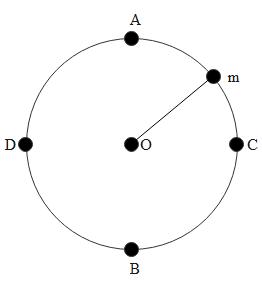
A mass is performing vertical circular motion (see figure). If the average velocity of the particle is increased, then at which point is the maximum breaking possibility of the string:
Answer
 Verified
628.5k+ views
Hint: When an object attached to a string is moving in a circular motion it can rotate due to the forces acting as centripetal (tension force for the concerning question) and centrifugal forces. The forces acting at any point in the path of the motion can be studied with the help of a free body diagram (FBD). And at a point where there is maximum tension, there will be high chances of the breakage of the string.
Complete answer:
When an object is moving in a vertical circular motion as shown in the above diagram. The FBD for each point and the equilibrium equation can be given as,
The case I: (at point A)
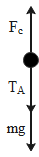
Concerning the FBD at point A at equilibrium state we can say that the centrifugal force acting on the body is equal to the tension force at A and the force mg.
Mathematically,
$\begin{align}
& {{F}_{c}}={{T}_{A}}+mg \\
& \Rightarrow {{T}_{A}}={{F}_{c}}-mg\quad ...(1) \\
\end{align}$
Case ll: (at point C and D)
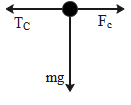
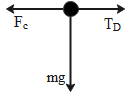
Concerning the FBD at point C and D at equilibrium state, the relation between the forces can be given as follows,
${{T}_{C}}={{T}_{D}}=T$
$T=\sqrt{{{F}_{C}}^{2}+m{{g}^{2}}}\quad ....(2)$
Case lll: (at point B)
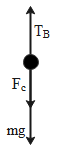
Concerning the FBD at point B at equilibrium state, we can say that the tension force acting on the body is equal to the centrifugal force at B and the force mg.
${{T}_{B}}={{F}_{c}}+mg\quad ....(3)$
Comparing the equations (1), (2), and (3) we can conclude that the tension will be maximum at point B. and when there is maximum tension there are the highest chances for the breakage of the string.
Thus the required answer to the question is point B.
Note:
Centripetal force is the force which makes the body rotate in a circular path. And from Newton’s ${{3}^{rd}}$ law of motion centrifugal force is the equal and opposing force to the body. Every object which is moving against gravity has a $mg$ force acting downward towards the ground. The downward force is the force due to the gravitational pull acting on the body.
Complete answer:
When an object is moving in a vertical circular motion as shown in the above diagram. The FBD for each point and the equilibrium equation can be given as,
The case I: (at point A)
Concerning the FBD at point A at equilibrium state we can say that the centrifugal force acting on the body is equal to the tension force at A and the force mg.
Mathematically,
$\begin{align}
& {{F}_{c}}={{T}_{A}}+mg \\
& \Rightarrow {{T}_{A}}={{F}_{c}}-mg\quad ...(1) \\
\end{align}$
Case ll: (at point C and D)
Concerning the FBD at point C and D at equilibrium state, the relation between the forces can be given as follows,
${{T}_{C}}={{T}_{D}}=T$
$T=\sqrt{{{F}_{C}}^{2}+m{{g}^{2}}}\quad ....(2)$
Case lll: (at point B)
Concerning the FBD at point B at equilibrium state, we can say that the tension force acting on the body is equal to the centrifugal force at B and the force mg.
${{T}_{B}}={{F}_{c}}+mg\quad ....(3)$
Comparing the equations (1), (2), and (3) we can conclude that the tension will be maximum at point B. and when there is maximum tension there are the highest chances for the breakage of the string.
Thus the required answer to the question is point B.
Note:
Centripetal force is the force which makes the body rotate in a circular path. And from Newton’s ${{3}^{rd}}$ law of motion centrifugal force is the equal and opposing force to the body. Every object which is moving against gravity has a $mg$ force acting downward towards the ground. The downward force is the force due to the gravitational pull acting on the body.
Recently Updated Pages
Basicity of sulphurous acid and sulphuric acid are

Master Class 11 English: Engaging Questions & Answers for Success
Master Class 11 Physics: Engaging Questions & Answers for Success
Master Class 11 Computer Science: Engaging Questions & Answers for Success
Master Class 11 Chemistry: Engaging Questions & Answers for Success
Master Class 11 Social Science: Engaging Questions & Answers for Success
Trending doubts
Difference Between Prokaryotic Cells and Eukaryotic Cells
Two of the body parts which do not appear in MRI are class 11 biology CBSE
One Metric ton is equal to kg A 10000 B 1000 C 100 class 11 physics CBSE
10 examples of friction in our daily life
Draw a diagram of nephron and explain its structur class 11 biology CBSE
What will happen if the mucus is not secreted by the class 11 biology CBSE