




A man who can swim at a velocity v relative to water wants to cross a river of width b flowing with a speed u.
This question has multiple correct options.
A. the minimum time in which he can cross the river is $\dfrac{b}{v}$
B. he can reach a point exactly opposite on the bank in time $t=\dfrac{b}{\sqrt{{{v}^{2}}-{{u}^{2}}}}$ if $v>u$
C. he cannot reach the point exactly opposite on the bank if $u>v$
D. he cannot reach the point exactly opposite on the bank if $v>u$
Answer
 Verified
612.6k+ views
Hint: We are given the relative velocity of the man with respect to the flow of water. Obtain the component of velocity of the man along the flow of water and in its perpendicular direction. Find the minimum time required using the velocity perpendicular to the flow of water.
Complete step by step solution:
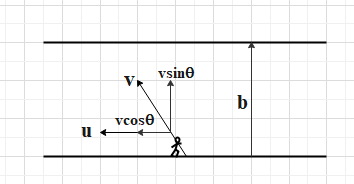
A man is swimming in a river with velocity v relative to the river. Where the water flows with a speed u.
Let, the velocity v makes an angle of $\theta $ with the velocity of the river u.
So, the component of velocity of the swimming man in the direction of flow of water will be $v\cos \theta $ and in the perpendicular direction of flow of water will be $v\sin \theta $ .
Now, to cross the river in minimum time the component of velocity $v\sin \theta $ should be maximum.
For $v\sin \theta $ to be maximum, the $\sin \theta $ should be maximum and for this $\theta =\pi /2$
At $\theta =\pi /2$, $v\sin \theta $ will be v.
The width of the river is b.
So, the minimum time taken to cross the river will be,
${{t}_{\text{min}}}=\dfrac{b}{v}$
Again, to reach a point exactly opposite on the bank, net velocity of the man will be,
$\sqrt{{{v}^{2}}-{{u}^{2}}}$ where, $v>u$
He cannot reach the exact opposite point if $u>v$
Hence, the time taken by the man to reach the point exactly opposite on the bank is,
$t=\dfrac{b}{\sqrt{{{v}^{2}}-{{u}^{2}}}}$
So, correct options are (A), (B) and (C)
Note: We can directly say that to cross the river to the point directly opposite to the bank, the velocity of swimming of the man should always be larger than the velocity of flow of water of the river. If the velocity of the flow of the river is larger than the velocity of the man, he can never reach the point directly opposite to the bank.
Complete step by step solution:
A man is swimming in a river with velocity v relative to the river. Where the water flows with a speed u.
Let, the velocity v makes an angle of $\theta $ with the velocity of the river u.
So, the component of velocity of the swimming man in the direction of flow of water will be $v\cos \theta $ and in the perpendicular direction of flow of water will be $v\sin \theta $ .
Now, to cross the river in minimum time the component of velocity $v\sin \theta $ should be maximum.
For $v\sin \theta $ to be maximum, the $\sin \theta $ should be maximum and for this $\theta =\pi /2$
At $\theta =\pi /2$, $v\sin \theta $ will be v.
The width of the river is b.
So, the minimum time taken to cross the river will be,
${{t}_{\text{min}}}=\dfrac{b}{v}$
Again, to reach a point exactly opposite on the bank, net velocity of the man will be,
$\sqrt{{{v}^{2}}-{{u}^{2}}}$ where, $v>u$
He cannot reach the exact opposite point if $u>v$
Hence, the time taken by the man to reach the point exactly opposite on the bank is,
$t=\dfrac{b}{\sqrt{{{v}^{2}}-{{u}^{2}}}}$
So, correct options are (A), (B) and (C)
Note: We can directly say that to cross the river to the point directly opposite to the bank, the velocity of swimming of the man should always be larger than the velocity of flow of water of the river. If the velocity of the flow of the river is larger than the velocity of the man, he can never reach the point directly opposite to the bank.
Recently Updated Pages
Master Class 11 Social Science: Engaging Questions & Answers for Success

Master Class 11 Physics: Engaging Questions & Answers for Success
Master Class 11 Maths: Engaging Questions & Answers for Success
Master Class 11 Economics: Engaging Questions & Answers for Success
Master Class 11 Computer Science: Engaging Questions & Answers for Success
Master Class 11 Chemistry: Engaging Questions & Answers for Success
Trending doubts
There are 720 permutations of the digits 1 2 3 4 5 class 11 maths CBSE
1 Quintal is equal to a 110 kg b 10 kg c 100kg d 1000 class 11 physics CBSE
Which among the following are examples of coming together class 11 social science CBSE
Discuss the various forms of bacteria class 11 biology CBSE
What organs are located on the left side of your body class 11 biology CBSE
Draw a labelled diagram showing structure of LS of class 11 biology CBSE