




A man walks in a horizontal circle round the foot of a pole which is inclined to the vertical. The foot of the pole is at the center of the circle. The greatest and least angles which the pole subtends at his eye are ${\text{ta}}{{\text{n}}^{ - 1}}\left( {\dfrac{9}{5}} \right)$and ${\text{ta}}{{\text{n}}^{ - 1}}\left( {\dfrac{6}{5}} \right)$respectively and when he is midway between the corresponding positions, the angle is$\theta $. If the man’s height is neglected, find the length of the pole.
Answer
 Verified
661.2k+ views
Hint: From the question we need to find the length of the pole, where ${\text{ta}}{{\text{n}}^{ - 1}}\left( {\dfrac{9}{5}} \right)$and ${\text{ta}}{{\text{n}}^{ - 1}}\left( {\dfrac{6}{5}} \right)$are the greatest and least angles. We can calculate the tangent angle formula that is, if a is angle tan a $ = \dfrac{{{\text{opposite side value}}}}{{{\text{adjacent side value}}}}$. Using this formula assuming angles alpha and beta, we can find the length of the pole.
Complete step-by-step answer:
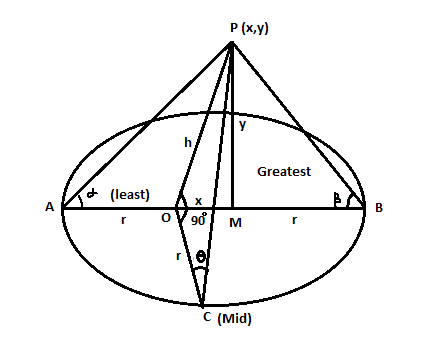
From the diagram, we can see that the man walks in a horizontal circle round the foot of a pole which is inclined to the vertical.
Let angle at A be $\alpha $ and angle at B be $\beta $
OA=OB=OC=r the radius of the horizontal circle where C is a point mid-way between the points A and B. OP is a pole which is inclined to the vertical. It will subtend least angle say $\angle $at A and greatest angle b at B.
From P draw a perpendicular PM to AB and let PM=y and OM=x
From the given,${\text{tan}}\alpha = \dfrac{{{\text{opposite side value}}}}{{{\text{adjacent side value}}}}$
${\text{tan}}\alpha $$ = \dfrac{{\text{y}}}{{{\text{x + r}}}} = \dfrac{6}{5}$
$ \Rightarrow 5{\text{y = 6}}\left( {{\text{x + r}}} \right)$
$ \Rightarrow 5{\text{y = 6x + 6r}}$
$ \Rightarrow 5{\text{y - 6x = 6r}}$
And, ${\text{tan}}\beta = \dfrac{{\text{y}}}{{{\text{r - x}}}} = \dfrac{9}{5}$
$ \Rightarrow 5{\text{y = 9}}\left( {{\text{r - x}}} \right)$
$ \Rightarrow 5{\text{y = 9r - 9x}}$
$ \Rightarrow 5{\text{y + 9x = 9r}}$
Therefore, Solving$5{\text{y - 6x = 6r and 5y + 9x = 9r}}$
\[\begin{gathered}
\Rightarrow 5{\text{y + 9x = 9r}} \\
{\text{ - }}\left( {5{\text{y - 6x = 6r}}} \right) \\
\end{gathered} \]
\[\begin{gathered}
\Rightarrow 5{\text{y + 9x = 9r}} \\
{\text{ - 5y + 6x = - 6r}} \\
\end{gathered} \]
\[ \Rightarrow 15{\text{x = 3r}}\]
\[ \Rightarrow {\text{x = }}\dfrac{3}{{15}}{\text{r}}\]
$\therefore {\text{x = }}\dfrac{{\text{r}}}{5}$
Substitute x value in one of the equation that is,
$ \Rightarrow 5{\text{y - 6x = 6r}} \Rightarrow 5{\text{y - 6}}\left( {\dfrac{{\text{r}}}{5}} \right){\text{ = 6r}}$
$ \Rightarrow 5{\text{y - }}\dfrac{{6{\text{r}}}}{5}{\text{ = 6r}}$
$ \Rightarrow \dfrac{{25{\text{y - }}6{\text{r}}}}{5}{\text{ = 6r}}$
$ \Rightarrow 25{\text{y - }}6{\text{r = 30r}}$
$ \Rightarrow 25{\text{y = 30r + 6r}}$
$ \Rightarrow 25{\text{y = 36r}}$
$ \Rightarrow {\text{y = }}\dfrac{{36}}{{25}}r$
$\therefore {\text{x = }}\dfrac{{\text{r}}}{5}{\text{ and y = }}\dfrac{{36}}{{25}}r$
Also as given angle subtended at C is $\theta $
$\therefore {\text{tan}}\theta = \dfrac{{\text{h}}}{{\text{r}}} = \dfrac{{\sqrt {{{\text{x}}^2} + {{\text{y}}^2}} }}{{\text{r}}}$
Where, based on Pythagoras theorem
$ \Rightarrow {{\text{h}}^2}{\text{ = }}{{\text{x}}^2} + {{\text{y}}^2}$
${\text{h = }}\sqrt {{{\text{x}}^2} + {{\text{y}}^2}} $
$ \Rightarrow \dfrac{{\sqrt {{{\left( {\dfrac{1}{5}{\text{r}}} \right)}^2} + {{\left( {\dfrac{{36}}{25}{\text{r}}} \right)}^2}} }}{{\text{r}}}$
$ \Rightarrow \dfrac{{\sqrt {{{\left( {\dfrac{{\text{r}}}{5}} \right)}^2} + {{\left( {\dfrac{{36}}{25}{\text{r}}} \right)}^2}} }}{{\text{r}}}$
Taking $\dfrac{{{{\text{r}}^2}}}{{{5^2}}}$from the root of the equation as it is common divisor to take it out from the equation.
$ \Rightarrow \dfrac{{\dfrac{{\text{r}}}{5}\sqrt {1 + {{\left( {\dfrac{{36}}{5}} \right)}^2}} }}{{\text{r}}}$
$ \Rightarrow \dfrac{{\dfrac{{\text{r}}}{5}\sqrt {1 + \left( {\dfrac{{1296}}{{25}}} \right)} }}{{\text{r}}}$
$ \Rightarrow \dfrac{{{\text{r}}\sqrt {\dfrac{{25 + 1296}}{{25}}} }}{{{\text{5r}}}}$
$ \Rightarrow \dfrac{{\sqrt {\dfrac{{1321}}{{25}}} }}{{\text{5}}}$
$ \Rightarrow \dfrac{{\sqrt {\dfrac{{1321}}{{25}}} }}{{\text{5}}}$
$\therefore {\text{h = }}\dfrac{1}{{25}}\sqrt {1321} $
Therefore, the length of the pole, if the man’s height is neglected =$\dfrac{1}{{25}}\sqrt {1321} $
Note: We can use sine and cosine trigonometric formulae to find the length of the pole. In this solution it was clearly given the tangent so we have taken the tangent angles and compared it against the values given. The Pythagoras theorem will be applicable only if it is a right angled triangle.
Complete step-by-step answer:
From the diagram, we can see that the man walks in a horizontal circle round the foot of a pole which is inclined to the vertical.
Let angle at A be $\alpha $ and angle at B be $\beta $
OA=OB=OC=r the radius of the horizontal circle where C is a point mid-way between the points A and B. OP is a pole which is inclined to the vertical. It will subtend least angle say $\angle $at A and greatest angle b at B.
From P draw a perpendicular PM to AB and let PM=y and OM=x
From the given,${\text{tan}}\alpha = \dfrac{{{\text{opposite side value}}}}{{{\text{adjacent side value}}}}$
${\text{tan}}\alpha $$ = \dfrac{{\text{y}}}{{{\text{x + r}}}} = \dfrac{6}{5}$
$ \Rightarrow 5{\text{y = 6}}\left( {{\text{x + r}}} \right)$
$ \Rightarrow 5{\text{y = 6x + 6r}}$
$ \Rightarrow 5{\text{y - 6x = 6r}}$
And, ${\text{tan}}\beta = \dfrac{{\text{y}}}{{{\text{r - x}}}} = \dfrac{9}{5}$
$ \Rightarrow 5{\text{y = 9}}\left( {{\text{r - x}}} \right)$
$ \Rightarrow 5{\text{y = 9r - 9x}}$
$ \Rightarrow 5{\text{y + 9x = 9r}}$
Therefore, Solving$5{\text{y - 6x = 6r and 5y + 9x = 9r}}$
\[\begin{gathered}
\Rightarrow 5{\text{y + 9x = 9r}} \\
{\text{ - }}\left( {5{\text{y - 6x = 6r}}} \right) \\
\end{gathered} \]
\[\begin{gathered}
\Rightarrow 5{\text{y + 9x = 9r}} \\
{\text{ - 5y + 6x = - 6r}} \\
\end{gathered} \]
\[ \Rightarrow 15{\text{x = 3r}}\]
\[ \Rightarrow {\text{x = }}\dfrac{3}{{15}}{\text{r}}\]
$\therefore {\text{x = }}\dfrac{{\text{r}}}{5}$
Substitute x value in one of the equation that is,
$ \Rightarrow 5{\text{y - 6x = 6r}} \Rightarrow 5{\text{y - 6}}\left( {\dfrac{{\text{r}}}{5}} \right){\text{ = 6r}}$
$ \Rightarrow 5{\text{y - }}\dfrac{{6{\text{r}}}}{5}{\text{ = 6r}}$
$ \Rightarrow \dfrac{{25{\text{y - }}6{\text{r}}}}{5}{\text{ = 6r}}$
$ \Rightarrow 25{\text{y - }}6{\text{r = 30r}}$
$ \Rightarrow 25{\text{y = 30r + 6r}}$
$ \Rightarrow 25{\text{y = 36r}}$
$ \Rightarrow {\text{y = }}\dfrac{{36}}{{25}}r$
$\therefore {\text{x = }}\dfrac{{\text{r}}}{5}{\text{ and y = }}\dfrac{{36}}{{25}}r$
Also as given angle subtended at C is $\theta $
$\therefore {\text{tan}}\theta = \dfrac{{\text{h}}}{{\text{r}}} = \dfrac{{\sqrt {{{\text{x}}^2} + {{\text{y}}^2}} }}{{\text{r}}}$
Where, based on Pythagoras theorem
$ \Rightarrow {{\text{h}}^2}{\text{ = }}{{\text{x}}^2} + {{\text{y}}^2}$
${\text{h = }}\sqrt {{{\text{x}}^2} + {{\text{y}}^2}} $
$ \Rightarrow \dfrac{{\sqrt {{{\left( {\dfrac{1}{5}{\text{r}}} \right)}^2} + {{\left( {\dfrac{{36}}{25}{\text{r}}} \right)}^2}} }}{{\text{r}}}$
$ \Rightarrow \dfrac{{\sqrt {{{\left( {\dfrac{{\text{r}}}{5}} \right)}^2} + {{\left( {\dfrac{{36}}{25}{\text{r}}} \right)}^2}} }}{{\text{r}}}$
Taking $\dfrac{{{{\text{r}}^2}}}{{{5^2}}}$from the root of the equation as it is common divisor to take it out from the equation.
$ \Rightarrow \dfrac{{\dfrac{{\text{r}}}{5}\sqrt {1 + {{\left( {\dfrac{{36}}{5}} \right)}^2}} }}{{\text{r}}}$
$ \Rightarrow \dfrac{{\dfrac{{\text{r}}}{5}\sqrt {1 + \left( {\dfrac{{1296}}{{25}}} \right)} }}{{\text{r}}}$
$ \Rightarrow \dfrac{{{\text{r}}\sqrt {\dfrac{{25 + 1296}}{{25}}} }}{{{\text{5r}}}}$
$ \Rightarrow \dfrac{{\sqrt {\dfrac{{1321}}{{25}}} }}{{\text{5}}}$
$ \Rightarrow \dfrac{{\sqrt {\dfrac{{1321}}{{25}}} }}{{\text{5}}}$
$\therefore {\text{h = }}\dfrac{1}{{25}}\sqrt {1321} $
Therefore, the length of the pole, if the man’s height is neglected =$\dfrac{1}{{25}}\sqrt {1321} $
Note: We can use sine and cosine trigonometric formulae to find the length of the pole. In this solution it was clearly given the tangent so we have taken the tangent angles and compared it against the values given. The Pythagoras theorem will be applicable only if it is a right angled triangle.
Recently Updated Pages
Which will be the least stable resonating structure class 11 chemistry CBSE

How many 5 digit telephone numbers can be construc-class-11-maths-CBSE
How do you find the angle of the resultant vector class 11 physics CBSE
Draw labelled diagram of the following i Gram seed class 11 biology CBSE
What is the need and importance of classification class 11 biology CBSE
The way in which the sparrows expressed their sorrow class 11 english CBSE
Trending doubts
One Metric ton is equal to kg A 10000 B 1000 C 100 class 11 physics CBSE
Find the value of the expression given below sin 30circ class 11 maths CBSE
1 Quintal is equal to a 110 kg b 10 kg c 100kg d 1000 class 11 physics CBSE
Draw a diagram of nephron and explain its structur class 11 biology CBSE
10 examples of friction in our daily life
Proton was discovered by A Thomson B Rutherford C Chadwick class 11 chemistry CBSE