




A man walks 4 km due north in one hour and 3 km in the next hour. What is his average velocity?
A. $2.5km/h,{37^ \circ }EofN$
B. $3.5km/h,{37^ \circ }EofS$
C. $5km/h,{37^ \circ }EofN$
D. $2.5km/h,{37^ \circ }EofE$
Answer
 Verified
578.1k+ views
Hint: average velocity is the ratio of displacement i.e., shortest distance and time taken by the man. Displacement is obtained from the Pythagoras theorem as it forms a right angle triangle.
Complete step by step answer:A man walks 4 km in the direction of the north in one hour and now he walks 3 km in the north direction (this direction is taken from where he is standing) in another one hour.
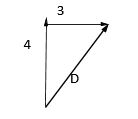
The displacement D is the shortest route between the initial and final position of the man. The above triangle forms a right angle triangle. Hence, it will obey the Pythagoras theorem which states that
${\left( {{\text{Hypotenuse}}} \right)^2} = {\left( {base} \right)^2} + {\left( {height} \right)^2}$
$\Rightarrow {D^2} = {4^2} + {3^2}$
$\Rightarrow {D^2} = 16 + 9$
$\Rightarrow D = \sqrt {25} $
$\Rightarrow D = 5km$
The average velocity of the man is defined as the total displacement divided by the total time taken by him.
Total time taken =$1 + 1 = 2hours$
Average velocity = $\dfrac{{total{\text{ }}displacement}}{{total{\text{ }}time{\text{ }}taken}}$
$\Rightarrow $Average velocity = $\dfrac{5}{2} = 2.5km/h$
The angle $Ɵ$ is given by tangent of the angle between displacement and initial position
$\tan \theta = \dfrac{{height}}{{base}}$
$\Rightarrow \tan \theta = \dfrac{3}{4}$
$\Rightarrow \theta = \arctan \left( {\dfrac{3}{4}} \right)$
$\Rightarrow \theta = {36.86^ \circ } = {37^ \circ }\left( {approx.value} \right)$
The final position is ${37^ \circ }$ east of north as compared to the initial position.
Therefore, option A is correct.
Note:In the given figure, upward direction represents north side, downward I.e., bottom of north represents south, left side represents west and right side is east.
Complete step by step answer:A man walks 4 km in the direction of the north in one hour and now he walks 3 km in the north direction (this direction is taken from where he is standing) in another one hour.
The displacement D is the shortest route between the initial and final position of the man. The above triangle forms a right angle triangle. Hence, it will obey the Pythagoras theorem which states that
${\left( {{\text{Hypotenuse}}} \right)^2} = {\left( {base} \right)^2} + {\left( {height} \right)^2}$
$\Rightarrow {D^2} = {4^2} + {3^2}$
$\Rightarrow {D^2} = 16 + 9$
$\Rightarrow D = \sqrt {25} $
$\Rightarrow D = 5km$
The average velocity of the man is defined as the total displacement divided by the total time taken by him.
Total time taken =$1 + 1 = 2hours$
Average velocity = $\dfrac{{total{\text{ }}displacement}}{{total{\text{ }}time{\text{ }}taken}}$
$\Rightarrow $Average velocity = $\dfrac{5}{2} = 2.5km/h$
The angle $Ɵ$ is given by tangent of the angle between displacement and initial position
$\tan \theta = \dfrac{{height}}{{base}}$
$\Rightarrow \tan \theta = \dfrac{3}{4}$
$\Rightarrow \theta = \arctan \left( {\dfrac{3}{4}} \right)$
$\Rightarrow \theta = {36.86^ \circ } = {37^ \circ }\left( {approx.value} \right)$
The final position is ${37^ \circ }$ east of north as compared to the initial position.
Therefore, option A is correct.
Note:In the given figure, upward direction represents north side, downward I.e., bottom of north represents south, left side represents west and right side is east.
Recently Updated Pages
Master Class 11 Computer Science: Engaging Questions & Answers for Success

Master Class 11 Business Studies: Engaging Questions & Answers for Success
Master Class 11 Economics: Engaging Questions & Answers for Success
Master Class 11 English: Engaging Questions & Answers for Success
Master Class 11 Maths: Engaging Questions & Answers for Success
Master Class 11 Biology: Engaging Questions & Answers for Success
Trending doubts
One Metric ton is equal to kg A 10000 B 1000 C 100 class 11 physics CBSE
There are 720 permutations of the digits 1 2 3 4 5 class 11 maths CBSE
Discuss the various forms of bacteria class 11 biology CBSE
Draw a diagram of a plant cell and label at least eight class 11 biology CBSE
State the laws of reflection of light
10 examples of friction in our daily life